Search This Blog

Monday, September 7, 2020

Probe That Will Survive A Trip To The Sun

Building A Probe
That Will Survive 
Tumblr: Image
A Trip To The Sun


The Parker Solar Probe is going to go closer to the sun than any spacecraft has come before. It will take seven years to fly 93 million miles to reach the sun’s corona, its outermost atmosphere. The probe will withstand temperatures up to 2,500º F as it gathers data about how energy and heat travel through the corona and what’s up with solar wind. We meet the engineer whose work on the heat shield will protect the probe from being burnt to a crisp as it makes history.

How Three New Tools Will Revolutionize Our Understanding of the Sun

Two spacecrafts and a telescope are set to jumpstart a new age of solar astronomy

The sun may be our closest star but it has managed to keep a few big secrets hidden. Now a trio of solar telescopes are kicking off a new era of solar astronomy that has scientists excited about major potential discoveries. NASA's Parker Solar Probe is currently on its way to “touch” the sun—the spacecraft will make the closest orbit around Earth's nearest star, flying through the sun’s atmosphere, in 2025. The Solar Orbiter, a spacecraft launched as part of a joint mission between the European Space Agency (ESA) and NASA, will become the first mission to study the solar poles. Back on Earth, the National Science Foundation (NSF's) Daniel K. Inouye telescope will make the most detailed ground-based observations of the sun, providing broader context for the pair of satellites.

[These missions] will revolutionize solar physics during this decade," Yannis Zouganelis, deputy project scientist for the Solar Orbiter mission, writes in an email.


https://www.smithsonianmag.com/science-nature/how-three-new-tools-will-revolutionize-our-understanding-sun-180975650


Saturday, September 5, 2020

Friday, September 4, 2020

Times Scientists 🤔Fact-Checked 📖the Bible

7 Times Scientists
Fact-Checked the Bible
Eleanor Cummins


Despite the Bible being a religious text, scientists have occasionally turned their microscopes and measuring sticks on its contents — with some surprising results.

7. Blood Red Nile
Tumblr: Image
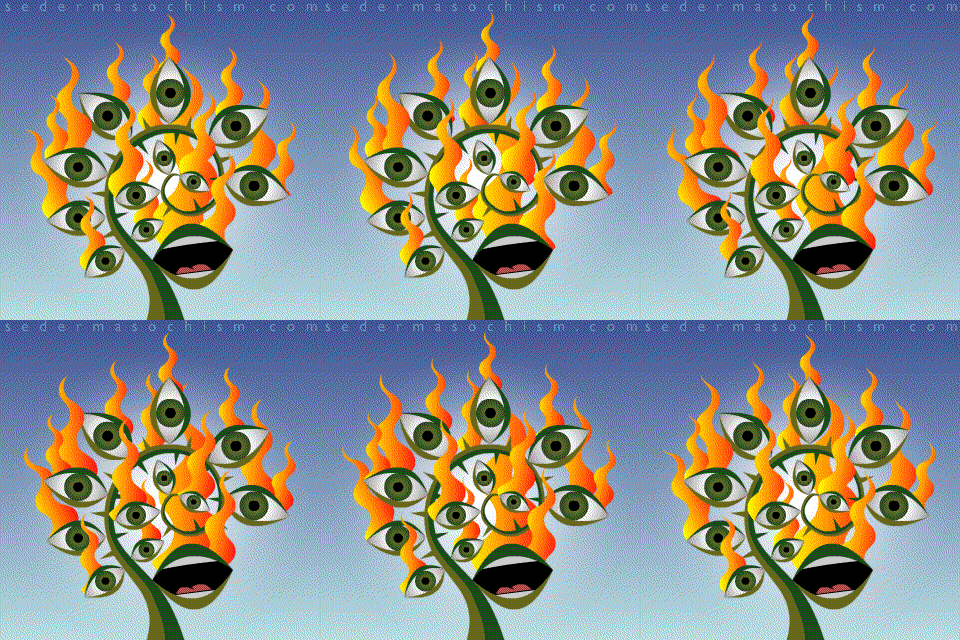
In the Book of Exodus, the Egyptian empire is beset by the plague — 10 plagues, to be exact. Animals behave oddly, and the sky turns black. Even more alarming, the river fills with blood. Everything in that bloody river dies.
Clearly, it’s not possible for a river to start bleeding, but scientists believe the plague in question may have been a red algae bloom. A very real phenomenon, “red tides” are a collection of algae packed so densely the plants discolor water. The blooms are caused by a variety of environmental factors, including warming water and excess nutrients like fertilizer. What’s more, red tides kill — just like the Book of Exodus says the bloody Nile did — with their natural toxins and oxygen-depleting decomposition.

6. A Plague of Locusts
Tumblr: Image
Another nasty aspect of the Exodus were the locusts.
See, short-horned grasshoppers are typically innocuous little things, hopping around, bothering no one. But in times of severe drought, they can undergo a horrible metamorphosis. Triggered by serotonin in their brains, grasshoppers can become locusts — the Jekyll to the grasshopper’s Dr. Hyde. In this new state, locusts breed like crazy, sprout strong wings that can power them for miles, and start to swarm. In groups, they can block out the sun.
Though we haven’t seen too many plagues in recent years, swarms of locusts have been common throughout history. It’s safe to say these tiny terrors definitely messed with ancient Egyptians. 

 Tumblr: Image
5. Parting the Red Sea
Tumblr: Image
As the plagues are raining down, the Israelites decide to flee from the Egyptians and, let’s be real, it wasn’t going well.
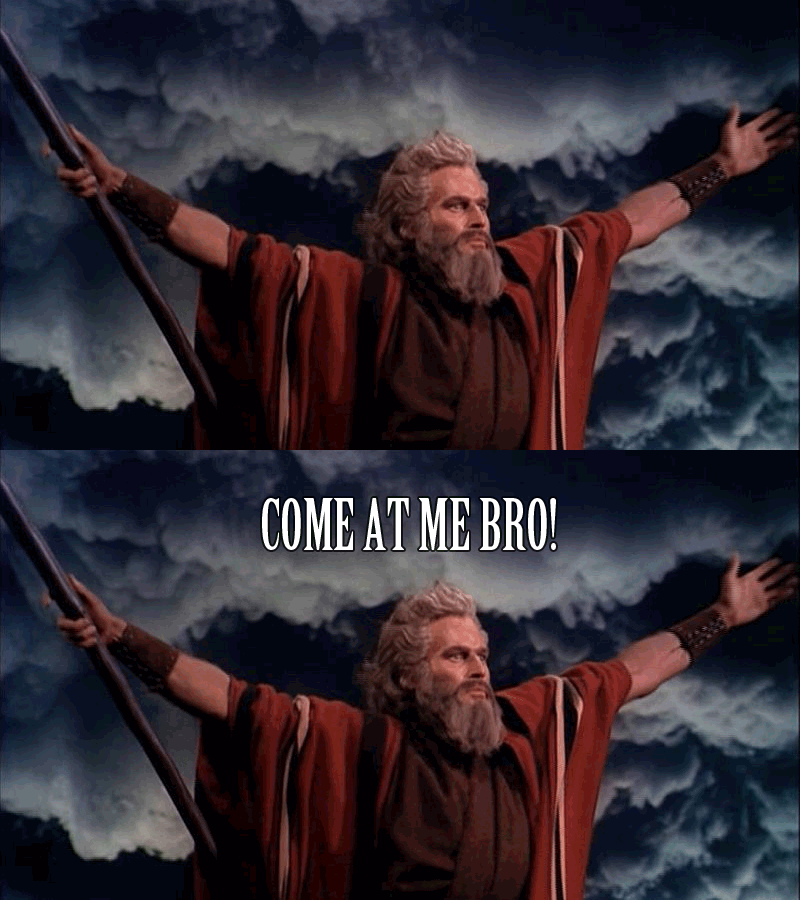
That is, until Moses, the original Prince of Egypt himself, split the Red Sea in half, allowing the Israelites to run across to safety before the water rebounded, crashing over the Egyptians and stopping them in their tracks.
Computer simulations suggest this was actually possible. In 2010, an article published in the journal PLOS ONE suggested that a natural phenomenon could have parted the Red Sea. If wind blows hard enough, water can recede from its usual shoreline, exposing land that’s typically awash. Using a computer modeling tool, the researchers were able to show that at one site in the Nile, the right blustery wind could have created a land bridge 2.5 miles long and 3 miles wide, sustaining it for four hours. 

4. The Canaanites Are All Right
Tumblr: Image
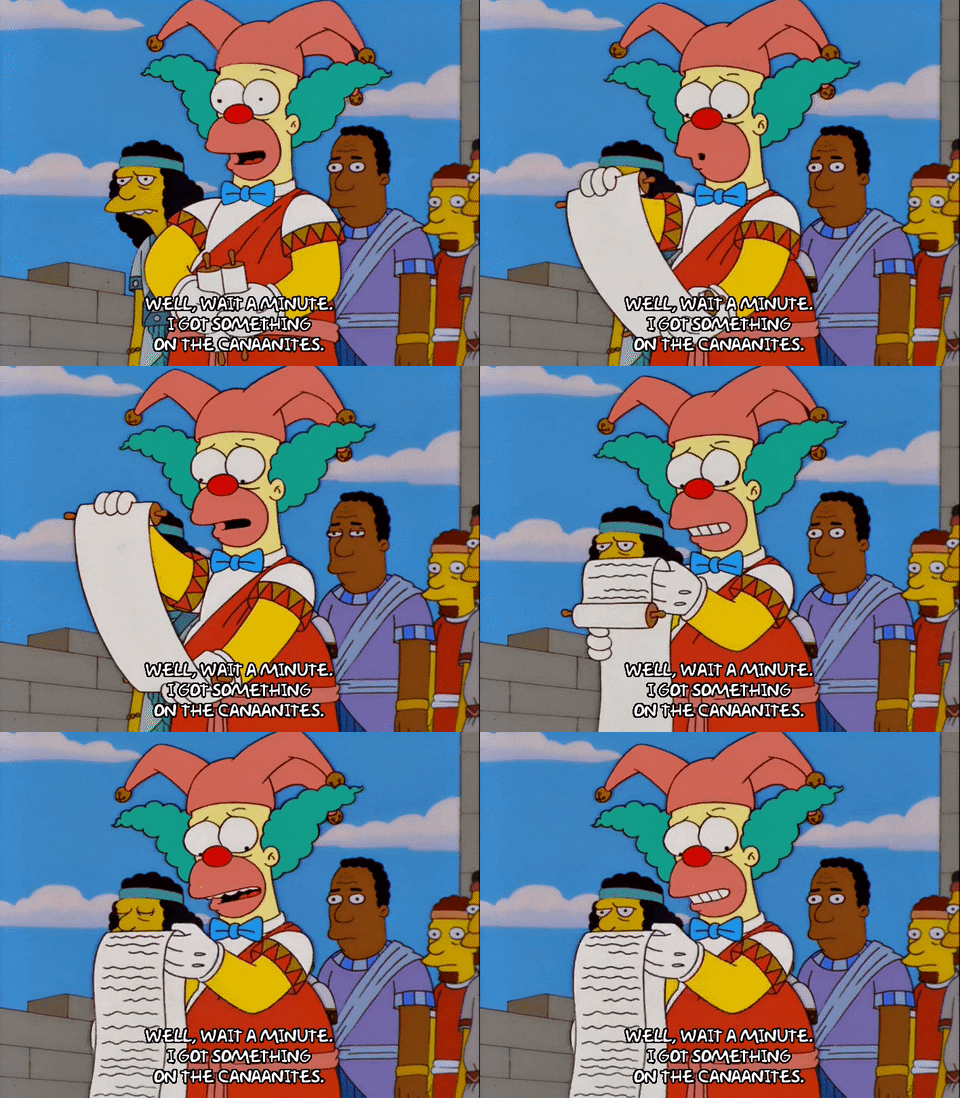
Deuteronomy 20:17 instructed the Israelites to “completely destroy them — the Hittites, Amorites, Canaanites, Perizzites, Hivites and Jebusites — as the LORD your God has commanded you.” And the Israelites listened, destroying their enemies.
Or so the Bible said.
But a July 2017 paper published in the American Journal of Human Genetics presents compelling evidence that the Canaanites survived, and that their descendants are thriving in modern Lebanon, according to a historical genome constructed from Canaanite corpses, which were compared to the DNA of 99 modern Lebanese people. According to the study, the vast majority of the DNA tested in the modern Lebanese individuals came from the Canaanites, suggesting someone didn’t follow through with God’s commands. 

3. Gigantism
Tumblr: Image
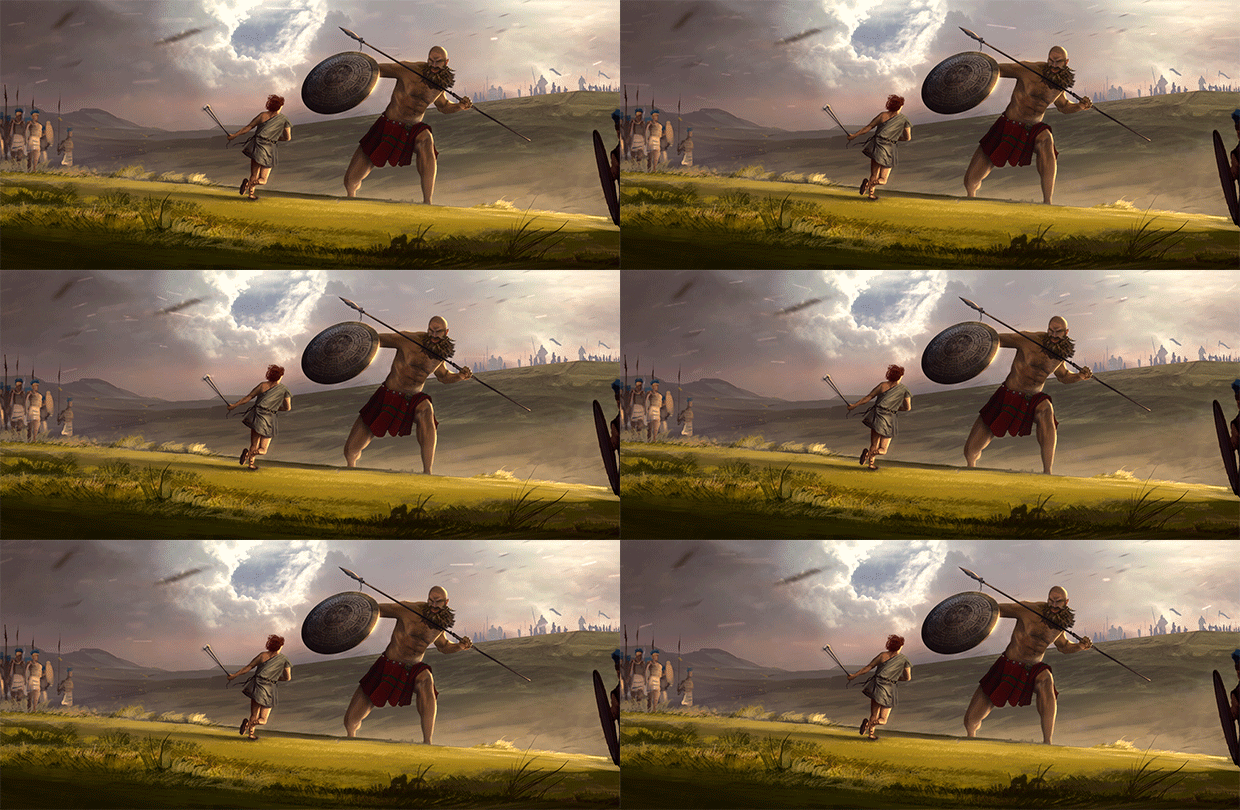
It’s been immortalized in art for millennia, but what does science have to say about Goliath and his puny, but triumphant, friend David?
Well, for much of human history, people were pretty short. While the average American man today is pushing 5 feet 10 inches, for much of human history the average dude hovered around 5 feet 5 inches. So it’s no wonder that Goliath, reportedly 6 feet 9 inches tall and thirsty for blood, scared the crap out of everyone.
Though he’s since become a relic of history — a parable about overestimating the strong and undervaluing the weak — he definitely could have existed. Some have ventured to guess he was just a guy with gigantism, a disorder typically caused by overproduction of human growth hormones that causes people to grow to an uncommon size. In contrast to some plagued by this disorder, like Robert Pershing Wadlow, who was 8 feet 11 inches when he died, Goliath is downright puny.

2. The Voice of God
Tumblr: Image
God talks a lot in the Bible, which, fair, since it’s his book. But how could anyone — scribes or prophets — hear the big man upstairs? Well, they probably couldn’t. But that doesn’t mean they weren’t hearing something.
Auditory hallucinations, where people hear sounds that aren’t actually there, are actually fairly common in the general population. One study of more than 13,000 participants in Europe indicated that almost 40 percent of people have had an auditory hallucination in their life. Another study, published in the Scandinavian Journal of Psychology in 2015, suggests seven percent of people have experienced auditory voice hallucinations, or hearing voices that aren’t there. 
https://64.media.tumblr.com/be01b84afaf64dccded978086f3a2115/61b329c5d5ee012d-95/s1280x1920/b497f333f050375c41cb861a55f80c1756cd61d3.jpg
Some of the people in either study may have had mental health issues or been influenced by past drug use, of course, but it was by no means all of them. And while those sounds and voices take many different forms, it’s possible some people interpret the stimuli as the voice of God. 

1. Sometimes the Dead Aren’t Actually Dead
Tumblr: Image
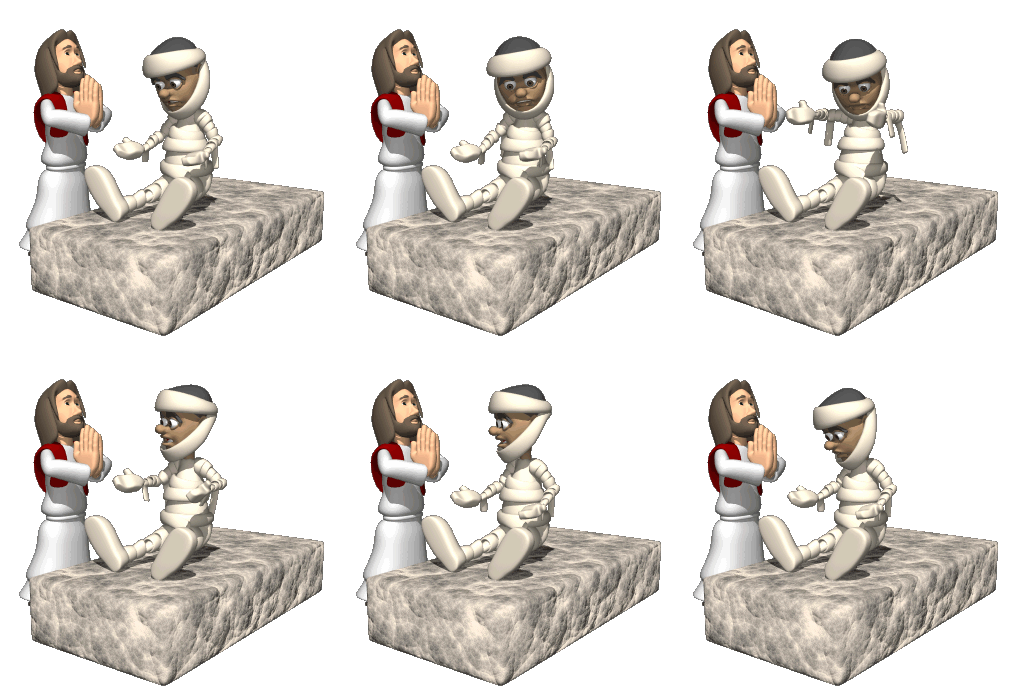
Coming back to life is prime content for the Bible — it happened at least twice in the New Testament alone. One of the lucky resurrected was Lazarus.
In the Gospel of John, Jesus gets word that his friend Lazarus of Bethany is dying. But he doesn’t rush to his side. By the time Jesus finally shows up, Lazarus has been dead for four days and is already buried. Nobody wants to dig Lazarus up — the truly dead reek — but Jesus insists. “Lazarus, come out!” he yells and, what do you know, the formerly dead dude pops back to life, good as new.
While this might seem like one of the more outlandish biblical stories to you, a scientifically-minded skeptic, the medical marvel aptly named the Lazarus Phenomenon is actually real. 

In 2007, an article published in the Journal of the Royal Society of Medicine compiled 38 documented cases of “delayed return of spontaneous circulation”. In other words, 38 cases in which people’s hearts appeared to stop, before, uh, un-stopping. Granted, most of these people returned to life in 10 minutes (not four days), and the majority did eventually die from stopping their hearts, but maybe it’s worth a holler of “come out!” before the burial — or at least politely bury your loved ones in a “safety coffin” equipped with a bell should they prove to be, you know, alive. 


Eleanor Cummins is a science journalist focusing on all things urban, especially climate change resilience and transportation. 
Her work can also be found in Slate, Popular Science, Atlas Obscura and the podcast miniseries Tie My Tubes.

Violin Facts 🎻Will Surprise You

25+ Fascinating Violin Facts
That Will Surprise You
May 25, 2018 
Music  🎻  Violin

🎼
Looking for fun violin facts? Here, you’ll find the 25 most interesting facts about the violin we could round up!
People have spent their entire lives studying the possible benefits of playing the violin, its history, and how it functions. Enjoy exploring some of their findings in this short list of violin facts. 
Interesting Facts About the Violin
In Detail
  1. Most people consider playing the violin an intellectual pursuit. However, a violinist can burn around 170 calories per hour. That’s equivalent to about one soft drink!
  2. Based on research measuring the different levels of cognitive processing, violinists have shown to develop faster processing speeds compared to the average person who does not play an instrument.
  3. Even though the exact year the violin was officially created is a mystery, we do know that the design of the modern violin is over 500 years old. While the violin hasn’t changed much over that time, the bow and other accessories have gone through many changes.
  4. Italy is primarily attributed with the creation of the modern violin. A lot of Italian makers, such as Stradivari, lived and worked in the small town of Cremona, creating some of the world’s oldest and most valuable violins.
  5. The word “violin” comes from the medieval Latin word vitula. What makes this one of the funniest violin facts is that oddly enough, the modern Latin translation of vitula also means “female cow.”
  6. String players, like violinists, tend to have larger brains. This is due in part to the complex motor skills and reasoning required to play the instrument.
  7. The main body of the modern violin contains 70 different parts. In high quality instruments, these parts are all made from a variety of woods.
  8. Famous violinist Fritz Kreisler served in WWI as a captain. His aural sensitivity, developed by playing the violin, allowed him to determine the location of large artillery by listening to the changing pitch of incoming shells across the battlefield.
  9. The violin was the leader of the orchestra before conductors became a main fixture. Prominent composers would often conduct their orchestral arrangements from the first violin chair or the concertmaster position.
  10. Even though Mozart was a prominent pianist and composer, he also played the violin. In fact, Mozart’s father began his son’s musical training on the violin.
  11. The modern violin was developed largely by Gasparo da Salò, Andrea Amati, and Antonio Stradivari, all of which lived in Italy during the 17th century.
  12. The violin has ancestral ties to the Byzantine empire through its distant cousin, the lyra. This archaic instrument evolved into the “rebec” and then the medieval fiddle, before finally transforming into the modern violin.
  13. The violin has become an essential instrument in cultures all over the world, from Ireland to India. Some of these cultures have developed different ways of playing the instrument. One of the most interesting violin facts is that some Indian players sit cross-legged while playing, and rest the scroll on their feet with the bottom of the violin under their chin!
  14. The parts of the brain that are responsible for the left and right hand are more sensitive in violinists. This means that violinists have greater conscious control over more areas of their hands.
  15. Some of the most popular careers for violinists include teaching, and performing in orchestras or other small groups. Highly sought after orchestral positions are extremely difficult to obtain.
  16. In 1626, King Louis XIII of France created an orchestra, Les 24 Violons du Roi. This helped launch the violin into prominence for the first time in history.
  17. Violinist Niccolò Paganini was one of the first musicians to pioneer the “rock star” image. His revolutionary compositional style and playing inspired many other performers and composers such as Liszt, Schumann, Brahms, and Rachmaninoff.
  18. Many violin facts show that playing the instrument has a significant impact on the mind. A study from Harvard University found that early training in the violin improves a myriad of cognitive skills including memory, nonverbal reasoning, and attention.
  19. The rich sound of the violin partially comes from a small dowel inside the instrument beneath the bridge, called the “sound post.” It does this by receiving the vibrations, created by the strings, from the bridge and transmitting them to the back of the violin.
  20. The most expensive violin ever purchased by a private investor was acquired for $16 million dollars. However, The Ashmolean Museum currently owns an estimated $20 million violin.
  21. Despite contracting polio as child, famous violinist Itzhak Perlman rose to prominence and is now one of the best violinists in the world. In fact, Perlman was honored in 2016 when he was asked to perform at President Obama’s inauguration.
  22. The violin and fiddle are the same instrument. Even though the term “violin” is more often used in connection with classical music, and the “fiddle” with Irish or folk music, they are in fact the same.
  23. Researchers studying the brain’s plasticity often use violinists to examine how much the brain can adapt.
  24. YouTube sensation and violinist Lindsey Stirling has over 10.5 million subscribers. Her most watched video, “Crystallize,” has over 194 million views.
  25. Want even more shocking violin facts? Violin strings were originally made from the dried intestines of cats and other animals! Nowadays the strings are made from a combination of synthetic materials and a variety of metals.
  26. The violin bow was originally shaped like a hunting bow. This changed in the 19th century when François Tourte perfected the modern bow by creating a concave curve.
These are just a few of the most interesting facts about the violin, but there are so many other wonderful things to learn. If any of these violin facts sparked your interest, or if you’ve always wanted to play the violin, check out the spectacular teachers at TakeLessons.
The violin is one of the most challenging and rewarding instruments you can learn. It is also one of the few instruments capable of matching the diversity and complexity of the human voice. 
Know any more interesting facts about the violin? 

👇🎼📺  Music🎻Violin Click  Below  to   Choose   a Video  👇  

https://64.media.tumblr.com/37eb94ac8c4b57c441f9b103a3caa69f/22477408ebd8d702-a2/s2048x3072/d9578a70d8dde6874a819f87dd7aef61c0671dde.pnj
 (This infographic was made by our friends at Venngage)
Interested in Private Lessons?
Search thousands of teachers for local and live, online lessons. Sign up for convenient, affordable private lessons today!
Sources:
  • Elber, T., Pantev, C, Wienbruch, C., et al. (1995). “Increased cortical representation of the fingers of the left hand in string players.” Science 270, 305-309
  • “Lira.” Edited by The Editors of Encyclopaedia Britannica, Encyclopædia Britannica, Encyclopædia Britannica, Inc., 30 June 2017, www.britannica.com/art/lira-musical-instrument
  • “Violin.” Edited by The Editors of Encyclopaedia Britannica, Encyclopædia Britannica, Encyclopædia Britannica, Inc., 23 Mar. 2018, www.britannica.com/art/violin
  • “Music Improves Brain Functio.” Written by Phillip F. Shewe, Live Science, Purch, 29 Mar. 2018, https://www.livescience.com/7950-music-improves-brain-function.html
  • Halfpenny, Eric, and Theodore C. Grame. “Stringed Instrument.” Encyclopædia Britannica, Encyclopædia Britannica, Inc., 9 Feb. 2018, www.britannica.com/art/stringed-instrument/The-violin-family
  • “New Study Finds Playing Violin Sheds the Calories of 2 Glasses of Wine per Hour.” The World’s Leading Classical Music News Source. Est 2009., 10 Jan. 2014, theviolinchannel.com/new-study-finds-violin-practice-sheds-around-2-glasses-wine-hour
  • Lewis, Charlton T, et al. “Vitula.” Vitula – Wiktionary, Wikipedia, 26 May 2017, 16:31, en.wiktionary.org/wiki/vitula
  • KREISLER, FRITZ. FOUR WEEKS IN THE TRENCHES: the War Story of a Violinist (Wwi Centenary Series). LAST POST PRESS, 2014
  • Sadie, Stanley. “Wolfgang Amadeus Mozart.” Encyclopædia Britannica, Encyclopædia Britannica, Inc., 12 Jan. 2018, www.britannica.com/biography/Wolfgang-Amadeus-Mozart
  • Britannica, The Editors of Encyclopaedia. “Viol.” Encyclopædia Britannica, Encyclopædia Britannica, Inc., 5 Dec. 2016, www.britannica.com/art/viol
  • Britannica, The Editors of Encyclopaedia. “Niccolò Paganini.” Encyclopædia Britannica, Encyclopædia Britannica, Inc., 24 Feb. 2017, www.britannica.com/biography/Niccolo-Paganini
  • “These Are The 12 Most Expensive Violins Of All Time.” CMUSE, 6 Sept. 2017, www.cmuse.org/12-most-expensive-violins/
https://64.media.tumblr.com/c8a38408ba0ece6cfe69e5058c94832c/22477408ebd8d702-40/s1280x1920/a6e962d28fe7bbf52452767844900c50bb2e5e17.pnj
Post Author: Nicole R.  Nicole has been teaching violin since 2011 in Colorado. She has a BA in Music from the University of Denver, with certificates in the Suzuki and Alexander techniques. Learn more about Nicole here!

Sunday, August 30, 2020

What a Little 🌜Moonlight🌛 Can Do

"What a Little Moonlight Can Do"
#Billie Holiday from Ma MusiQ

Peggy Lee
 What a Little Moonlight Can Do
(Remastered)
👇 ♪ 📽 ♪ 👇

Composer: Harry Woods
🎼 📀🎧 🎹💎  📸 🎺 💎 📀 🎸 🥁 🎷💎 🎻📀💓
 Peggy Lee
"What a Little Moonlight Can Do"
Original Stereo LP - HQ
👇 ♪ 📽 ♪ 👇
🎼 📀🎧 🎹💎  📸 🎺 💎 📀 🎸 🥁 🎷💎 🎻📀💓
#What a Little Moonlight Can Do from Ma MusiQ
Billie Holiday
What a Little Moonlight Can Do
(Remastered)
👇 ♪ 📽 ♪ 👇
#What a Little Moonlight Can Do from Ma MusiQ
Billie Holiday
What A Little Moonlight Can Do (1935)
👇 ♪ 📽 ♪ 👇


👇 ♪ 📽 ♪ 👇


 Betty Carter · Richard Wess
 What A Little Moonlight Can Do
👇 ♪ 📽 ♪ 👇

 
(Remastered)

🎼 📀🎧 🎹💎  📸 🎺 💎 📀 🎸 🥁 🎷💎 🎻📀💓

🎼 📀🎧 🎹💎  📸 🎺 💎 📀 🎸 🥁 🎷💎 🎻📀💓

The Hot Sardines
"What a Little Moonlight Can Do"
Joe's Pub, NYC
👇 ♪ 📽 ♪ 👇
April 5, 2013.  Another sold out gig at Joe's Pub. "What a Little Moonlight Can Do" was written by Harry M. Woods in 1934.  Though recorded by many, it's most closely associated with the version Billie Holiday and Teddy Wilson & His Orchestra recorded in 1935.

🎼 📀🎧 🎹💎  📸 🎺 💎 📀 🎸 🥁 🎷💎 🎻📀💓
Nancy Wilson
 What A Little Moonlight Can Do
 (1993 Digital Remaster) 
👇 ♪ 📽 ♪ 👇
#Billie Holiday from Ma MusiQ
What A Little Moonlight Can Do
Wynton Marsalis & Richard Galliano
👇 ♪ 📽 ♪ 👇
Ben Webster
 What a Little Moonlight Can Do

🎼 📀🎧 🎹💎  📸 🎺 💎 📀 🎸 🥁 🎷💎 🎻📀

Billy Eckstine
 What A Little Moonlight Can Do
Orchestra: Pete Rugolo And His Orchestra
Composer  Lyricist: Harry M. Woods
#The Hot Sardines from Ma MusiQ
What a Little Moonlight Can Do

🎼 📀🎧 🎹💎  📸 🎺 💎 📀 🎸 🥁 🎷💎 🎻📀
Camellia Todorova
 What a Little Moonlight Can Do
 #Jazz from Ma MusiQ
🎼 📀🎧 🎹💎  📸 🎺 💎 📀 🎸 🥁 🎷💎 🎻📀💓🎼 📀
🎼 📀🎧 🎹💎  📸 🎺 💎 📀 🎸 🥁 🎷💎 🎻📀💓

Saturday, August 29, 2020

The Mask 😷 Slackers of 1918

The Mask Slackers of 1918
As the influenza pandemic swept across the United States in 1918 and 1919, masks took a role in political and cultural wars.

 https://64.media.tumblr.com/1df942d69279eee9d8ed9f1caf22eead/d227ce168d6b58c3-5e/s640x960/7646f0ff42bd44b16c329cc4fcfc95e16f2a6bbe.jpg
By Christine Hauser -  Aug. 3, 2020
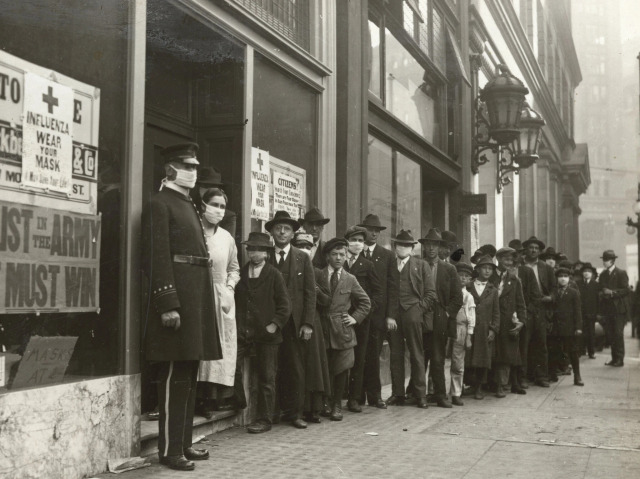
The masks were called muzzles, germ shields and dirt traps. They gave people a “pig-like snout.” Some people snipped holes in their masks to smoke cigars. Others fastened them to dogs in mockery. Bandits used them to rob banks.
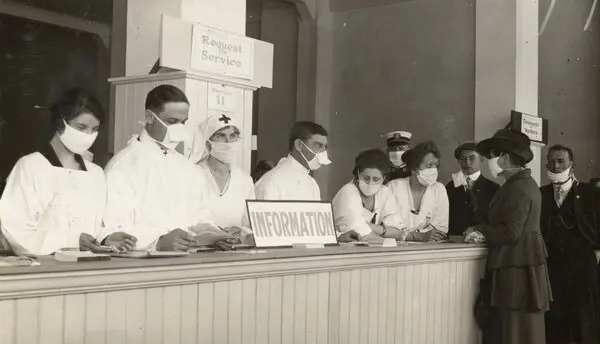
More than a century ago, as the 1918 influenza pandemic raged in the United States, masks of gauze and cheesecloth became the facial front lines in the battle against the virus. But as they have now, the masks also stoked political division. Then, as now, medical authorities urged the wearing of masks to help slow the spread of disease. And then, as now, some people resisted.

In 1918 and 1919, as bars, saloons, restaurants, theaters and schools were closed, masks became a scapegoat, a symbol of government overreach, inspiring protests, petitions and defiant bare-face gatherings. All the while, thousands of Americans were dying in a deadly pandemic.

1918: The infection spreads.
The first infections were identified in March, at an Army base in Kansas, where 100 soldiers were infected. Within a week, the number of flu cases grew fivefold, and soon the disease was taking hold across the country, prompting some cities to impose quarantines and mask orders to contain it.

By the fall of 1918, seven cities — San Francisco, Seattle, Oakland, Sacramento, Denver, Indianapolis and Pasadena, Calif. — had put in effect mandatory face mask laws, said Dr. Howard Markel, a historian of epidemics and the author of “Quarantine!

Organized resistance to mask wearing was not common, Dr. Markel said, but it was present. “There were flare-ups, there were scuffles and there were occasional groups, like the Anti-Mask League,” he said, “but that is the exception rather than the rule.

At the forefront of the safety measures was San Francisco, where a man returning from a trip to Chicago apparently carried the virus home, according to archives about the pandemic at the University of Michigan.
By the end of October, there were more than 60,000 cases statewide, with 7,000 of them in San Francisco. It soon became known as the “masked city.”

 https://64.media.tumblr.com/3fc82794300cf61beedaab44ff8587c8/d227ce168d6b58c3-02/s640x960/adfc6d92ed58381d90bfc661f30b887078c035c0.jpg
“The Mask Ordinance,” signed by Mayor James Rolph on Oct. 22, made San Francisco the first American city to require face coverings, which had to be four layers thick.

Resisters complained about appearance, comfort and freedom, even after the flu killed an estimated 195,000 Americans in October alone.
Alma Whitaker, writing in The Los Angeles Times on Oct. 22, 1918, reviewed masks’ impact on society and celebrity, saying famous people shunned them because it was “so horrid” to go unrecognized.
 
“The big restaurants are the funniest sights, with all the waiters and diners masked, the latter just raising their screen to pop in a mouthful of food,” she wrote.
When Ms. Whitaker herself declined to wear one, she was “forcibly taken” to the Red Cross as a “slacker,” and ordered to make one and put it on.

https://64.media.tumblr.com/97613d183ff77d3e983cf5e9c525af1f/d227ce168d6b58c3-e7/s640x960/8f024edf3cee5a298f6038fe6db8a709a1122f40.jpg
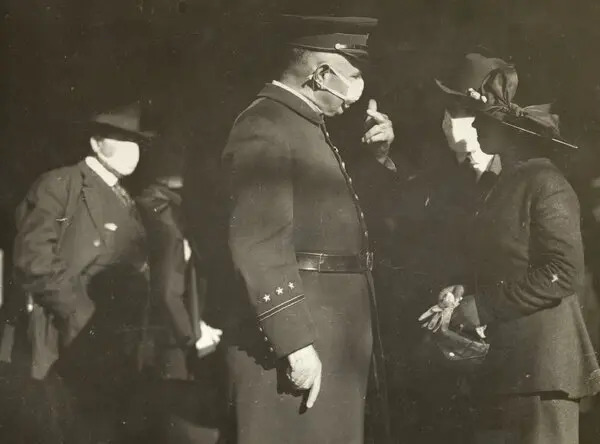
A policeman wearing a flu mask talking to a couple, one masked, one not

The San Francisco Chronicle said the simplest type of mask was of folded gauze affixed with elastic or tape. The police went for gauze masks, which resembled an unflattering “nine ordinary slabs of ravioli arranged in a square.”

There was room for creativity. Some of the coverings were “fearsome looking machines” that lent a “pig-like aspect” to the wearer’s face.
https://64.media.tumblr.com/75b36a20dd29382dc2b264987e15f584/f421f9962d1aed5f-42/s1280x1920/0a62499fd598c860cb7c921b8a43ef619ab8e053.jpg
A man is refused access to a streetcar in 1918 Seattle, 
because he is not wearing a face mask
The penalty for violators was $5 to $10, or 10 days’ imprisonment.
On Nov. 9, 1,000 people were arrested, The San Francisco Chronicle reported. City prisons swelled to standing room only; police shifts and court sessions were added to help manage.
“Where is your mask?” Judge Mathew Brady asked offenders at the Hall of Justice, where sessions dragged into night. Some gave fake names, said they just wanted to light a cigar or that they hated following laws.
Jail terms of 8 hours to 10 days were given out. Those who could not pay $5 were jailed for 48 hours.

 https://64.media.tumblr.com/08572e8079dff35ce4ff2a5ca3d77fd8/d227ce168d6b58c3-ba/s640x960/bb74d6c22e0df95a170c0cb3061ebcb462c5850c.jpg 
Rail commuters wearing white protective masks, one with the additional message
“wear a mask or go to jail,” during the 1918 influenza pandemic in California.

On Oct. 28, a blacksmith named James Wisser stood on Powell and Market streets in front of a drugstore, urging a crowd to dispose of their masks, which he described as “bunk.”
A health inspector, Henry D. Miller, led him to the drugstore to buy a mask.
At the door, Mr. Wisser struck Mr. Miller with a sack of silver dollars and knocked him to the ground, The San Francisco Chronicle reported. While being “pummeled,” Mr. Miller, 62, fired four times with a revolver. Passers-by “scurried for cover,” The Associated Press said.
Mr. Wisser was injured, as were two bystanders. He was charged with disturbing the peace, resisting an officer and assault. The inspector was charged with assault with a deadly weapon.
That was the headline for a report published in The Los Angeles Times when city officials met in November to decide whether to require residents to wear “germ scarers” or “flu-scarers.”
Public feedback was invited. Some supported masks so theaters, churches and schools could operate. Opponents said masks were “mere dirt and dust traps and do more harm than good.”
“I have seen some persons wearing their masks for a while hanging about their necks, and then apply them to their faces, forgetting that they might have picked up germs while dangling about their clothes,” Dr. E.W. Fleming said in a Los Angeles Times report.
An ear, nose and throat specialist, Dr. John J. Kyle, said: “I saw a woman in a restaurant today with a mask on. She was in ordinary street clothes, and every now and then she raised her hand to her face and fussed with the mask.”

Suffragists fighting for the right to vote made a gesture that rejected covering their mouths at a time when their voices were crucial.
At the annual convention of the Illinois Equal Suffrage Association, in October 1918, they set chairs four feet apart, closed doors to the public and limited attendance to 100 delegates, the Chicago Daily Tribune reported.

 https://64.media.tumblr.com/8a13b6e935d253eb03b188f906b9f6dc/d227ce168d6b58c3-f7/s640x960/e25bf0169aeedeb539625cb8a4a427b8560492c9.jpg 
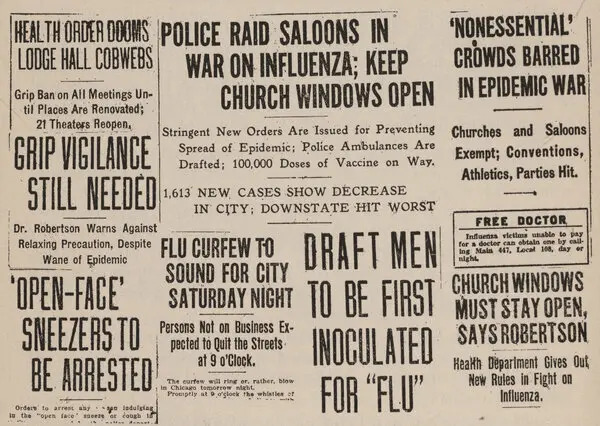
Headlines from newspapers in Chicago

But the women “showed their scorn” for masks, it said. It’s unclear why.
Allison K. Lange, an associate history professor at Wentworth Institute of Technology, said one reason could have been that they wanted to keep a highly visible profile.
“Suffragists wanted to make sure their leaders were familiar political figures,” Dr. Lange said.

San Francisco’s mask ordinance expired after four weeks at noon on Nov. 21. The city celebrated, and church bells tolled.
A “delinquent” bent on blowing his nose tore his mask off so quickly that it “nearly ruptured his ear,” The San Francisco Chronicle reported. He and others stomped on their masks in the street. As a police officer watched, it dawned on him that “his vigil over the masks was done.”
Waiters, barkeeps and others bared their faces. Drinks were on the house. Ice cream shops handed out treats. The sidewalks were strewn with gauze, the “relics of a torturous month,” The Chronicle said.

The spread had been halted. But a second wave was on the horizon.

By December, the San Francisco Board of Supervisors was again proposing a mask requirement, meeting with testy opposition.


https://64.media.tumblr.com/a72dbaeec2c97da28bb1483bd36bb5ea/d227ce168d6b58c3-8c/s640x960/d9f4eb035ab814bce0a1b206c81b930fbe9b6d60.jpg
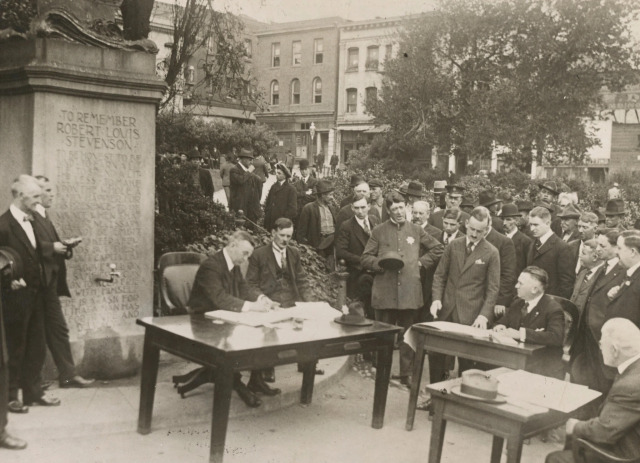
Police Court Officials of San Francisco
Holding a session in the open, as a precaution against the spreading influenza epidemic in late November of 1918.


Around the end of the year, a bomb was defused outside the office of San Francisco’s chief health officer, Dr. William C. Hassler. “Things were violent and aggressive, but it was because people were losing money,” said Brian Dolan, a medical historian at the University of California, San Francisco. “It wasn’t about a constitutional issue; it was a money issue.”
By the end of 1918, the death toll from influenza had reached at least 244,681, mostly in the last four months, according to government statistics.

In January, Pasadena’s city commission passed a mask ordinance. The police grudgingly enforced it, cracking down on cigar smokers and passengers in cars. Sixty people were arrested on the first day, The Los Angeles Times reported on Jan. 22, in an article titled “Pasadena Snorts Under Masks.”
“It is the most unpopular law ever placed on the Pasadena records,” W.S. McIntyre, the chief of police, told the paper. “We are cursed from all sides.”
Some mocked the rule by stretching gauze across car vents or dog snouts. Cigar vendors said they lost customers, though enterprising aficionados cut a hole in the cloth. (They were still arrested.) Barbers lost shaving business. Merchants complained traffic dropped as more people stayed home.
Petitions were circulated at cigar stands. Arrests rose, even of the powerful. Ernest May, the president of Security National Bank of Pasadena, and five “prominent” guests were rounded up at the Maryland Hotel one Sunday.
They had masks on, but not covering their faces.


The Anti-Mask League.
As the contagion moved into its second year, so did the skepticism.
On Dec. 17, 1918, the San Francisco Board of Supervisors reinstituted the mask ordinance after deaths started to climb, a trend that spilled over into the new year with 1,800 flu cases and 101 deaths reported there in the first five days of January.

That board’s decision led to the creation of the Anti-Mask League, a sign that resistance to masks was resurfacing as cities tried to reimpose orders to wear them when infections returned. 


The league was led by a woman, E.J. Harrington, a lawyer, social activist and political opponent of the mayor. About a half-dozen other women filled its top ranks. Eight men also joined, some of them representing unions, along with two members of the board of supervisors who had voted against masks. “The masks turned into a political symbol,” Dr. Dolan said.
https://64.media.tumblr.com/6ea8026675b09cdbabc2c6ad91d07158/d227ce168d6b58c3-13/s640x960/5a7ea8860286d0b885f03ff981fb4cd5822388a4.jpg
A call to protest by the Anti-Mask League in The San Francisco Chronicle, on Jan. 25, 1919.


On Jan. 25, the league held its first organizational meeting, open to the public at the Dreamland Rink, where they united behind demands for the repeal of the mask ordinance and for the resignations of the mayor and health officials.
Their objections included lack of scientific evidence that masks worked and the idea that forcing people to wear the coverings was unconstitutional. 

On Jan. 27, the league protested at a Board of Supervisors meeting, but the mayor held his ground. There were hisses and cries of “freedom and liberty,” Dr. Dolan wrote in his paper on the epidemic.

Repeal came a few days later on Feb. 1, when Mayor Rolph cited a downturn in infections. 


But a third wave of flu rolled in late that year. The final death toll reached an estimated 675,000 nationwide, or 30 for every 1,000 people in San Francisco, making it one of the worst-hit cities in America.

Dr. Dolan said the story of the Anti-Mask League, which has drawn renewed interest now in 2020, demonstrates the disconnect between individual choice and universal compliance.

That sentiment echoes through the century from the voice of a San Francisco railway worker named Frank Cocciniglia.

Arrested on Kearny Street in January, Mr. Cocciniglia told the judge that he “was not disposed to do anything not in harmony with his feelings,” according to a Los Angeles Times report.  

He was sentenced to five days in jail.
“That suits me,” Mr. Cocciniglia said as he left the stand. “I won’t have to wear a mask there.”


Alain Delaqueriere contributed research.


Those who do not learn from history
Are doomed to repeat it.


👇 📚 👇

👇 📚 👇

Christine Hauser is a reporter, covering national and foreign news. Her previous jobs in the newsroom include stints in Business covering financial markets and on the Metro Desk in the police bureau. @ChristineNYT