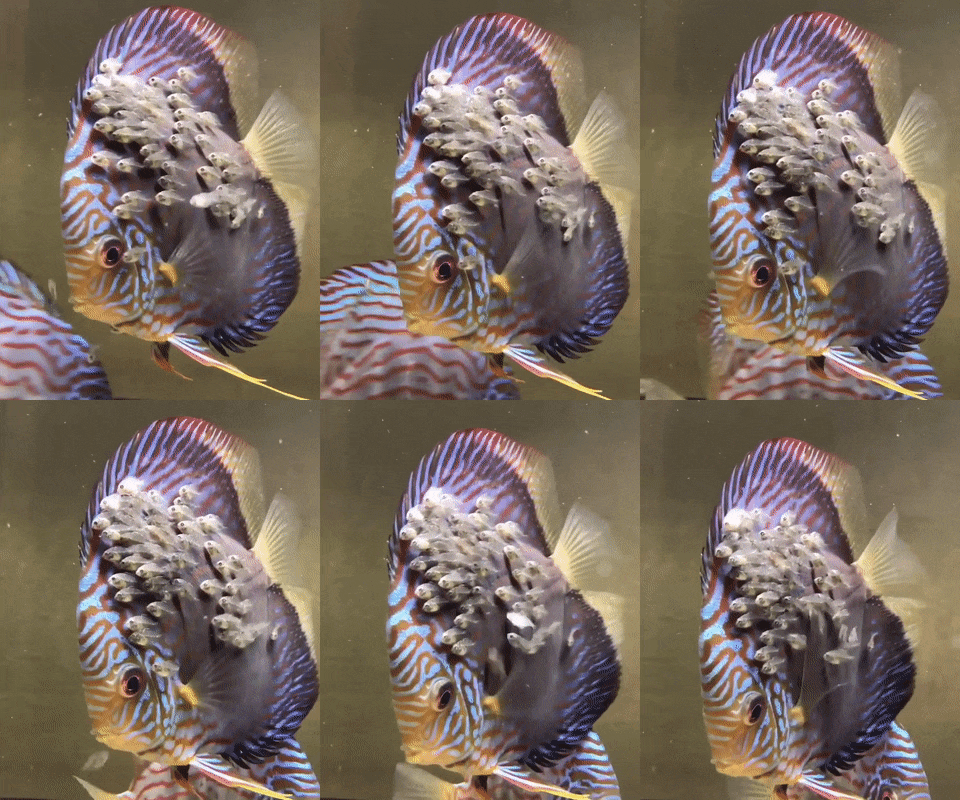
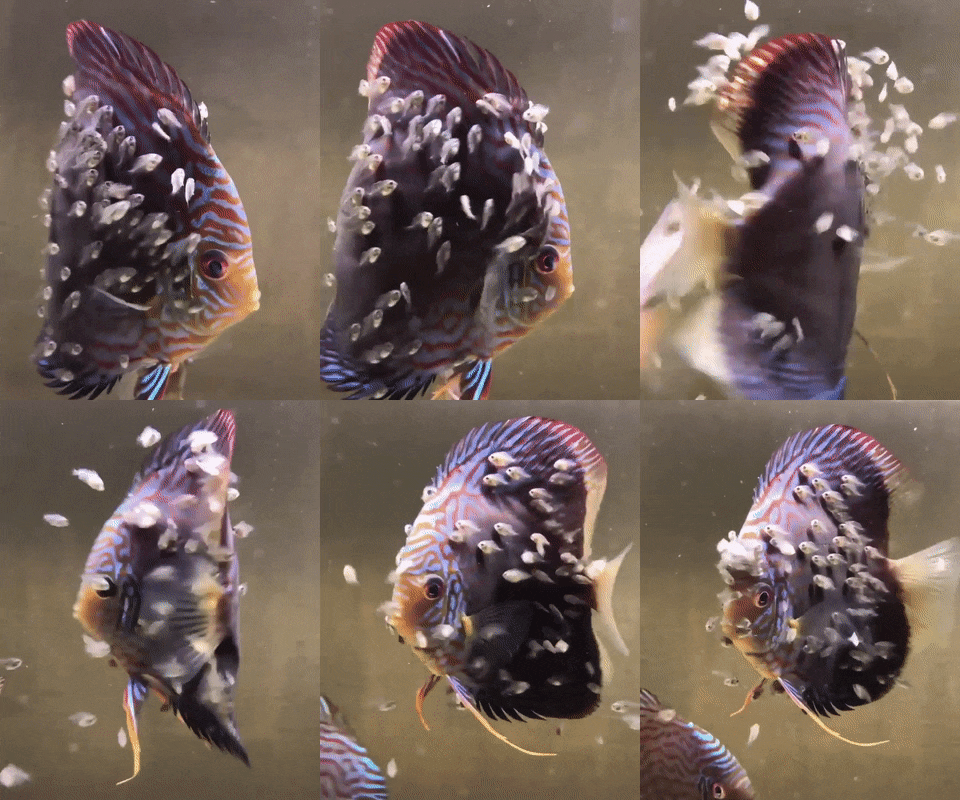
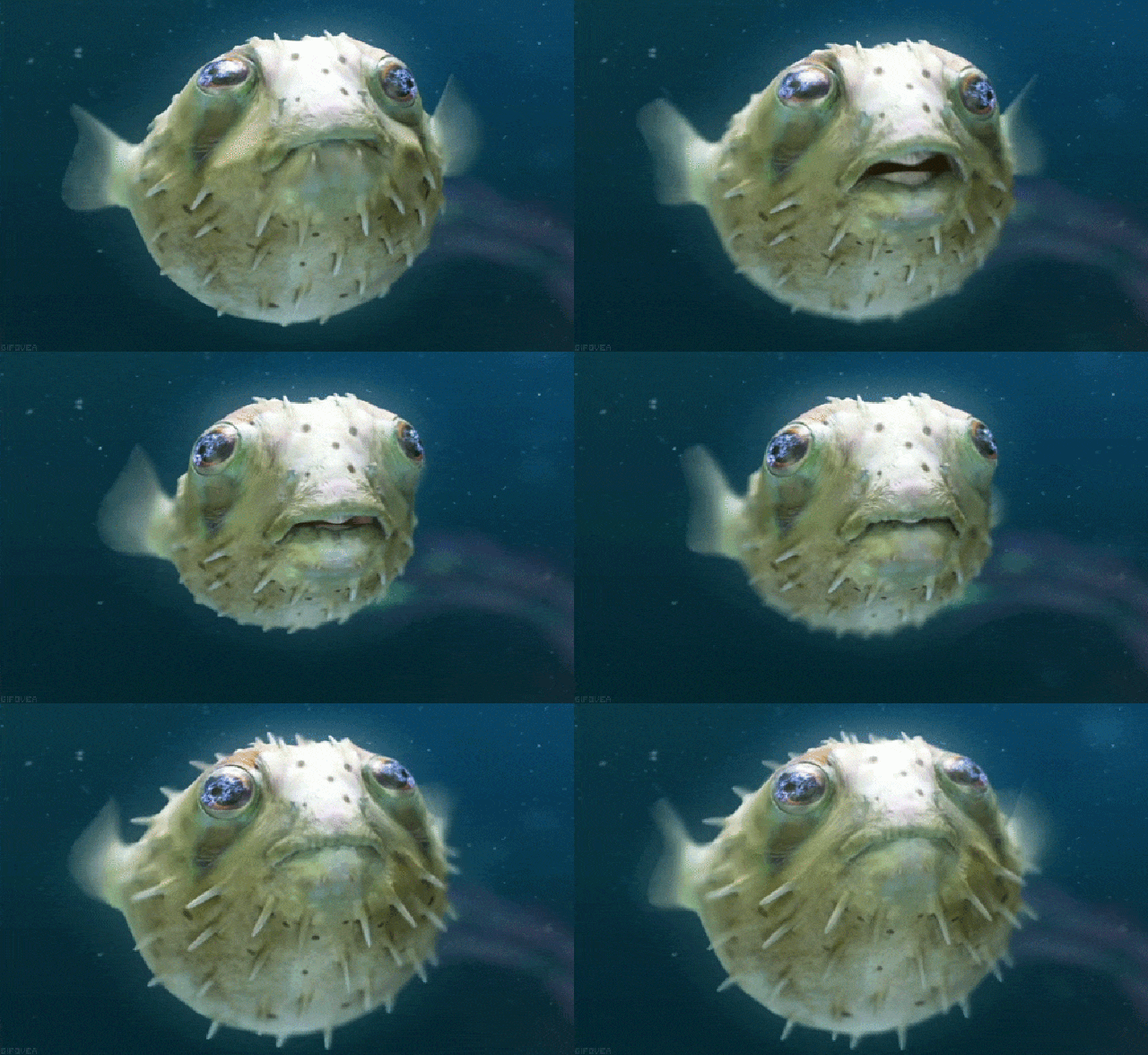
Alex Jordan,
an evolutionary biologist at the Max Planck Institute for Ornithology
in Germany, thinks this fish — a cleaner wrasse — has just passed a
classic test of self-recognition. Scientists have long thought that
being able to recognize oneself in a mirror reveals some sort of self-awareness,
and perhaps an awareness of others’ perspectives, too. For almost 50
years, they have been using mirrors to test animals for that capacity.
After letting an animal get familiar with a mirror, they put a mark
someplace on the animal’s body that it can see only in its reflection.
If the animal looks in the mirror and then touches or examines the mark
on its body, it passes the test.
Humans don’t usually reach this milestone until we’re toddlers. Very few other species ever pass the test; those that do are mostly or entirely big-brained mammals such as chimpanzees. And yet as reported in a 2018 study that appeared on bioRxiv.org and that is due for publication in PLOS Biology, Jordan and his co-authors observed this seemingly self-aware behavior in a tiny fish.
Jordan’s findings have
consequently inspired strong feelings in the field. “There are
researchers who, it seems, do not want fish to be included in this
secret club,” he said. “Because then that means that the [primates] are
not so special anymore.”
If a fish passes the mirror
test, Jordan said, “either you have to accept that the fish is
self-aware, or you have to accept that maybe this test is not testing
for that.” The correct explanation may be a little of both. Some
animals’ mental skills may be more impressive than we imagined, while
the mirror test may say less than we thought. Moving forward in our
understanding of animal minds might mean shattering old ideas about the
mirror test and designing new experiments that take into account each
species’ unique perspective on the world.
Reflecting on Primates
The evolutionary psychologist
Gordon Gallup thought up his field-defining experiment while shaving in a
mirror one day as a graduate student. When Gallup took a position at
Tulane University a little later, he had access to animals at the Delta Regional Primate Research Center he could test his idea on.
Gallup started by showing a
mirror to four chimpanzees, each alone in a cage. At first the chimps
reacted as if they were seeing a stranger. But after a few days, they
stopped threatening and vocalizing at the reflections. They started
using the mirrors to look at themselves: They cleaned food from their
teeth, picked their noses and examined their genitals. To prove that the
chimps understood what they were seeing, researchers anesthetized the
animals and dabbed red dye onto their eyebrows and ears. Then they
returned the chimps to the mirrors. Looking at their reflections, the
animals touched their fingers to the paint on their faces.
What surprised Gallup more than
the chimpanzees’ success at recognizing themselves was the failure of
macaques he tested at the same time. When the paper came out in Science in 1970, “it was bigger than I thought it would be,” Gallup said. “People were quite taken with the finding.”
We were speaking in his cramped
office on the campus of the State University of New York, Albany, where
Gallup has worked since 1975. Every surface and drawer overflowed with
stacks of paper. A phone teetered atop a paper heap that covered the
entire desk. Here and there, obsolete technologies peeked through the
clutter: a dusty vintage computer scattered with floppy disks, VHS tapes
on a rolling TV cart, a slide projector. Gallup sat on a rolling desk
chair that had worn a circular hole through the carpet to the industrial
floor below.
He showed me black-and-white
photos of chimps studying themselves in mirrors. What the mirror test
shows, Gallup said, is self-awareness, which he defines as “the ability
to become the object of your own attention.” And he believes this
implies a certain rare intellect. Any animal that can recognize itself
in a mirror, Gallup thinks, can potentially recognize that others have
their own minds and even empathize with them. A sense of self means a
sense of selves.
Around the same time as Gallup’s
initial study, the psychologist Beulah Amsterdam, at the University of
North Carolina, Chapel Hill, was working on a similar experiment with babies and toddlers,
in which she dotted their noses with rouge. She found that most
children recognize themselves in a mirror by age two. In the following
years, Gallup and his colleagues tested a range of other animals with
mirrors, from primates to chickens, and found more failures than
successes. Most animals never moved beyond seeing the reflection as
another animal.
But a few did — or seemed to. Diana Reiss,
a marine mammal scientist and cognitive psychologist at Hunter College
in New York City, has done extensive research on dolphins, including
mirror tests both with Gallup and other co-authors.
Though the study she worked on with Gallup wasn’t conclusive, she said,
later studies showed that dolphins can pass the test. In their
reflections, aquarium dolphins studied their eyes and mouths, did flips
and blew different kinds of bubbles. After being drawn on with black
marker, the dolphins spent more time looking at the marked sides of their bodies in the mirror.
Monkeys, for the most part, have continued to fail mirror tests. Some rhesus macaques passed after weeks of training with their heads restrained, forced to stare at the mirror. In another experiment,
researchers tried marking marmosets with chocolate to increase their
motivation, with no luck. (Some of the monkeys tried to lick the
chocolate in the mirror.) But Reiss and her colleagues have found mirror self-recognition in Asian elephants. Orangutans, bonobos and gorillas have all passed the test, too, Reiss said — along with one bird, the magpie.
In Gallup’s view, though, only three species
have definitively passed: chimpanzees, orangutans and humans. He finds
the evidence for every other species uncompelling, and thinks
researchers are reading things into animals’ behavior that aren’t there.
Gallup has co-authored papers critiquing others’ methods and interpretations.
One researcher whose results Gallup
challenged was the Harvard University biologist Marc Hauser, who
charmingly marked monkeys called cotton-top tamarins by dyeing their
fluffy white hair exotic colors. Hauser and his co-authors reported that the monkeys touched their heads while looking in the mirror. Yet an attempted replication of the study failed, and in 2011 Hauser left Harvard after an investigation found he had falsified data in other studies.
Still, Gallup claimed he keeps an open mind.
“I’m more than happy to consider the possibility that any other species
might be capable of recognizing itself in a mirror,” he said.
Enter Jordan’s fish.
Social Enough to Be Self-Aware
Jordan is interested in the mental skills
that animals lose or gain as they evolve to live in social groups. He
and his co-authors wanted to explore the cognitive limits of social fish
— so they thought of the mirror test. First they tested cichlids, which
didn’t pass. So the researchers pondered what fish to try next. “The
answer came: Of course it should be the cleaner wrasse,” Jordan said.
“It is an incredibly intelligent animal, and highly social.”
Cleaner wrasse live on coral reefs and
specialize in nibbling parasites and dead skin off the bodies of larger
fish that could easily make a meal of them. It’s a dangerous life, and
the wrasse have to be savvy to avoid being eaten themselves. In the lab
and in the wild, Jordan said, the fish are inquisitive about their
environments and attentive to humans, attempting to clean a person’s
hands or face masks as they would a client.
In front of a mirror, cleaner wrasse seemed
to pass through the same stages as chimpanzees. First they attacked
their reflections. Then they performed unusual behaviors in front of the
mirrors, like swimming upside down. After several days, the fish were
spending extra time near the mirrors, as if studying their reflections.
Next, the researchers marked the fish that
seemed to be catching on. They injected a bit of brown material (or
clear, for a control) under the skin of each fish’s throat. Afterward,
some of the fish seemed to study the marks in front of the mirror. Then
they scraped their throats against rocks or the sandy bottom of their
tanks — a common fish behavior for removing irritants, Jordan said. The
fish often followed this maneuver by swimming back up to the mirror.
Three out of the four fish that made it this far in the study passed the
mirror test, the authors concluded.
The researchers spent more than three years
trying to get the paper published. Peer review is a largely cloaked
process in which experts in a field respond anonymously to papers that
have been submitted to journals. But Gallup signed his reviews of the
cleaner wrasse paper, which were “violently anti,” Jordan said.
In Albany, Gallup chuckled at the suggestion
that the fish had recognized themselves. To him, the demonstrated
behavior was too ambiguous. He wrote in one of his reviews that when a
wrasse scraped its throat, maybe it was pantomiming an instruction for
what the mirrored fish should do — as in “You’ve got some mustard on
your chin,” said Jordan, who called this alternate explanation
“incredibly far-fetched.”
Reiss also reviewed the paper several times
for different publications, she said. She wasn’t convinced that
behaviors like swimming upside down showed that fish were testing how
the mirror worked. She and Gallup also found it problematic that the
brown mark resembled a parasite — to which wrasses instinctively react —
unlike the unnatural marks on other animals. “I think for a claim like
this, the evidence has to be much stronger,” Reiss said.
In response to the reviewers’ objections,
Jordan and his co-authors added more control experiments to their study.
Now that the paper has finally been accepted for publication, Jordan
thinks the grueling revision period made the study stronger. “And, you
know, I didn’t die in the process,” he joked.
Alexandra Horowitz,
a psychologist at Barnard College in New York City who studies dog
cognition, called the wrasse study “amazing.” She added, “I think it …
challenges our presumptive notions about what fish can or cannot
experience.”
Jordan wants the world to know how smart
fish can be. But, he said, “I am the last to say that fish are as smart
as chimpanzees. Or that the cleaner wrasse is equivalent to an
18-month-old baby. It’s not.” Rather, he thinks the main point of his
paper has more to do with science than fish: “The mirror test is
probably not testing for self-awareness,” he said. The question then is
what it is doing, and whether we can do better.
What Is Self-Awareness?
Sometimes it’s easy to tell that an animal really doesn’t understand mirrors. The writer Mary Laura Philpott
has frequently been awakened in the wee hours of the morning by a loud
knocking on her door in Nashville, Tennessee. When she opens the door,
she finds only a small turtle. She nicknamed the prankster reptile
Frank. Eventually she came to suspect that Frank might be challenging or
attacking the strange turtle he sees in the reflective part of her door
— night after night after night.
But just because one individual animal fails
a mirror test doesn’t mean every member of its species would do the
same. It’s a more meaningful positive test than a negative one. And even
when animals do recognize themselves in mirrors, researchers are
divided about what that implies.
“Recognition of one’s own reflection would seem to require a rather advanced form of intellect,” Gallup wrote in 1970. “These data would seem to qualify as the first experimental demonstration of a self-concept in a subhuman form.”
Either a species shows self-awareness or it
doesn’t, as Gallup describes it — and most don’t. “And that’s prompted a
lot of people to spend a lot of time trying to devise ways to salvage
the intellectual integrity of their favorite laboratory animals,” he
told me.
But Reiss and other researchers think self-awareness is more likely to exist on a continuum. In a 2005 study,
the Emory University primatologist Frans de Waal and his co-authors
showed that capuchin monkeys make more eye contact with a mirror than
they do with a strange monkey behind Plexiglas. This could be a kind of
intermediate result between self-awareness and its lack: A capuchin
doesn’t seem to understand the reflection is itself, but it also doesn’t
treat the reflection as a stranger.
Scientists also have mixed feelings about
the phrase “self-awareness,” for which they don’t agree on a definition.
Reiss thinks the mirror test shows “one aspect of self-awareness,” as
opposed to the whole cognitive package a human has. The biologists Marc
Bekoff of the University of Colorado, Boulder, and Paul Sherman of
Cornell University have suggested a spectrum of “self-cognizance” that ranges from brainless reflexes to a humanlike understanding of the self.
Jordan likes the idea of a spectrum, and
thinks cleaner wrasse would fall at the lower end of self-cognizance. He
points out that moving your tail before it gets stepped on, or scraping
a parasite off your scales, isn’t the same as sitting and pondering
your place in the universe. Others in the field have supported his
contention that the mirror test doesn’t test for self-awareness, he
said. “I think the community wants a revision and a reevaluation of how
we understand what animals know,” Jordan said.
One thing on which most scientists in the
field do agree is that there’s a link between recognizing yourself in a
mirror and being social. The species that perform well on mirror tests
all live in groups. In an intriguing 1971 study
by Gallup and others, chimpanzees born in captivity and raised in
isolation failed the mirror test. The chimps that passed the test had
been born in the wild, in social groups. Gallup thought this finding
supported the ideas of the philosopher George Herbert Mead of the
University of Chicago, who said our sense of self is shaped by our
interactions with others. “[T]here could not be an experience of a self
simply by itself,” Mead wrote in 1934.
Gallup sees a clear connection between
recognizing yourself in a mirror, understanding something about others’
states of mind, and even empathizing. “Once you can become the object of
your own attention, and you can begin to think about yourself, you can
use your experience to infer comparable experiences in others,” Gallup
said. No species evolved looking in mirrors, but some of us can see
ourselves reflected in our companions.
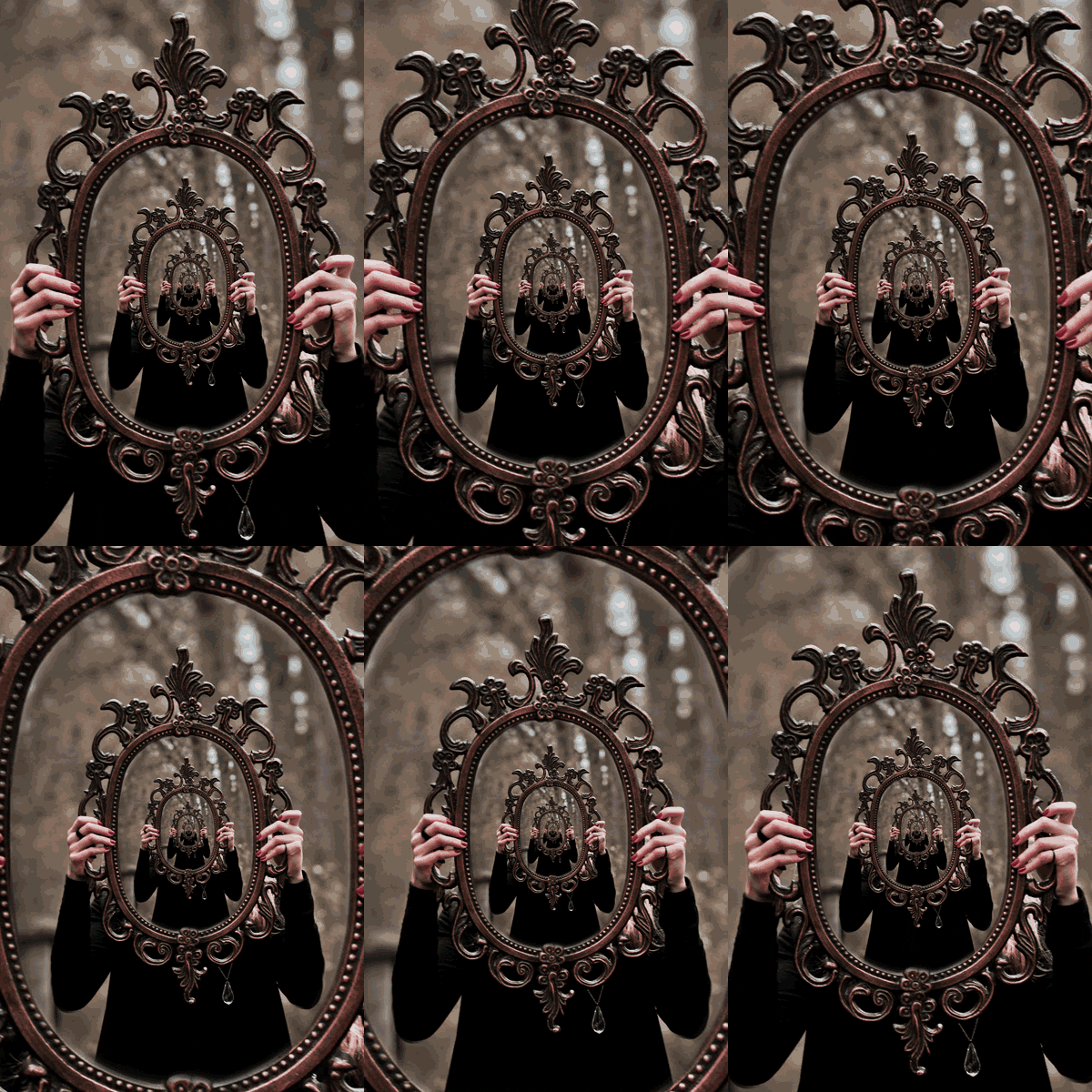
The Mirror as a Window
The sociality of Asian elephants helped researchers to design a better mirror test in 2006. Joshua Plotnik, a comparative psychologist now at Hunter College in New York City, worked on the study with de Waal and Reiss. In an earlier test that elephants failed,
the animals had been in an enclosure, looking at a small mirror. For
the revised test, the researchers used an eight-foot-by-eight-foot
mirror, so the elephants could see their whole bodies at once. They also
let the elephants approach the mirror so that they could stand on their
back legs to look behind it or kneel to peer beneath it.
They also tested elephants in pairs, which
“gave them an opportunity to use their partner as a frame of reference,”
Plotnik said. When an elephant saw a friend standing in the mirror next
to a stranger, she might be able to deduce that the strange elephant
was herself.
This time, one of three elephants passed the
test. Plotnik said the researchers have promising results from other
elephants that haven’t been published yet.
“You have to really try to take the
perspective of the animal that you’re working with,” Plotnik said. For
example, elephants like being dirty and might not care about marks on
their bodies, unlike grooming animals such as chimpanzees. Gorillas
groom, but they hate making direct eye contact with others. This might
help explain why they haven’t had the same success in the mirror test as
chimps or orangutans.
Plotnik thinks future experiments should
take an animal’s particular motivations and perceptions into account.
For example, the mirror test is visual, but elephants are more
interested in what they smell and hear. “Is it fair if you test an
animal that’s not a primarily visual animal and they fail?” Plotnik
said. “You could make that argument for dogs.”
Dogs are lousy at recognizing themselves
in mirrors. But Horowitz recently designed an “olfactory mirror test”
for dogs. She found that dogs spent longer sniffing samples of their own
urine when it had an extra scent “mark” added to it.
“It’s challenging for us as visual creatures
to imagine ourselves into the sensory worlds of nonvisual animals,”
Horowitz said. But we have to do it, she thinks, if we want to
understand how their minds work.
Reiss, who calls Horowitz a friend, doesn’t
think the olfactory mirror study proves dogs can recognize themselves.
But she thinks the experiment is an interesting jumping-off point. “How
else can we [design] tests to get glimpses into what animals know about
themselves?” she said.
As empathetic as Homo sapiens is,
we struggle to place ourselves in the viewpoints of other species. Yet
this kind of understanding could help us not just to grasp our own place
in the world but to protect the world. For example, Plotnik said, a
lack of habitat for Asian elephants is driving conflict between the
endangered species and humans. “I think a lot of what’s missing from the
debate around how to solve this conflict is the elephant’s
perspective,” he said. The kind of insight we get from putting
pachyderms in front of mirrors might be a helpful window into their
minds.
Several mirrors decorate the walls of
Gallup’s office, partially hidden behind the towers of papers. It’s just
a coincidence, he told me — the mirrors were there when he moved in. He
got up from his chair to show me another coincidence born of
pareidolia, our mind’s inclination to look for faces.
In the black wood grain of his office door, a student had once pointed
out the barely discernible face of a gorilla. Gordon traced it for me:
an eye, another eye, two nostrils. He directed me to stand in front of
the door and move back and forth until I saw it.
Suddenly the light caught the grain in just
the right way and the gorilla’s giant face emerged. It stared back at me
directly, as a real gorilla never would, like a glimpse straight into
the unknowable mind of an animal. “I do see it!” I said. Gallup laughed
delightedly. “Isn’t it amazing?” he asked. Then it was gone.
🐟 🐠 🐡  🐟 🐠 🐡
🐟 🐠 🐡 Elizabeth Preston is a
freelance science writer whose work has appeared in the Atlantic, the
Boston Globe, Slate, Wired, National Geographic and many other
publications.











 🇮🇹
🇮🇹 






.gif)