Search This Blog

Showing posts with label Protest. Show all posts

Thursday, June 25, 2026

Guernica 🎨Painting 🖼️ that Fought ✊🏻 Fascism

🖼️  Guernica  🎨
Pablo Picasso
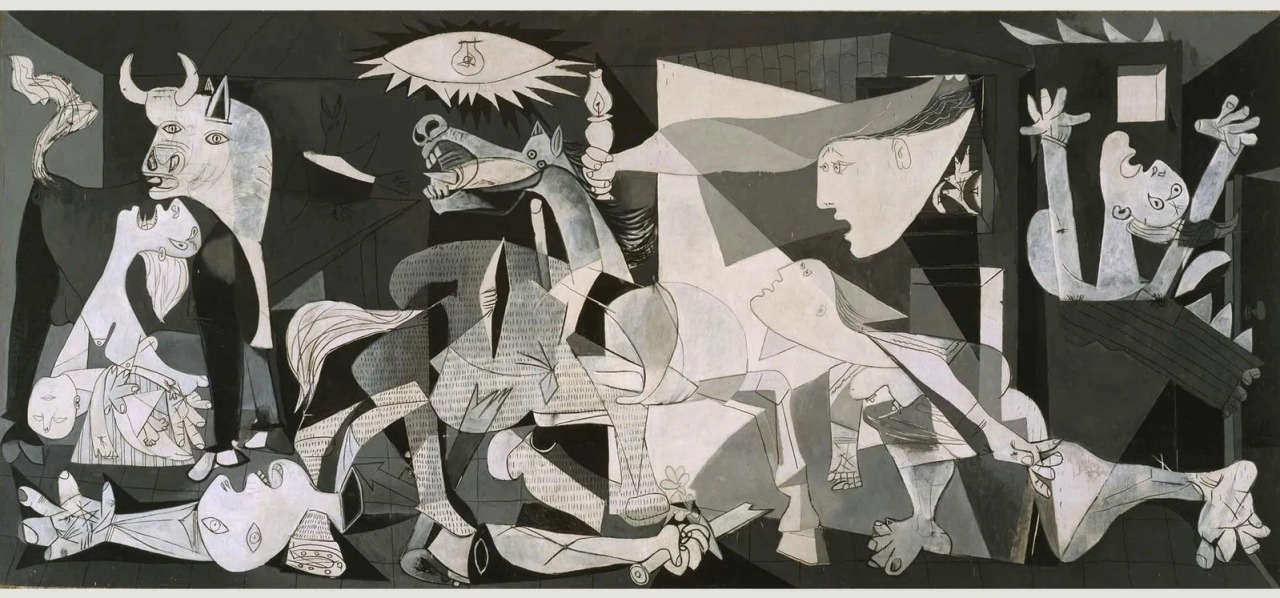
Guernica, a large black-and-white oil painting executed by Spanish artist Pablo Picasso in 1937 following the German bombing of Guernica, a city in Spain’s Basque region. The complex painting received mixed reviews when it was shown in the Spanish Republic Pavilion at the world’s fair in Paris, but it became an icon as it traveled the world in ensuing years, raising controversies on its meaning and its rightful home.
https://64.media.tumblr.com/ce0d0587c6f8ed1870200f6d8b7078d1/2284b26a02268c6f-8a/s1280x1920/5d3674cd91a2656fbe58adf344ab451963025d05.jpg
The Story of a Painting
That Fought Fascism
By Fiona Macdonald * 6 February 2017

Opening during the Spanish Civil War, the 1937 Paris Exhibition allowed artists to speak out against brutality. Fiona Macdonald looks at a moment when paintings became propaganda.

On 26 April 1937, Nazi German and Italian bombers attacked the Basque city of Guernica. Over the course of three hours, they destroyed three-quarters of the ancient town, killing and wounding hundreds. The raid was “unparalleled in military history”, according to reports at the time – and it inspired one of the most famous anti-war paintings in history. A new exhibition staged in London by Barcelona’s Mayoral Gallery honours a group of artists who responded to the atrocities of the Spanish Civil War.

These artists were brought together by the 1937 Paris Exhibition, which opened less than a month after the bombing and just 10 months after the Civil War began. The Exhibition is usually remembered for the competing bluster of two nations: Germany, with its monumental granite tower topped with a giant eagle and swastika, and the Soviet Union, whose marble-clad structure was capped by an even bigger statue of two figures clutching a hammer and a sickle. Yet it also played host to a humbler project that has outlasted either monolith. Mayoral’s exhibition commemorates the 80th anniversary of the Spanish pavilion, seen by the Second Spanish Republic as a way of revealing General Franco’s cruelty to the rest of the world against a backdrop of rising authoritarianism.

Its ambitions were far removed from Nazi and Soviet architectural one-upmanship. As Europe moved towards war, the situation in Spain took on significance around the world. It became a battleground for the forces of Fascism and Communism and inspired new works from some of the greatest artists of the time. Pablo Picasso, Julio González, Joan Miró, Alexander Calder, Alberto Sánchez, and José Gutiérrez Solan were all shown in the Spanish pavilion.

Inspired by the bombing of the Basque city, Picasso’s mural Guernica is one of the most famous anti-war paintings in history (Credit: Museo Nacional Centro de Arte Reina Sofía)
Picasso was commissioned to create a mural for the pavilion, and had started on a series of anti-Nationalist images called Dream and Lie of Franco earlier in 1937. After reading reports of the attack on Guernica by Franco’s allies, he began work on a painting that would come to symbolise the wider fight against Fascism. According to the art historian Fernando Martín Martín, “For the first time in the contemporary history of war, a town and its civilian population had been annihilated both as a scare tactic and a way of testing the war machine.” He says this was the “instant Picasso knew what would be the subject of his mural for the pavilion.”
https://64.media.tumblr.com/82949205b10d300da5482bafc9b147bd/3dc72427ae448545-3b/s1280x1920/8810e25ac891b1cae9e413fadb9bcf0f872d9241.jpg
In Guernica, I clearly express my abhorrence of the military caste which has sunk Spain in an ocean of pain and death – Pablo Picasso 

His painting, Guernica, is not on display at Mayoral (it is exhibited at Madrid’s Reina Sofía Museum) – but there are insights into its creation, including photographs taken by Picasso’s girlfriend at the time, Dora Maar. The mural took him just over a month to complete. 

While painting, to combat rumours that he supported the Nationalists, Picasso issued a statement: 
“In the panel on which I am working, which I shall call Guernica, and in all my recent works of art, I clearly express my abhorrence of the military caste which has sunk Spain in an ocean of pain and death”.

Political canvas
The artists creating pieces for the pavilion were explicit in their aims. Mayoral’s exhibition curator Juan Manuel Bonet says that “all the major works at the pavilion were fruits of a commission. The special thing about this commission was that it was not intended to be a political commission; the artists took it upon themselves to react in such a way.”
https://64.media.tumblr.com/5e8e4833132abf7d859c2beb64cee456/2284b26a02268c6f-65/s400x600/19841cf7e12702961e1b45a50fb41833befaadb4.jpg
Designed as a stamp to aid the Republican Government, Help Spain (Aidez L'Espagne) was one of Miró’s first political works  
(Credit: Museo Nacional Centro de Arte Reina Sofía)

It was a new outlook for some of them, says Bonet. “Before 1936, neither Picasso nor Miró were very political; but the Spanish Civil War changed this.” According to him, 1937’s Dream and Lie of Franco by Picasso and Aidez l’Espagne (Help Spain) by Miró are the artists’ first overtly political works. “Later on in their careers, Picasso joined the French Communist Party in 1944 and Miró continued to be very active against Franco’s regime into and during the 1960s and ‘70s.”

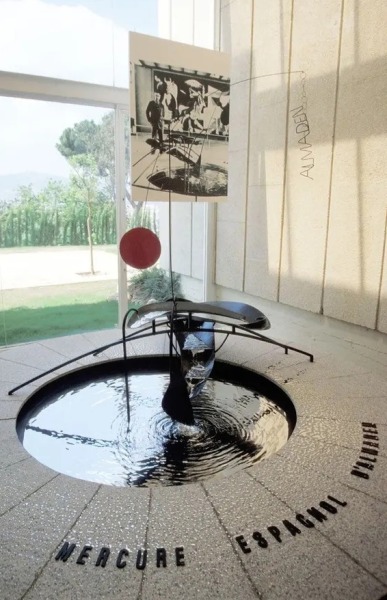
The American sculptor Alexander Calder’s contribution to the pavilion was also a piece of propaganda. A supporter of the Republican cause and great friend of Miró, Calder was initially refused permission to create an artwork because he wasn’t Spanish, but the organizers relented after a marble fountain from Spain had to be repurposed. It was filled with mercury that was poured through a series of sculptures created by Calder until it reached a mobile labelled ‘Almadén’.
https://64.media.tumblr.com/dd47b3456c08b3ca7a626ab161631747/2284b26a02268c6f-9a/s400x600/885e9e67260db41542ac2163d6258a8de8b5c0f1.jpg
The Mercury Fountain by Alexander Calder referenced a Republican stronghold famous for its mercury mines

The word resonated with Republicans. It was the name of a stronghold that held out against an offensive by Franco’s troops in March 1937, famous for its deposits of mercury, an element valued for its use in manufacturing weapons. Calder’s piece, The Mercury Fountain, doubled as a symbol for Republican resistance. “Nothing in the pavilion was free from intention,” writes Martín.
Tumblr: ImageGuernica was not a picture but graffiti, though graffiti done by a genius – José Bergamín

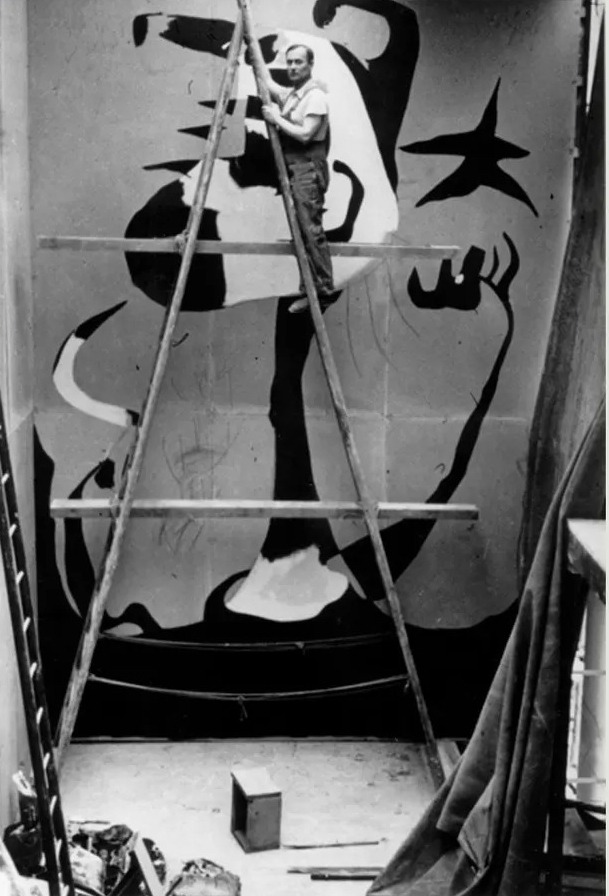
The exhibition has been put together with Joan Punyet Miró, historian and grandson of Joan. It includes a reconstruction of his grandfather’s El Segador (The Reaper) – a mural painted onto construction material in situ which was then lost or destroyed after the pavilion was dismantled. Showing a Catalan peasant with a huge misshapen head, it was a cry of outrage at the events in Spain. “Of course I intended it as a protest,” said Miró. “The Catalan peasant is a symbol of the strong, the independent, the resistant.”

Pop-up propaganda
Both The Reaper and Guernica were created as propaganda, in the manner of Soviet agitprop – “ephemeral art based on propaganda and agitation for a political cause aimed at stirring up the masses”, writes Joan Punyet Miró, arguing that the murals “looked like huge political propaganda posters”. The poet José Bergamín commented that “Guernica was not a picture but graffiti, though graffiti done by a genius”.
https://64.media.tumblr.com/8da52ea6daf78b555ecd6efcf3db120a/2284b26a02268c6f-d4/s640x960/d129ccba36b9c00643a3a152f3a56a70318c3ac1.jpg
Joan Miró painting El Segador (The Reaper), a mural intended as an ephemeral work of propaganda, according to his grandson 
 Credit: Successió Miró Archives/Courtesy of Mayoral)

Painted on poor quality canvas, Guernica could easily have been destroyed as well. According to Punyet Miró, “Neither of them chose a tough, hard-wearing support, for they knew in advance that these were ephemeral works, designed to cause an impact and then disappear along with the pavilion… Guernica was spared the same fate as Miró’s mural because Picasso was asked to send it to London and later to the United States”.
Tumblr: Image
The painting was not to return to Spain until democracy had been returned – Juan Manuel Bonet

As it turned out, the pavilion was only the beginning. Guernica toured around the UK in 1938, says Bonet. “Picasso later entrusted the painting to MoMA in New York, as it was his wish that the painting not return to Spain until democracy had been returned to the country. This was symbolically very important.”

Through a dark lens
Guernica took on a wider meaning in the years that followed. “It speaks about the Spanish Civil War, and the destiny of civilians in it, as well as the bombs that killed so many people in this Basque city,” says Bonet. “It also remarks on all wars.” The French writer Michel Leiris was moved to say of it: “On a black and white canvas that depicts ancient tragedy… Picasso also writes our letter of doom: all that we love is going to be lost.”

Yet there was hope in it too. Amid shrieking figures and corpses, Picasso left a beacon, according to Martín. “At the top, stretching out from a window, a woman with an oil lamp seems to want to illuminate the encroaching panic and darkness.”
https://64.media.tumblr.com/14aa3cf40611a419d5a5264d238a53e0/2284b26a02268c6f-8d/s640x960/0179fa9aebc56ef1afc8638564b9e0527e308dd4.jpg
No Pasarán! (They will not pass!) by Ramón Puyol, who said “the rickety theory of art for art’s sake has just died” (Credit: CRAI Biblioteca del Pavelló de la República/Mayoral)

Guernica tapped into an earlier tradition, echoing Goya’s works commemorating resistance to the Napoleonic invasion of Spain.  According to curators at the Reina Sofía, “The grotesque vision that Goya brought to his political critique was not lost on artists as a powerful tool for crafting their own views of the present.” Picasso admired Goya’s “dark lens on Spain’s complex political and religious traditions”.

“Picasso, Miró, Calder and González taught us that sometimes major moments such as the Spanish Civil War force us to take sides,” says gallery director Jordi Mayoral. “The works created by these artists for the pavilion are still part of the Spanish collective memory; they represented a major turning point in the Civil War and the country’s struggle between democracy and fascism”.

Picasso himself summed up his decision, remarking in 1937: “I have always believed and still believe that artists who live and work with spiritual values cannot and should not remain indifferent to a conflict in which the highest values of humanity and civilisation are at stake.”

If you would like to comment on this story or anything else you have seen on BBC Culture, head over to our Facebook page or message us on Twitter.
And if you liked this story, sign up for the weekly bbc.com features newsletter, called “If You Only Read 6 Things This Week”. A handpicked selection of stories from BBC Future, Earth, Culture, Capital, Travel and Autos, delivered to your inbox every Friday.
In 1937, in one of the worst civilian casualties of the Spanish Civil War, Fascist forces bombed the village of Guernica in Northern Spain. For Pablo Picasso, the tragedy sparked a frenzied period of work in which he produced a massive anti-war mural, titled “Guernica.” How can we make sense of this overwhelming image, and what makes it a masterpiece of anti-war art? Iseult Gillespie investigates.
Why is this painting so shocking?
TED-Ed - Iseult Gillespie

Discover the history and symbolism of Pablo Picasso’s powerful anti-war mural, “Guernica,” rendered in his signature Cubist style.

In 1937, in one of the worst civilian casualties of the Spanish Civil War, Fascist forces bombed the village of Guernica in Northern Spain. For Pablo Picasso, the tragedy sparked a frenzied period of work in which he produced a massive anti-war mural, titled “Guernica.” How can we make sense of this overwhelming image, and what makes it a masterpiece of anti-war art? Iseult Gillespie investigates.
Lesson by Iseult Gillespie, directed by Avi Ofer.
https://ed.ted.com/lessons/why-is-this-painting-so-shocking-iseult-gillespie
Bella Ciao
👇 ♪ 📽️ ♪ 👇

The song Bella Ciao was sung by the left-wing anti-fascist resistance movement in Italy, a movement by anarchists, communists, socialists and other militant anti-fascist partisans. 
The author of the lyrics is unknown, and the music seems to come from an earlier folk song sung by riceweeders in the Po Valley. 
Another interpretation has been given following the discovery in 2006 by Fausto Giovannardi of the CD "Klezmer - Yiddish swing music" including the melody "Koilen" played in 1919 by Mishka Ziganoff.
 
🎨
The original is in black and white in museum in Madrid.
The black and white colouring links it to journalistic photos from the time of the massacre. It lacks that connection in colour.
🎨
Coloring it only shows a different perspective, I enjoyed it, isn’t the idea of enjoying and creating art, an opportunity to expand and share our perspectives?
🎨
Picasso himself took joy in replicating works by other artists such as “Velazquez’s “Las Meninas” and while he actually re-conceived it, it was a borrowed theme, and no-one thought it was an infringement. Furthermore Picasso often times took Cubist themes images so close to Georges Braque that one would readily conclude it was copied imitation. They both developed cubism in tandem, though not necessarily created by Picasso.
https://64.media.tumblr.com/88a0f9172655f2c65ce03f63d3b451fa/e0f37f7be7c12adf-cb/s1280x1920/391f47fe6b0fb367de3b0f2f6584ff5349fc44fb.jpg
As an artist myself I am aware of copyright infringement, however copying art has been a tradition where we all learn, it’s part of a rigorous academic approach. Presumably it’s when one claims it’s created by the original artist, that is fraud, legally reprehensible, admitting/ acknowledging it’s a copy does not damage anyone. By this rule thousands of artists and students would be liable. There are thousands, upon thousands of works out there that are derivative.
I am not presenting this as an argument against anyone’s position on the issue, simply expressing my perspective.
I appreciate yours.
Tumblr: Image
👇 📽️ 👇
Bella Ciao - La Casa de Papel
👇 ♪ 📽️ ♪ 👇
Una mattina mi sono svegliato,
o bella, ciao! bella, ciao! bella, ciao, ciao, ciao!
Una mattina mi sono svegliato,
e ho trovato l'invasor.

O partigiano, portami via,
o bella, ciao! bella, ciao! bella, ciao, ciao, ciao!
O partigiano, portami via,
ché mi sento di morir.

E se io muoio da partigiano,
o bella, ciao! bella, ciao! bella, ciao, ciao, ciao!
E se io muoio da partigiano,
tu mi devi seppellir.

E seppellire lassù in montagna,
o bella, ciao! bella, ciao! bella, ciao, ciao, ciao!
E seppellire lassù in montagna,
sotto l'ombra di un bel fior.

Tutte le genti che passeranno,
o bella, ciao! bella, ciao! bella, ciao, ciao, ciao!
Tutte le genti che passeranno,
Mi diranno «Che bel fior!»

«È questo il fiore del partigiano»,
o bella, ciao! bella, ciao! bella, ciao, ciao, ciao!
«È questo il fiore del partigiano, morto per la libertà!»
https://64.media.tumblr.com/db0d58f674784fe0d0f0ee58839a84b7/d66c66cc80583a90-22/s2048x3072/440e7f1f43655e044f471fd4b61085af807f7a7a.jpg
Bella Ciao - Manu Pilas
 (Lyrics)
👇 ♪ 📽️ ♪ 👇

Bella Ciao ! 
Tumblr: Image
https://64.media.tumblr.com/db4e9fc312c4124836c948871529be02/ded5483d93fef10f-3c/s2048x3072/5595499de9ebc3f227566e749b93bba5547ef0d1.jpg
 ✊ 🙏 🙏🏻 ✊🏻🙏 🙏🏾 ✊🏿🙏 🙏🏻✊🏽🙏🏾 🙏 

Saturday, August 9, 2025

This Land Is Your Land 🎼 Story of the Protest ✊ Song

 “This Land Is Your Land”
The Story Behind America’s
Best-Known 🗣 Protest Song
https://64.media.tumblr.com/add9f7f48cf25bee5fe6e2cc09e12203/22bd2b43d523c45d-5f/s1280x1920/f374ad4af46b88e1eb1bbe2e953b1d858f2a3c62.pnj
It has been a staple of kindergarten classrooms for decades. But Woody Guthrie didn’t intend for the song to be a ringing endorsement of American exceptionalism - he wrote it for those who were getting left behind. 
🎸
Woody Guthrie was a highly influential American folk singer, songwriter, and political activist, best known for his protest songs, ballads, and children's music.
  • Born Woodrow Wilson Guthrie on July 14, 1912, in Okemah, Oklahoma.
  • Experienced a challenging youth marked by family tragedy, including the death of his sister and his mother's institutionalization for Huntington's disease, a genetic neurological disorder that would later also affect him.
  • Taught himself to play guitar and harmonica.
  • Traveled extensively during the Great Depression, often working odd jobs and performing in saloons and migrant worker camps, witnessing and giving voice to the struggles of working-class people, earning him the nickname "Dust Bowl Troubadour".
  • His experiences during this time became the bedrock of his songs and stories, including his autobiography "Bound for Glory". 
https://64.media.tumblr.com/42dc2d0478444094752ed59491739c1d/22bd2b43d523c45d-b1/s1280x1920/b814a491d820e3e99f007c534413522364d4b788.jpg
Woody Guthrie
This Land Is Your Land
The Story Behind America’s Best-Known Protest Song
It has been a staple of kindergarten classrooms for decades. But Woody Guthrie didn’t intend for the song to be a ringing endorsement of American exceptionalism -
he wrote it for those who were getting left behind.
🎸
Few songs are more ingrained in the American psyche than "This Land Is Your Land," the greatest and best-known work by folk icon Woody Guthrie. For decades, it's been a staple of kindergarten classrooms "from California to the New York island," as the lyrics go. It's the musical equivalent of apple pie, though the flavor varies wildly depending on who's doing the singing.
On its most basic level, "This Land Is Your Land" is a song about inclusion and equality
- the American ideal broken down into simple, eloquent language and set to a melody you memorize on first listen. The underlying message, repeated throughout the song, makes the heart swell: "This land was made for you and me." 
🎸
But there's more to "This Land Is Your Land" than many people realize - two verses more, in fact. Guthrie's original 1940 draft of the song contains six verses, two of which carry progressive political messages that add nuance to the song's overt patriotism. These controversial verses are generally omitted from children's songbooks and the like, but they speak volumes about Guthrie's mindset when he put pen to paper 80 years ago.
The Story Of
 'This Land Is Your Land' 
Woody Guthrie's American Folk Anthem
This legendary protest song was Guthrie's response to Irving Berlin's 1938 hit "God Bless America." Explore how the hardships of the Great Depression and the rise of the American folk genre shaped Guthrie's music and activism. Tune in to uncover how one song became an enduring symbol of equality and social justice!
👇   🎼   👇
Guthrie wrote "This Land Is Your Land" in a divey hotel room in New York City. He'd just landed in Manhattan after years of rambling across the country and meeting impoverished people affected by the Dust Bowl and Great Depression. Throughout his travels in the late '30s, Guthrie was haunted by Kate Smith's hit recording of  Irving Berlin's ""God Bless America." Guthrie found Berlin's song to be jingoistic and out of touch with the reality facing many of his fellow citizens. So he set about writing a response.
Peter, Paul & Mary
This Land Is Your Land 
(25th Anniversary Concert) 
Peter, Paul and Mary perform "This Land Is our Land" live at their 25th anniversary concert in 1986. Now, two and a half decades later, in celebration of the 50th anniversary of the formation of the group in the famed Greenwich Village, this joyous yet deeply moving live concert is being first released on DVD by Shout! Factory. …
🎼♪♫🗣♪♫♫🎹♪♫♪🎷♪🎻♪♫🎺♪♫🥁♪♫🎸♫
Guthrie originally titled his rejoinder "God Blessed America" - emphasis on the past tense - but eventually changed his tone. Instead of doing a sarcastic parody, he wrote a song that pulls double-duty, celebrating America's natural splendor while criticizing the nation for falling short of its promise. In the "lost" fourth verse, Guthrie decries the notion of private property, suggesting America is being carved up by the wealthy:
       There was a big high wall there that tried to stop me. 
       The sign was painted, said: 'Private Property.'
       But on the backside, it didn't say nothing.
       This land was made for you and me.
The sixth and final verse in the original manuscript references the poor folks Guthrie saw living on government assistance during the Great Depression: 
 
     One bright sunny morning in the shadow of the steeple,
      By the relief office I saw my people;
      As they stood there hungry, I stood there wondering if
      God blessed America for me?
When Guthrie 
first recorded  the song in 1944, he included the verse about private property but left out the one about the relief office. That original recording was lost until the '90s, however, so for years, all anyone knew was the version Guthrie recorded for 1951's Songs to Grow On. Guthrie's rendition on that album features neither the "no trespassing" verse nor the one about the relief office, which he never actually recorded.
It's unclear why the 1944 recording with the "private property" verse was never released, or why Guthrie edited out the radical stuff for the 1951 version. (He also chopped out both controversial verses when he first published the lyrics in the 1945 pamphlet Ten of Woody Guthrie's Songs.) It may have had something to do with the mounting anti-communist furor that would lead to the Red Scare of the late '40s and early '50s. As a pro-union communist sympathizer, Guthrie and his fellow rabble-rousing folky buddy Pete Seeger had already faced industry blacklisting in the early '40s.
🎸
"We did one program on CBS Radio, and a newspaper reported out, said, 'Red minstrels try to get on the networks,'" Seeger told NPR. "And that was the last job we got."
Woody Guthrie, circa March 1943
https://64.media.tumblr.com/388a85d82b10c70398b39e1cb29dd058/db18b33fd5d922f0-11/s640x960/bddcd7fa3c05345fe9779504cd57f0c246bc7e1e.pnj
Regardless of which verses are included, "This Land Is Your Land" is terrific for singing. That was by design. Guthrie likely stole the melody from the Carter Family's 1935 tune " Little Darling, Pal of Mine," which itself was patterned after an old gospel hymn titled " When the World's On Fire" (sometimes called " Oh, My Loving Brother"). "This Land" was a perfect fit for classrooms and campsites, where the song would take on new life.
🎸
In the early '50s, famed American folklorist Alan Lomax came up with a nifty plan for preserving the nation's musical heritage. He approached legendary music publisher Howie Richmond with the idea of including rural folk songs—the kind he'd been documenting for the Library of Congress—in school music textbooks. Richmond, who had become Guthrie's publisher in 1950, loved the idea, and to sweeten the deal for textbook publishers, he lowered his usual licensing rates and offered "This Land Is Your Land" for just $1. 
🎸
That's how "This Land Is Your Land" went viral and became nearly as ubiquitous as the national anthem, even without the radio play and jukebox real estate of Smith's "God Bless America." While the versions distributed to America's impressionable youth lacked "no trespassing" and "relief office" verses, the song's original lyrics were never forgotten. Following Guthrie's death in 1967, artists like Seeger continued performing the "lost verses," lest people forget the anger that inspired the song. 
 🎼♪♫🗣♪♫♫🎹♪♫♪🎷♪🎻♪♫🎺♪♫🥁♪♫🎸♫
But regardless of Guthrie's intentions, "This Land Is Your Land" has come to mean different things to different people. That's part of what makes it so timeless. When President Ronald Reagan used the song at his victory party in 1984, after it had been used by Walter Mondale's campaign, both sides were probably trying to evoke feel-good patriotism. The same goes for Reagan's advisors and allies who were invoking Bruce Springsteen's " Born in the U.S.A." during rallies and in newspaper articles. Reagan himself name-checked Springsteen and his "message of hope" during a rally in Hammonton, New Jersey. The president either didn't know or didn't care that "Born in the U.S.A." was another song about loving your country but hating how poorly it treats some of its citizens. 
🎸
Ironically, the Boss had begun performing "This Land Is Your Land" in the early '80s. On the version included on the Live 1975–85 box set, Springsteen gives his audience the backstory about Irving Berlin and refers to "This Land" as "just about one of the most beautiful songs ever written." And, when given the opportunity to perform the song with Pete Seeger at Barack Obama's pre-inauguration concert in 2009, he readily agreed to sing all the verses at Seeger's insistence. 
🎸
Over the years, "This Land Is Your Land" has been covered by everyone from the Mormon Tabernacle Choir to former Rage Against the Machine guitarist Tom Morello, who performed the song in Zuccotti Park during an Occupy Wall Street protest in 2011. Lady Gaga sang a snippet to open her Super Bowl halftime show in 2017, causing fans and critics to speculate about whether she was making a political statement. She mashed it up with "God Bless America," so it's a safe bet she knew the history of the song.
 https://64.media.tumblr.com/18e811996c847909e236533dd08230ec/db18b33fd5d922f0-a3/s1280x1920/d15290ab4ec84ce2c8524da23b3434af7f77cc36.jpg
There may be even more officially recorded versions in years to come. Much like what has been done with ubiquitous songs like "Happy Birthday" and " We Shall Overcome" (which Seeger toured with and taught across the country at rallies and protests throughout the '50s and '60s), there is a push to have "This Land Is Your Land" enter the public domain. The Brooklyn rock band Satorii filed a lawsuit in 2016 challenging the copyrights held by the Richmond Organization and its subsidiary, Ludlow Music, and maintain that since Guthrie only wrote the lyrics and not that pilfered melody, he shouldn't have been able to register the song in the first place, nor should Ludlow have been able to own the copyright. The suit is ongoing.
🎸
Whether it enters the public domain, as one imagines Guthrie would have wanted, or doesn't, "This Land Is Your Land" isn't going anywhere. The song has been adopted and modified by Native Americans, Swedish anti-Nazi troubadours, and people all over the globe who find truth and comfort in Guthrie's words, however they choose to interpret them.
🎸
"The whole idea of a land is your spot on Earth, you know," Woody's daughter Nora told NPR. "A spot where you can claim safety, sanity."
🎸
Kenneth Partridge is a music and pop-culture writer based in Brooklyn. He's written for such publications as Billboard, The AV Club, Pitchfork, and Refinery29. His hobbies include reading, running, shopping for records, and attempting to justify his love of ska. 
Tumblr: Image 
Woody Guthrie
Music & Activism
  • Wrote thousands of songs, including "This Land Is Your Land", often considered a counterpoint to "God Bless America", with lyrics reflecting a nuanced view of the country, acknowledging its beauty but also raising questions about social and economic inequality.
  • His music was frequently imbued with social and political commentary, advocating for the rights of workers, the poor, and minorities.
  • Associated with left-wing causes and groups, though he never formally joined the Communist Party.
  • Famous for having "This Machine Kills Fascists" emblazoned on his guitar, embodying his anti-fascist stance.
Legacy and influence
  • Died in 1967 at the age of 55 from complications of Huntington's disease.
  • His work inspired generations of musicians and activists, including Bob Dylan, Bruce Springsteen, Pete Seeger, and others.
  • Marjorie Guthrie, his second wife, founded the Committee to Combat Huntington's Disease (now the Huntington's Disease Society of America), dedicated to supporting research and families affected by the disease.
  • The Woody Guthrie Center in Tulsa, Oklahoma, houses his archives and features a museum dedicated to his life and influence.
  • The Woody Guthrie Folk Festival, also known as "WoodyFest", is held annually in his hometown of Okemah, Oklahoma, to celebrate his music and legacy.
This Land Is Your Land 🎼 The True Story
Adam Miller - Folksinger, Storyteller, and Autoharp Virtuoso.  
In February of 1940, Woody Guthrie (1912-1967) wrote what is now one of the most well-known and widespread English language Folksongs.  Here's how it happened.
👇   🎼   👇
🖱️ Folksinging.org
https://64.media.tumblr.com/0191b3ca67627c15f5305582422099cd/db18b33fd5d922f0-76/s640x960/2024b670956dbb721f36538b4ad08abe9cb3c847.jpg
Woody Guthrie's Artwork
https://64.media.tumblr.com/02afab2ef47190864ab5ac5879db1651/db18b33fd5d922f0-a6/s1280x1920/e96574e3859615375b62c5f094355fe27b202601.pnj

Friday, February 24, 2023

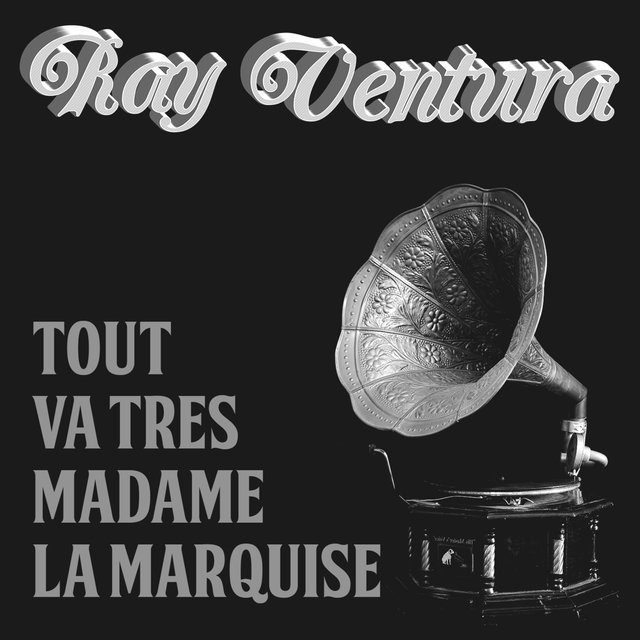
Tout va Très Bien💃Madame La Marquise

Tout va Très Bien
Madame La Marquise
https://78.media.tumblr.com/a6214502cb3fb163bcd1180928411175/tumblr_pe580sPQCD1urtgw2o2_1280.jpg
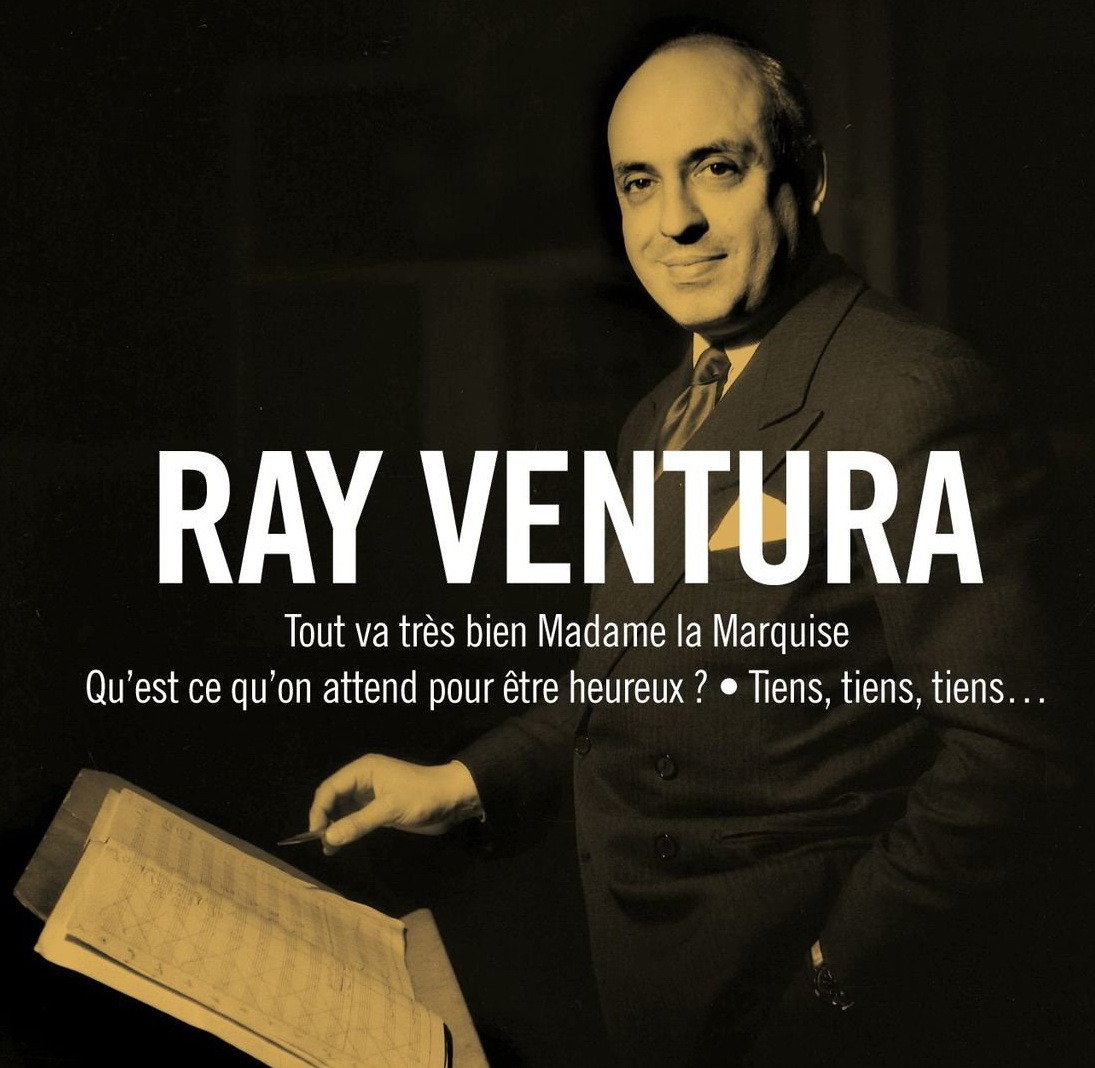
Everything is fine Madame la Marquise/Tout va très bien, Madame la Marquise  is a 1935 song , lyrics and music by Paul Misraki , published by Ray Ventura editions has become a proverbial expression to designate an attitude of blindness in the face of a hopeless situation and a clumsy attempt to hide its reality
💃
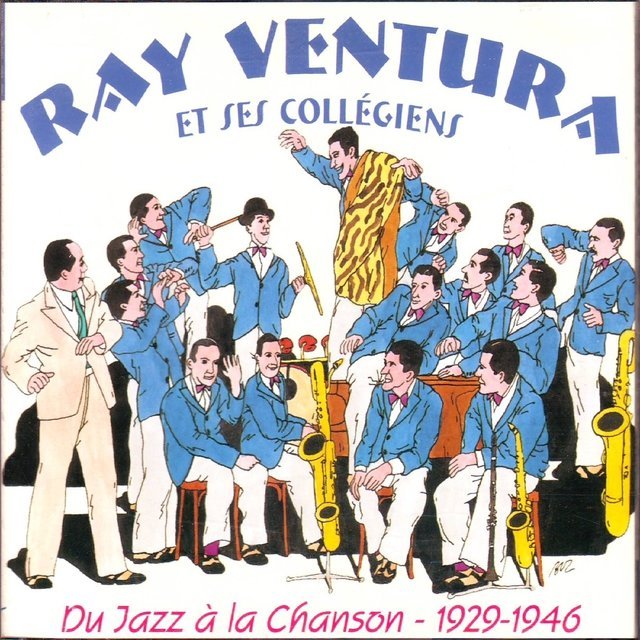
Tout va très bien, madame la marquise est une chanson de 1935, paroles et musique de Paul Misraki, publiée aux éditions Ray Ventura ; c'est un des grands succès de l'orchestre de Ray Ventura et ses Collégiens avec Qu'est-ce qu'on attend pour être heureux ? et Ça vaut mieux que d'attraper la scarlatine. Tout va très bien Madame la Marquise est devenu une expression proverbiale pour désigner une attitude d'aveuglement face à une situation désespérée.
Ray Ventura et ses Collégiens
https://78.media.tumblr.com/b742e6fdcf37cccf6846ad550ff4fef3/tumblr_pe57d1i3K71urtgw2o10_1280.jpg
https://78.media.tumblr.com/3f9a9c2456c6d9c641407a7ffeecb5db/tumblr_inline_pe2w71bKDT1sqnfhp_1280.jpg
https://38.media.tumblr.com/55322dde195875ac4fc3e64c3fdd6ecd/tumblr_inline_nxxfh8Eys81sqnfhp_500.gif https://38.media.tumblr.com/55322dde195875ac4fc3e64c3fdd6ecd/tumblr_inline_nxxfh8Eys81sqnfhp_500.gif
Ses auteurs, Charles Bach et Henry Laverne, et son interprète, Ray Ventura, se moquaient par là de l’optimisme forcené que montraient les gouvernements français successifs devant la montée du nazisme.
Tout va très bien 
Madame la Marquise
(Remastered)
La création des premiers camps de concentration, l’incendie du Reichstag, les lois de Nuremberg… n’inspiraient aucune inquiétude. 
Il était plus facile de dire que «tout allait bien» !
Cette indifférence française participa à l’enchaînement d’autres événements historiques hors de France, telles la guerre d’Espagne ou l’invasion de la Tchécoslovaquie et de la Pologne .
Tout continuait à aller bien en France…

 jusqu’au 10 mai 1940,
où l'on cessa de chanter...
https://78.media.tumblr.com/9e49ca801d3e9fdfd0a931da6e0a722c/tumblr_pe580sPQCD1urtgw2o3_640.jpg
Tout va Très Bien Madame La Marquise
All is Well Madame La Marquise

.
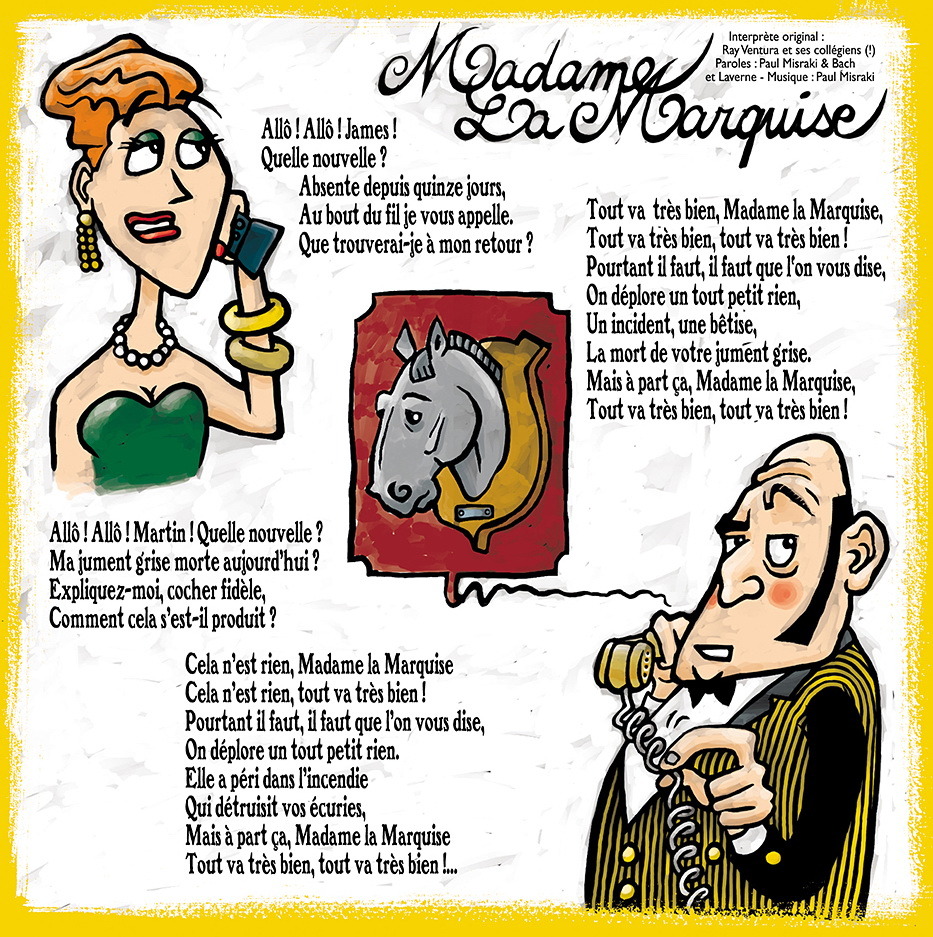
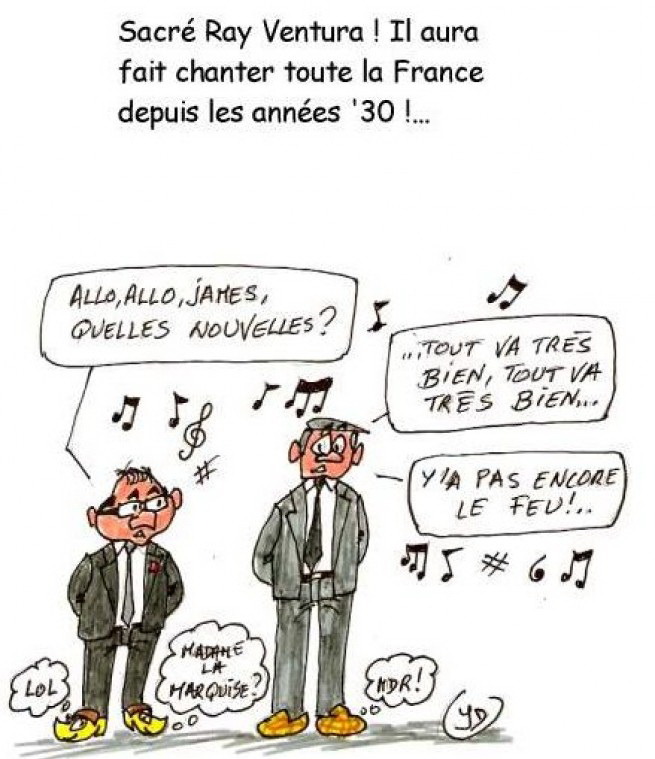
Allô, allô James ! Quelles nouvelles? Hello, hello James!  What news ?
Absente depuis quinze jours, Absent for fifteen days,
Au bout du fil, je vous appelle : On the phone I'm calling you :
Que trouverai-je à mon retour? What will I find when I return?


Tout va très bien, madame la Marquise Everything is fine, Madame la Marquise,
Tout va très bien, tout va très bien Everything is fine, everything is fine.
Pourtant il faut, il faut que l'on vous dise But we must, we must tell you
On déplore un tout petit rien : We deplore a really little thing, 
Un incident, une bêtise, An incident, a foolish thing
La mort de votre jument grise The death of your gray mare,
Mais à part ça, Madame la Marquise But apart from that, Madame la Marquise
Tout va très bien, tout va très bien ! Everything is fine, everything is fine.


Allô, allô Martin! Quelles nouvelles? Hello, hello Martin! What news ?
Ma jument grise, morte aujourd'hui ? My gray mare dead today!
Expliquez-moi cocher fidèle, Explain to me  Faithful coach,
Comment cela s'est- il produit? How did this happen?


Cela n'est rien, madame la Marquise That's nothing, Madame la Marquise,
Cela n'est rien, tout va très, It's nothing, everything is fine.
Pourtant il faut, il faut que l'on vous dise Yet you have to, you have to tell you,
On déplore un tout petit rien : We deplore a tiny thing, 
Elle a périt dans l'incendie She perished In the fire
Qui détruisit vos écuries. Who destroyed your stables.
Mais à part ça, Madame la Marquise But apart from that, Madame la Marquise
Tout va très bien, tout va très bien ! Everything is fine, everything is fine.


Allô, allô Pascal ! Quelles nouvelles? Hello, Hello Pascal!  What news ?
Mes écuries ont donc brûlé? My stables have burned?
Expliquez-moi Mon chef-modèle, Explain to me My head cook, (Head Chef)
Comment cela s'est- il passé How did it go ?


Cela n'est rien, Madame la Marquise, That's nothing, Madame la Marquise,
Cela n'est rien, tout va très bien ! It's nothing, everything is fine.
Pourtant il faut, il faut que l'on vous dise But we must, we must tell you
On déplore un tout petit rien : We regret a tiny nothing:
Si l'écurie brûla, Madame, If the stable burned, Madam,
C'est qu'le château était en flammes. It's because the castle was burning.
Mais à part ça, Madame la Marquise But apart from that, Madame la Marquise
Tout va très bien, tout va très bien ! Everything is fine, everything is fine.


Allô, allô Lucas ! Quelles nouvelles ? Hello, hello Lucas! What news ?
Notre château est donc détruit ? Our castle is destroyed!
Expliquez-moi... Car je chancelle Explain to me Because I'm staggering
Comment cela s'est- il produit ? How did this happen?


Eh! bien voilà, Madame la Marquise Well, here, Madame la Marquise,
Apprenant qu'il était ruiné Learning that he was ruined,
A peine fut-il rev'nu de sa surprise Just recovering from the surprise
Qu’ Monsieur l'Marquis s'est suicidé The Marquis committed suicide,
Et c'est en ramassant la pelle **
And as he was falling down
Qu'il renversa toutes les chandelles That he toppled all the candles,
Mettant le feu à tout l'château Setting the castle on fire
Qui s'consuma de bas en haut Which burned from the bottom up
Le vent souflant sur l'incendie, The wind blowing on the fire,
Le propagea sur l'écurie, Spread it to the stable,
Et c'est ainsi qu'en un moment And that's how in a moment
On vit périr votre jument ! We saw your mare perish!


Mais, à part ça, Madame la Marquise, But, besides that, Madame la Marquise,
Tout va très bien! Tout va très bien ! Everything is fine, everything is fine.


** “Ramasser une pelle” = signifie tomber **  “Ramasser la pelle” = “to fall”

https://38.media.tumblr.com/55322dde195875ac4fc3e64c3fdd6ecd/tumblr_inline_nxxfh8Eys81sqnfhp_500.gif https://38.media.tumblr.com/55322dde195875ac4fc3e64c3fdd6ecd/tumblr_inline_nxxfh8Eys81sqnfhp_500.gif https://38.media.tumblr.com/55322dde195875ac4fc3e64c3fdd6ecd/tumblr_inline_nxxfh8Eys81sqnfhp_500.gif
Tout va très bien 
Madame La Marquise
Histoire et Analyse de la Chanson
Tout à fait d'actualité !
Un dialogue de ce type figure déjà, en plusieurs versions, dans les Contes populaires russes d'Alexandre Afanassiev (1871), sous le titre générique Khorocho, da khoudo (« Ça va bien, mais ça va mal »). En particulier la version numérotée 230f/417, intitulée en français par Lise Gruel-Apert « Tout va très bien ou le Noble ruiné », qui reproduit un dialogue entre un barine (châtelain) et son intendant, est très similaire au texte de la chanson. Ce texte, recueilli dans la province de Perm, avait été censuré dans la première édition du recueil. Le thème circule à travers toute l'Europe depuis le Moyen-Âge3, certaines des plus anciennes traces littéraires (en latin) ayant été retrouvées dans les Exempla de Pierre Alphonse (XIIe siècle) et ceux de Jacques de Vitry (XIIIe siècle).

L'origine (moderne) du refrain est attribuée à Bach et Laverne, auteur d'un sketch portant le même titre.

Sa création résulte, selon Paul Misraki lui-même [Tout va très bien, la vie d'un compositeur, manuscrit inédit] de l'échec d'une première soirée de tournée de Ray Ventura et ses Collégiens, dans le sud de la France. L'ambiance était morose, et l'orchestre ne parvenait pas à réchauffer la salle. Les musiciens catastrophés cherchaient tous une idée pour relancer le spectacle. C'est Coco Aslan qui semble avoir suggéré l'idée du « sketch avec la Lady écossaise ». Paul Misraki se mit alors au travail, trouva assez vite le « départ » (les premières notes), puis composa toute la nuit, avec comme compagnon un camembert, qu'il mangea en entier. Au petit matin, le compositeur s'accorda une ultime fantaisie : le « pont » qui commence par « un incident, une bêtise... », en rupture totale avec le rythme et l'ambiance de la chanson jusque-là. Et le soir, ce fut un triomphe.
https://78.media.tumblr.com/b2a573d125e305580607c03315761706/tumblr_pe57d1i3K71urtgw2o8_1280.jpg
https://38.media.tumblr.com/55322dde195875ac4fc3e64c3fdd6ecd/tumblr_inline_nxxfh8Eys81sqnfhp_500.gif https://38.media.tumblr.com/55322dde195875ac4fc3e64c3fdd6ecd/tumblr_inline_nxxfh8Eys81sqnfhp_500.gif https://38.media.tumblr.com/55322dde195875ac4fc3e64c3fdd6ecd/tumblr_inline_nxxfh8Eys81sqnfhp_500.gif
חוץ מזה הכל בסדר - צמד העופרים
Découvrir l’adaptation en hébreu de la chanson par Dan Almagor, interprétée par Esther & Abi Ofarim en 1962
https://38.media.tumblr.com/55322dde195875ac4fc3e64c3fdd6ecd/tumblr_inline_nxxfh8Eys81sqnfhp_500.gif https://38.media.tumblr.com/55322dde195875ac4fc3e64c3fdd6ecd/tumblr_inline_nxxfh8Eys81sqnfhp_500.gif https://38.media.tumblr.com/55322dde195875ac4fc3e64c3fdd6ecd/tumblr_inline_nxxfh8Eys81sqnfhp_500.gif
Tout va très bien, Madame la Marquise, sous les ressorts populaires d’un divertissement musical, avec son refrain en fanion sonore, devient la rengaine d’une dérision de l’ignorance volontaire, au temps de l’installation du nazisme ; d’une allusion au déni satisfait des signaux des malheurs qui s’avancent.  

Ce que Freud pointait déjà, lorsqu’il dénonçait dans ses Conférences de 1932, ces «méchantes illusions dont les hommes attendent un embellissement et un allégement de leur vie, alors qu’elles n’apportent en réalité que dommage».

Le succès de Tout va très bien, Madame la Marquise n’eut hélas pas plus d’effet que ce qu’Éric Fromm disait du chœur de la tragédie grecque: «commenter le cours tragique des événements sans avoir le pouvoir d’ l’infléchir»
C’était en 1935!
Tout à fait d'actualité!

Chantée à trois voix à l'origine, la chanson raconte une conversation téléphonique entre une vieille aristocrate et son valet James qui lui fait part des catastrophes survenues dans son château pendant son absence de deux semaines (de manière antéchronologique, depuis la mort de sa jument jusqu'au suicide de son mari, chacune de ces catastrophes étant la conséquence directe de la précédente, plus grave encore).
https://78.media.tumblr.com/da5f959ffc34d307a9f2005e7d56ad89/tumblr_inline_pe2vf6iZO31sqnfhp_1280.jpg
Ses auteurs, Charles Bach et Henry Laverne, et son interprète, Ray Ventura, se moquaient par là de l’optimisme forcené que montraient les gouvernements français successifs devant la montée du nazisme. La création des premiers camps de concentration, l’incendie du Reichstag, les lois de Nuremberg… n’inspiraient aucune inquiétude. Il était plus facile de dire que « tout allait bien » ! Cette indifférence française participa à l’enchaînement d’autres événements historiques hors de France, telles la guerre d’Espagne ou l’invasion de la Tchécoslovaquie et de la Pologne. Tout continuait à aller bien en France… jusqu’au 10 mai 1940, où l'on cessa de chanter.

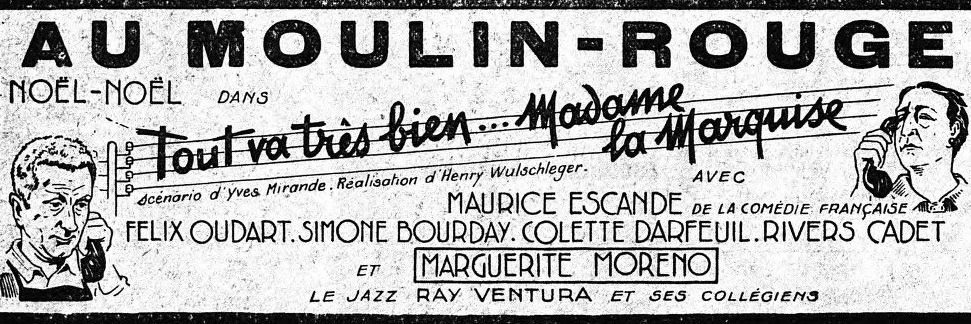
Au même titre que le film de Renoir La Règle du jeu, Tout va très bien madame la marquise est devenu un raccourci historique pour dépeindre l'immédiate avant-guerre (années 1935-1939) en France et peut-être plus particulièrement les accords de Munich (septembre 1938). Dès l'année suivant son enregistrement (22 mai 1935), la formule fait déjà florès auprès des journalistes. L'expression « Tout va très bien monsieur Herriot » est employée au moment des grèves de juin 1936. Ce sera ensuite « Tout va très bien Monsieur Mussolini. » 

Et enfin Tout va très bien mon Führer sur les ondes de Radio-Londres .
La chanson a été adaptée en russe dès 1935 par Alexandre Bezymenski, et interprétée dans cette langue notamment par Leonid Outiossov, en duo avec sa fille Edith ; en hébreu, par Dan Almagor ; en allemand (Heinrich Pfandl, 2010), et en italien.
Tout va très bien Madame la Marquise
Version Hollande

Paul Misraki continuera toute sa vie à avoir du mal à assumer ce fulgurant succès (il avait 28 ans, et la chanson s'est faite en une nuit), plusieurs de ses écrits mentionnant cette chanson comme un « incident », justement.

Tout va très bien Madame la Banquise
(clip officiel Dominique Dimey)

Pour les plus jeunes, le clip officiel de l'album "Tout va très bien Madame la Banquise". Un album, plein d’énergie qui convaincra petits et grands, qu’ensemble il est possible d’agir et de protéger notre planète. 12 titres aux rythmes colorés, aux paroles qui font mouche. Des chansons porteuses d’espoir, passerelles pour parler avec les plus jeunes du réchauffement climatique, de la solidarité, leur apprendre à penser le monde autrement, et leur donner envie de s'engager pour la planète...

https://78.media.tumblr.com/86b21b875e0c5f25c4f1220be1727d50/tumblr_pe57d1i3K71urtgw2o1_1280.jpg
https://38.media.tumblr.com/55322dde195875ac4fc3e64c3fdd6ecd/tumblr_inline_nxxfh8Eys81sqnfhp_500.gifhttps://38.media.tumblr.com/55322dde195875ac4fc3e64c3fdd6ecd/tumblr_inline_nxxfh8Eys81sqnfhp_500.gifhttps://38.media.tumblr.com/55322dde195875ac4fc3e64c3fdd6ecd/tumblr_inline_nxxfh8Eys81sqnfhp_500.gif
https://78.media.tumblr.com/95c2188c30703303782fceee2cc151c8/tumblr_pe580sPQCD1urtgw2o4_640.jpg
https://38.media.tumblr.com/55322dde195875ac4fc3e64c3fdd6ecd/tumblr_inline_nxxfh8Eys81sqnfhp_500.gif https://38.media.tumblr.com/55322dde195875ac4fc3e64c3fdd6ecd/tumblr_inline_nxxfh8Eys81sqnfhp_500.gif https://38.media.tumblr.com/55322dde195875ac4fc3e64c3fdd6ecd/tumblr_inline_nxxfh8Eys81sqnfhp_500.gif