Search This Blog

Tuesday, October 6, 2009

Digital Photography 📷 for Dummies

Digital Photography for Dummies
Category: Photography Tips
Written on Jan 31, 2008 by Sandro Dzneladze
Are you planning to buy a digital camera? Do you already have a digital camera? If both answers are yes then this basic tips and tricks are for you.
Digital photography seems easy to the amateur compared to analogue film cameras but taking really good photos requires knowledge and understanding of photography.
Here are the basics along with some tips and tricks to produce better digital photos. Here I will go through the following aspects:

- Storage and Image Quality
- Memory
- Battery Power
- Exposure
- Focus
- Depth of field
- Zooming
- Flash
- LCD View finder
 

Storage and image quality:
Most digital cameras allow you to reduce their resolution or increase the compression to get more images on to the memory card. However, both these will reduce quality. Unless you have a very small memory card, select the highest resolution pictures and lowest Jpeg compression settings.
When it comes to how much resolution you need, it depends on how much detail you want to capture. More mega pixels means higher detail and bigger enlargements or crops before you the image starts to become pixelated.
For a 3R size photo 1024*786 resolution should be just fine.
 

Memory:
Memory is an important part of digital photography but will become less of an issue in the future as storage capacities become larger and larger. Storage capacity dictates how many pictures you can take and how high a resolution they can be.
There are several memory card formats available for different cameras.
· Smart Media
· Compact Flash
· xD
· MS
· SD
· MMC

I’d recommend buying a 1GB memory card.
Memory cards can be erased and reused but you’ll want to back up your images first. Most people copy their snaps on to a PC or laptop.
Battery:
The lifespan of digital camera batteries depending on the model and usage, but one to four hours of solid use is about standard. In practice you’ll power down the camera between pictures, allowing you to take around 50 photos over a period of several days.
Tips to save your battery:
· Switch off the flash
· Do not use the LCD view finder.
· Switch off button beeps and other sound effects.
· Use high drain rechargeable batteries such as Ni-MH 2300mAh because disposable alkaline AA cells won’t last long in a digital camera
· Use a card reader to move pictures onto your PC instead of connecting the camera and using its batteries.
· If you own a SLR digital camera, purchase a spare battery and the battery grip attachment.
 

Exposure:
All digital cameras have an auto setting which calculates what it anticipates will be the most suitable exposure. Most devices get it about right, but mistakes happen. There will also be times when you want a darker or brighter result.

Deliberately underexposing an image can be an affective way of cutting through haze or bringing out a colorful sunset. Overexposing is also handy if your subject is dark and you can’t or don’t want to use a fill-in flash. Remember to set the exposure compensation back to zero afterwards though. 

Focus:
Digital cameras have an auto focus mode but, as with auto exposure, this can go wrong. A common problem is where the subject in the foreground is out of focus, but the background is in sharp focus. It’s clear that the camera has focused on the background by mistake.
The first time you try this it’s easy to press the button all the way and accidentally take the photo early. It takes practice to learn the right pressure, but at least a digital camera lets you delete the pictures that went wrong.

Depth of field is a technical term referring to how much of the picture is in focus. A large depth of field has lots in focus, while a shallow depth of field only has the main subject in focus.
The depth of field is controlled by the lens aperture, described by its f-number. Smaller f-numbers mean shallower depths of field; larger f.numbers mean larger depths of field. Digital cameras generally have a range of f-numbers between f2.8 and fl1. (You can read more about DOF here.)

Zooming:
Most digital cameras are fitted with optical and digital zoom facilities. It’s best to disable the digital zoom as it just crops the centre of the picture and enlarges it, thereby losing quality, The optical zoom uses lenses to get closer to a subject with no loss in quality, but zooming in and out also has other effects.


Camera Flash:
The key to using the flash is to understand its limitations. Built-in flashes are only effective over a distance of a few short metres and, beyond this, have no effect at all. Unless your subject is within a few metres, you might as well switch off the flash. It’s also a good idea to switch off the flash when shooting through windows to avoid reflection.
LCD View finder:
A big advantage of digital cameras is being able to use the LCD screens to check a photo immediately after taking it. This is invaluable for checking exposure, and composition, not to mention potentially blinked eyelids. Beware, though, as the screen resolution is too low to confirm whether a picture is definitely in focus. So if you’ve got a particularly important shot, play it back afterwards and zoom in closely to ensure everything’s fine.

Digital Photography All-In-One For Dummies
📷
Digital SLR Cameras & Photography For Dummies

Tuesday, March 10, 2009

Tuesday, February 10, 2009

Les Moulins de Mon Cœur💔Windmills of Your Mind

Les Moulins de Mon Cœur
The Windmills of Your Mind
https://64.media.tumblr.com/4921320b75e842111793dc301adb1a61/ad66e62a5ae32edf-6d/s640x960/46638809782913b8aea17fb1952fabb93b2357ef.jpg
"The Windmills of Your Mind" is a song with music by French composer Michel Legrand and English lyrics written by Americans Alan Bergman and Marilyn Bergman
The French lyrics, under the title "Les Moulins de Mon Cœur", were written by Eddy Marnay.

The song (with the English lyrics) was used as the theme for the 1968 film, The Thomas Crown Affair.
https://64.media.tumblr.com/f47449ced27318de896f2cf43867771f/ad66e62a5ae32edf-e8/s1280x1920/86a6db7238bd851767caeb4c09b7e93df771d536.jpg
The opening two melodic sentences were borrowed from Mozart's second movement from his Sinfonia Concertante for Violin, Viola and Orchestra, K. 364.

In the original 1968 film the song was performed by Noel Harrison who took the song to #8 in the UK Singles Chart. It won the Academy Award for Best Original Song in 1968.
A version by Sting was used in the 1999 remake of The Thomas Crown Affair.

Dusty Springfield's version of the song from her album Dusty in Memphis is also well known; this version reached #31 on the US Billboard Hot 100 chart and #3 on the Billboard adult contemporary chart in 1969.  This recording also appeared on the soundtrack to Breakfast on Pluto (2006).
The song has been interpreted by a large number of singers, instrumentalists, and orchestras.
👇 ♪  📽️ ♪ 👇

Michel Legrand 
The Thomas Crown Affair(1968) 

  • Dusty Springfield  1969 HD
  • Barbra Streisand   2011
  • Mireille Mathieu &  Michel Legrand - Duo
  • Amaury Vassili  
  • Michel Legrand
  • Tina Arena -  (Live)
  • Frida Boccara - 
  • Nana Mouskouri - 
  • Claude François   + Paroles
  • Patricia Kaas 
  • Barbra Streisand   2011
  • Sting 
  • Vicky Leandros
  • Sharleen Spiteri  + Lyrics
  • Noel Harrison
  • The Windmills Of Your Mind
  • Les Moulins de Mon Coeur 
  • Dusty In Memphis
Noel Harrison
👇 ♪  📽️ ♪ 👇

https://64.media.tumblr.com/40a6ebf61f6304034e4423edf731561b/ad66e62a5ae32edf-ac/s640x960/8269383bfb966e723e8224efce87a8d517e176de.jpg
Is there a definitive meaning to this song?
The most revealing line is:  "When you knew that it was over, you were suddenly aware that the autumn leaves were turning to the color of her hair"

Is it about the emotional turmoil caused by a relationship ending (abruptly?); endlessly re-winding to when you were so in love that everything else in life was a blur, and going round & round in circles over what went wrong and what you might have done differently?
Something we can all relate to.

One of the song's writers, Marilyn Bergman, said: "The lyric we wrote was stream-of-consciousness. "We felt that the song had to be a mind-trip of some kind.  "I think we were thinking… you know when you try to fall asleep at night and you can't turn your brain off and thoughts and memories tumble."

Life in the 60's was a constant whirl

Les Moulins de Mon Cœur
Les Moulins de Mon Coeur
The Windmills Of Your Mind
Michel Legrand - Musique
Michel Legrand - Music
Paroles: Eddy Marnay
Lyrics: Bergman, Marilyn / Bergman, Alan
Comme une pierre que l'on jette
Round,
Dans l'eau vive d'un ruisseau
Like a circle in a spiral
Et qui laisse derrière elle
Like a wheel within a wheel
Des milliers de ronds dans l'eau
Never ending or beginning
Comme un manège de lune
On an ever-spinning reel
Avec ses chevaux d'étoiles
Like a snowball down a mountain


Or a carnival balloon
Comme un anneau de Saturne

Un ballon de carnaval
Like a carousel that’s turning
Comme le chemin de ronde
Running rings around the moon
Que font sans cesse les heures
Like a clock whose hands are sweeping
Le voyage autour du monde
Past the minutes on it’s face
D'un tournesol dans sa fleur
And the world is like an apple
Tu fais tourner de ton nom
Whirling silently in space
Tous les moulins de mon cœur
Like the circles that you find


In the windmills of your mind
Comme un écheveau de laine

Entre les mains d'un enfant
Like a tunnel that you follow
Ou les mots d'une rengaine
To a tunnel of it’s own
Pris dans les harpes du vent
Down a hollow to a cavern
Comme un tourbillon de neige
Where the sun has never shone
Comme un vol de goélands
Like a door that keeps revolving
Sur des forêts de Norvège
In a half-forgotten dream
Sur des moutons d'océan
Like the ripples from a pebble


Someone tosses in a stream
Comme le chemin de ronde

Que font sans cesse les heures
Like a clock whose hands are sweeping
Le voyage autour du monde
Past the minutes on it’s face
D'un tournesol dans sa fleur
And the world is like an apple
Tu fais tourner de ton nom
Whirling silently in space
Tous les moulins de mon cœur
Like the circles that you find


In the windmills of your mind
Ce jour-là près de la source

Dieu sait ce que tu m'as dit
Keys that jingle in your pocket
Mais l'été finit sa course
Words that jangle in your head
L'oiseau tomba de son nid
Why did summer go so quickly?
Et voila que sur le sable
Was it something that I said?
Nos pas s'effacent déjà
Lovers walk along a shore
Et je suis seul à la table
And leave their footprints in the sand
Qui résonne sous mes doigts


Was the sound of distant drumming
Comme un tambourin qui pleure
Just the fingers of your hand?
Sous les gouttes de la pluie
Pictures hanging in a hallway
Comme les chansons qui meurent
Or the fragment of a song
Aussitôt qu'on les oublie
Half-remembered names and faces
Et les feuilles de l'automne
But to whom do they belong?
Rencontre des ciels moins bleus
When you knew that it was over
Et ton absence leur donne
Were you suddenly aware
La couleur de tes cheveux
That the autumn leaves were turning


To the colour of her hair?
Une pierre que l'on jette

Dans l'eau vive d'un ruisseau
Like a circle in a spiral
Et qui laisse derrière elle
Like a wheel within a wheel
Des milliers de ronds dans l'eau
Never ending or beginning
Au vent des quatre saisons
On an ever-spinning reel
Tu fais tourner de ton nom
As the images unwind
Tous les moulins de mon cœur
Like the circles that you find


In the windmills of your mind

Thursday, July 10, 2008

Animusic 🎼 Visual Music

AniMusic 🎼Visual Music
http://68.media.tumblr.com/254eb9e9e37b311bb5630c8cb09feac5/tumblr_inline_ohqbc1sbvS1sqnfhp_1280.jpg
Animusic is a renowned animation company specializing in the 3D visualization of MIDI-based music. Unlike traditional visualizers that react to audio frequencies, Animusic’s proprietary software, MIDIMotion, uses MIDI data to drive the physical movements of virtual instruments, ensuring every sound corresponds exactly to an on-screen action.
https://68.media.tumblr.com/256cbf932fdeba36db1aad752ced7ad1/tumblr_ohqa0y2Gpv1urtgw2o2_400.gif
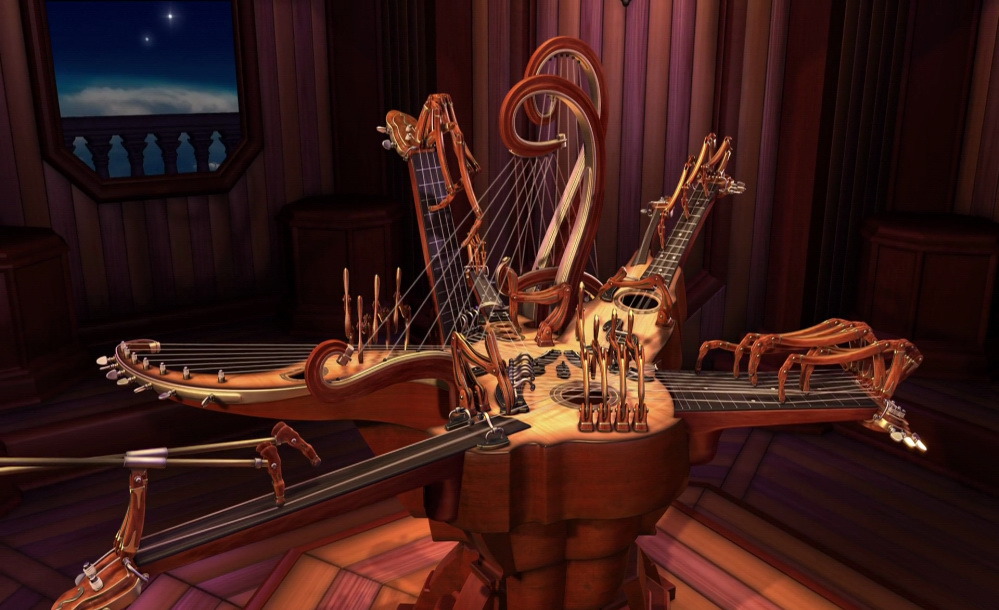
Resonant Chamber (Animusic)
Remastered 4K 60FPS 
👇   🎼   👇
Key Facts and History
  • Founder: Computer animator and scientist Wayne Lytle founded the company in 1990 (originally as Visual Music).
  • Breakthrough: Their most famous work, "Pipe Dream," featuring a complex Rube Goldberg-style machine that fires balls at percussion instruments, became a viral sensation and even sparked rumors that it existed in real life.
  • Major Releases:
    • Animusic (2001): The debut video album featuring tracks like Future Retro, Aqua Harp, and Drum Machine.
    • Animusic 2 (2005): The sequel included popular pieces such as Starship Groove and Resonant Chamber.
  • Current Status: While the company is largely dormant, a third installment (Animusic 3) has been in development for years following a successful but troubled Kickstarter campaign. 
Notable Virtual Instruments
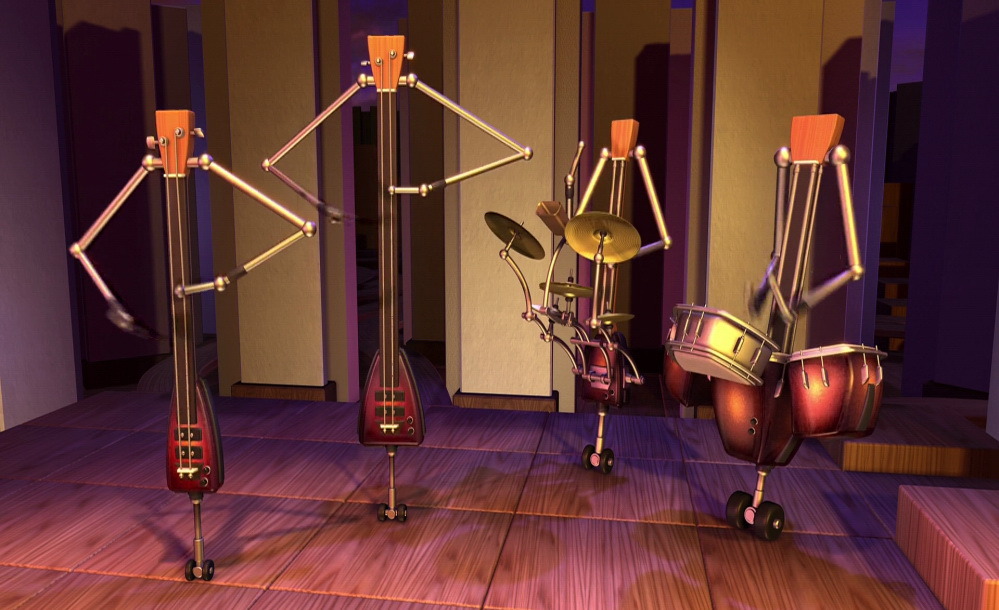
  • The Stick Figures: Bouncy, spring-like instruments that "walk" and perform on specialized platforms.
  • Resonant Chamber: A self-playing, multi-stringed instrument housed in a mysterious, dark chamber.
  • Aqua Harp: A serene, water-powered instrument that plays delicate melodies. 
For a look at the 'runaway hit' that defined the series and its innovative mechanical visualization
"Pipe Dream" - Animusic.com
http://68.media.tumblr.com/5891fcb5cd4289bcd825163ef8882a0a/tumblr_inline_ohqbbmbeuP1sqnfhp_1280.jpg
AniMusic 🎼 Visual Music
Playlist
👉          👉    Click  Below  to   Choose  a  👇  Video 

           Click  👆 to SKIP to another Video
# AniMusic 🎼 Visual Music Time Views
1 Resonant Chamber (Animusic) - Remastered 4K 60FPS 4:31 1.9M views • 3 years ago
2 Pogo Sticks (Animusic) - Remastered 4K 60FPS 3:20 3.9M views • 3 years ago
3 Making Animated Percussion In Real Life - Animusic Pipe Dream Tribute 10:50 205K views • 1 year ago
4 Pipe Dream (Animusic) - Remastered 4K 60FPS 3:24 13M views • 3 years ago
5 Cathedral Pictures (Animusic) - Remastered 4K 60FPS 6:07 2M views • 3 years ago
6 Animusic 1 & 2 ~ 4k 60fps Remastered! 1:18:22 210K views • 4 years ago
7 Starship Groove (Animusic) - Remastered 4K 60FPS 4:06 1.6M views • 3 years ago
8 Full Circle - Original Music Animation 4:39 401K views • 1 year ago
9 Animusic ~ Beyond the Walls 1996 (Remastered 4k 60fps) 4:39 119K views • 4 years ago
10 Stick Figures (Animusic) - Remastered HD 60FPS 5:21 1.6M views • 3 years ago
11 Heavy Light (Animusic) - Remastered 4K 60FPS 6:28 1.2M views • 3 years ago
12 Animusic 3: What ACTUALLY Happened - Krazy Ken's Tech Talk 16:14 183K views • 4 years ago
13 Gyro Drums (Animusic) - Remastered 4K 60FPS 4:11 1.4M views • 3 years ago
14 Rails - Original Music Animation 4:08 112K views • 1 month ago
15 ANIMUSIC - Future Retro - HD Recreation 4:50 62K views • 9 months ago
16 Animusic "UHD" 4K 60fps (upscaled from blu-ray): Pipe Dream and more 42:03:00 436 views • 3 years ago
17 Acoustic Curves - Animusic 1 - HD Recreation 5:39 55K views • 2 years ago
18 Future Retro - Animusic Cover With Marbles 3:21 242K views • 1 year ago
19 animusic the harvester 6:08 47K views • 1 year ago
20 Drum Machine - Animusic 1 - HD Recreation 3:26 142K views • 2 years ago
21 Animusic - Starship Groove (but I made the audio entirely on my phone) 4:06 54K views • 2 years ago
22 Pipe Dream - Animusic.com 3:29 16M views • 17 years ago
*
*
https://68.media.tumblr.com/da4a10748dca45d809b2d420ba6cd377/tumblr_ohqa0y2Gpv1urtgw2o8_400.gif
 

https://68.media.tumblr.com/256cbf932fdeba36db1aad752ced7ad1/tumblr_ohqa0y2Gpv1urtgw2o2_400.gif
Animusic, LLC is a dormant animation company specializing in the 3D visualization of MIDI-based music. Founded by Wayne Lytle in 1990, it is currently a registered limited liability company in New York and had offices in Texas and California during its active stages. The initial name of the company was Visual Music, but was changed to Animusic in 1995.

The company is known for its Animusic compilations of computer-generated animations, based on MIDI events processed to simultaneously drive the music and on-screen action, leading to and corresponding to every sound. The animated short "Pipe Dream," showed at SIGGRAPH's Electronic Theater in 2001, details the use of this specific sequencing.

Unlike many other music visualizations, Animusic uses MIDI information to drive the animation, while other 3D programs animate figures or characters to the music. Any animated models in Animusic are created first, and are then programmed to follow what the music, or MIDI information, instructs them to do.

Many of the instruments appear to be robotic or play themselves using seemingly curious methods to produce and visualize the original compositions. The animations typically feature dramatically-lit rooms or landscapes in rustic and/or futuristic locales.

The music in Animusic is principally pop-rock based, consisting of straightforward sequences of triggered samples and digital patches. According to the director's commentary track on Animusic 2, most instrument sounds are generated with software synthesizers on a music workstation. Many sounds resemble stock patches available on digital keyboards, subjected to some manipulation, such as pitch or playback speed, to enhance the appeal of their timbre

Software programs
According to the company's FAQ, animation is created procedurally with their own proprietary MIDImotion engine. Discreet 3D Studio Max was used for modeling, lighting, cameras, and rendering. Maps were painted with Corel Painter, Deep Paint 3D, and Photoshop. They have also created their own software called ANIMUSIC|studio that is based on scene-graph technology. According to an August 2015 newsletter, Animusic was using Unreal Engine 4 for the production of Animusic 3.

😲 What the F#%# Is Animusic? 😲
By Claire L. Evans - October 16, 2014