Search This Blog

Thursday, May 18, 2023

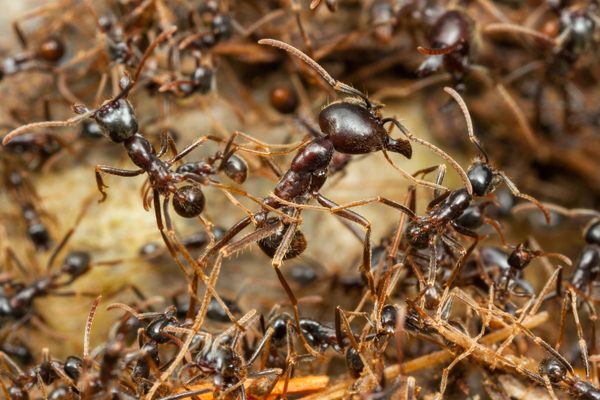
Natural Way to Get Rid of 🐜 Ants in Your House

Natural Way to Get Rid
of Ants in Your House
https://64.media.tumblr.com/cb25d9d12d84f295ed53ba784a7a1b3f/2a49171fc405dc48-97/s1280x1920/e59dd1fa02fc9974176a34fb792292d268b4714e.pnj
Tumblr: ImageTumblr: Image
Some pest repellents that you can find right in your kitchen cabinet or garden! Did you know, for example, that сinnamon can work as a double agent here? It makes your house smell like a dream and helps you defer ants at the same time. Another affordable thing ants totally hate is vinegar. You can spray it onto the ants, around the windowsills, doorways, and places that ants love. And, there’ll be no scent left behind after it dries!
Tumblr: Image        Tumblr: Image        Tumblr: Image
TIMESTAMPS: Citrus fruits  0:33 🐜  Cucumber slices  1:09 🐜 Peppermint  1:48 🐜 Cinnamon  2:12 🐜 Coffee grounds  2:51 🐜 Tansy  3:23 🐜 Diatomaceous earth  3:45 🐜 Chalk  4:19 🐜 Baking soda and powdered sugar  4:37 🐜 Cornmeal  5:12 🐜 Vinegar  5:34 🐜 Borax, water and sugar  6:01 🐜 Boiling water and dish soap  6:48 🐜  Mini moat  7:10 🐜
Tumblr: Image
Tumblr: Image
SUMMARY:
- You might love the smell of oranges, lemons, and grapefruit, but ants just can’t stand it! Use this knowledge to your advantage.
- Similar to citrus fruits, cucumbers smell like trouble to ants. Apparently, there’s something in their chemical composition that eliminates the fungi that ants love a lot.
- If you have ants in your kitchen and bathroom, you can repel them using peppermint essential oil. Sprinkle cotton balls with a few drops and leave them in areas where the ants hang out.
- If you mix cinnamon oil with water in a spray bottle and sprinkle it on ant trails, windows, doors and cracks, it’ll have an even stronger effect.
- Before you throw away used coffee grounds after you enjoy a hot cup, remember they can, in fact, be of good use to you. Put them right in the cracks, sprinkle them around the flower bed, or even the entire base of your house.
- Tansy flowers might look cute to you but not to the ants! Plant it near your front door, under full or indirect sun and in pretty dry soil, or among other plants you want to protect from ants.
- Food grade diatomaceous earth is a fine silica powder of fossilized algae. It’s perfectly safe for humans, but dangerous for insects.
- No ant shall pass a border made of chalk, since they can’t walk across powdery materials.
- Ants love sugar but can’t stand baking soda. The smell of sugar will attract them, and baking soda will say “hi” to their digestive system, and the results are pretty dramatic for them.
- Cornmeal isn’t the quickest way to ruin an ant colony, but it’s completely harmless to humans and super cheap, so you might want to give it a go.
- Make a thin paste of powdered Borax laundry booster, sugar and water in equal parts. Put a few tablespoons of it on a jar lid and set the bait. This solution attracts all possible kinds of ants with its sugary smell.
- Another ant secret they don’t want you to know is that they just hate hot water. Yes, something as simple as that makes them tremble with fear.
- Most ants just go for the food, but some love plants, both potted and planted ones. To prevent them from building a home in what’s adding aesthetics to your own home, try setting up a moat filled with water, much like people did in ancient times building fortresses. 

Tumblr: Image  🌷 🌹 💐Lavender Peppermint Rosemary Bay leaves Thyme oil Basil Eucalyptus Catnip Lemon Grass Citronella
Other videos you might like: 
If You Get This Plant at Home, You’ll Never See Mice, Spiders, or Ants Again • If You Get This P...   
10 Natural Ways to Get Rid of Ants And Bugs In Your House  • 10 Natural Ways t...   
10 Bug Bites You Should Be Able to Identify • Video  
Tumblr: Image
Subscribe to Bright Side : https://goo.gl/rQTJZz 
Our Social Media: Facebook: https://www.facebook.com/brightside/ 
5-Minute Crafts Youtube: https://www.goo.gl/8JVmuC
Tumblr: Image   Tumblr: ImageTumblr: ImageTumblr: Image
                                       

Tuesday, May 16, 2023

Plants to Rid of Bugs🐜Insects 🕷️ Etc.

Keep These Plants
To Get Rid of 
Ants, Bedbugs, Spiders, Mice, & Insects
https://64.media.tumblr.com/9eccd643808bfbe6c4a9f761d2912301/a7fb9c8714f6c838-bb/s1280x1920/95f225ac13d21203628e823e56d2b8247ca200ce.pnj
🐜🕷️🦗 🪰🐞 🐀 🪲 🐜🪳 🕷️🐁🦗
🐜🕷️🦗 🪰🐞 🐀 🪲 🐜🪳 🕷️🐁🦗
https://youtu.be/DgWvaCl2Idk
If you want to get rid of insects, bedbugs, spiders, cockroaches, mice and ants, keep this plant at your home!
According to scientific research, there are harmful chemicals found in pest repellents that can be dangerous to you and to your pets. Luckily, there are many plants that are known to repel pests, spiders, mice and ants.
Here are some readily available plants and herbs that are known to repel those annoying pests.

1. Lavender
https://64.media.tumblr.com/5c77e589bb8e26c528edf46dc2286fc9/d2a2f5455ca86603-ab/s2048x3072/4a1a93939be5e2aea1c5b4e7642c71f7e04306f1.jpg
Lavender is a plant that has been in use for a long time to add a sweet scent and fragrance to homes and clothe wardrobes. Although the smell of lavender is pleasant to people,
spiders and other undesirable insects loathe the smell. Place tied bouquets in strategic areas in your home or plant them in sunlit areas of your garden to keep the area pest free.
 
2. Peppermint
Tumblr: Image
You can get rid of those
creepy crawly bugs and mice with a mixture of water and mint. You may like the scent of mint but definitely mice and bugs don’t. Scent of mint irritates mice’s nose and blocks their trail pheromones.  Basically, what you need to do is apply a small quantity of peppermint oil to areas where insects and mice might reach, for example, furniture, clothes and even your skin.
You can also place cotton bods soaked with a few drops of peppermint oil in the corner of your room or other strategic areas.
 
3. Rosemary
Tumblr: Image
The rosemary plant comes in several forms and is effective as an insect or bedbug repellent. It can be grown in a garden bed or indoors in a container. A simple way of creating a repellent spray from the plant is adding a cup of dried rosemary to water to be boiled, then squeezing the water from the rosemary plant into another container of cold water. Finally, store the rosemary water in the refrigerator and add it to spray or squirt bottles. It’s a walk in the park.
 
4. Bay Leaves
 Tumblr: Image
Bay leaves are common ingredients in sauces and soups but they can also act as a natural insect repellent. When you sprinkle dried bay leaves around your home, they can be as effective in keeping off annoying insects as some common insecticide sprays would. However, the advantage is that there are no toxins involved and they are safe to be used in homes that have pets and children present.
 
5. Thyme Oil
Tumblr: Image
Carvacrol and alpha-terpinena are compounds that come from the essential oil of thyme and are found to have good repellent characteristics. Studies have shown that when thyme oil is applied to the skin, it provides a 90% protection rate against mosquito and insect bites.  In case of camping, putting some amount of fresh thyme in a campfire can provide protection for up to 2 hours. Pretty cool, right?
 
6. Basil
Tumblr: Image
Basil is known to add a delicious taste to salads, numerous pork, and chicken recipes. In addition, you can produce an insect repellent or spray using fresh Basil so that your summer fun is not disturbed by pesky insects. This homemade insect repellent calls for a small quantity of Vodka which is used as a carrier.  Mix some vodka with the liquid obtained from the Basil and shake gently. The mixture can be sprayed on the skin or clothes to repel those insects that trouble you.
 
7. Eucalyptus 
Tumblr: Image
Mice cannot withstand strong odors, and this makes eucalyptus oil a good mean to keep them away. You can simply apply a few drops in the areas where you have discovered mice droppings or you can fill your home with the scent of the Eucalyptus oil using a diffuser. This is pleasant to humans, but a terrible and deadly smell to mice and rodents

8. Catnip
Tumblr: Image
There are essential oils found in the catnip plants which have the ability to repel termites and bedbugs. Recent research from the U.S Department of Agriculture shows that termites would not burrow under a soil that has the presence of a catnip plant. Catnip which has a scent that attracts cats is repulsive to termites, ants, and mosquitoes. The plant contains nepetalactone, a terpene that is proven to be very effective at fending off insects.
 
9. Lemon Grass
https://64.media.tumblr.com/1ec0ae24be4f56af868c5999fa4f8223/2c1c7e4c73dcd4bd-de/s1280x1920/f9539c924f478f08f2599716ef99a48a05126b0e.jpg
Citronella is found in Lemongrass as natural oil and has the ability to keep ants, spiders, and other insects away. Whether you are attempting to keep away those pesky midges or bloodsucking
mosquitoes, citronella oil can help you keep those bugs at bay.
🐜🕷️🦗 🪰🐞 🐀 🪲 🐜🪳 🕷️🐁🦗
https://64.media.tumblr.com/83ef2b36b09cb882d56e7d2ccaff2830/a7fb9c8714f6c838-d5/s1280x1920/59a46db67b026f469a5949424dfafc90c44f7b70.pnj   
                                      

Saturday, May 13, 2023

Friday, May 12, 2023

Mother's👩‍👧‍👧Dictionary📖

📕 A Mother's Dictionary 📖

Bottle Feeding: 
An opportunity for Daddy to get up at 2 am too.

Drooling: 
How teething babies wash their chins.

Dumbwaiter:  
One who asks if the kids would care to order dessert.

Family Planning: The art of spacing your children the proper distance apart to keep you on the edge of financial disaster

Feedback:  
The inevitable result when the baby doesn't appreciate the strained carrots.

Full name: 
What you call your child when you're mad at him.

Grandparents: The people who think your children are wonderful even though they're sure you're not raising them right.

Hearsay: 
What toddlers do when anyone mutters a dirty word.

Impregnable:  
A woman whose memory of labor is still vivid.

Independent: 
How we want our children to be as long as they do everything we say.

Look out: 
What it's too late for your child to do by the time you scream it.

Prenatal:  
When your life was still somewhat your own.

Prepared Childbirth: 
A contradiction in terms.

Puddle:  
A small body of water that draws other small bodies wearing dry shoes into it.

Show off:  
A child who is more talented than yours.

Sterilize: 
What you do to your first baby's pacifier by boiling it and to your last baby's pacifier by blowing on it.

Storeroom:  
The distance required between the supermarket aisles so that children in shopping carts can't quite reach anything.

Top bunk: 
Where you should never put a child wearing Superman jammies.

Two-minute warning: 
When the baby's face turns red and she begins to make those familiar grunting noises.

Whodunit:  
None of the kids that live in your house.

Whoops:  
An exclamation that translates roughly into "get a sponge."

Things Mom Would Never Say

"How on earth can you see the TV sitting so far back?"

 "Yeah, I used to skip school a lot, too"

 "Just leave all the lights on ... it makes the house look more cheery"

"Let me smell that shirt -- Yeah, it's good for another week"

"Go ahead and keep that stray dog, honey. I'll be glad to feed and walk him every day"

"Well, if Timmy's mom says it's OK, that's good enough for me."

"The curfew is just a general time to shoot for. It's not like I'm running a prison around here."

"I don't have a tissue with me ... just use your sleeve"
       
"Don't bother wearing a jacket - the wind-chill is bound to improve"
 
History and Etymology for mother
Noun (1), Adjective, and Verb
Middle English moder, from Old English mōdor; akin to Old High German muoter mother, Latin mater, Greek mētēr, Sanskrit mātṛ
 
 
The definition of a mother is a woman who gives birth or who has the responsibility of physical and emotional care for specific children.

Thursday, May 11, 2023

What a Difference🎩a Century Makes!

The  Year  is  1910
https://64.media.tumblr.com/050f57587acbe84985d7d84740167b97/7591c0d176e8218f-c2/s1280x1920/853f4a0a0ba19b3da2de6e95a327c7cfcf0baa15.jpg
100 + Years Ago In America
What a Difference a Century Makes!!

Here are some statistics for the Year 1910:
  • The average life expectancy for men was 47 years.
  • Fuel for this car was sold in drug stores only.
  • Only 14 percent of the homes had a bathtub.  
  • Only 8 percent of the homes had a telephone.
  • There were only 8,000 cars and only 144 miles of paved roads.
  • The maximum speed limit in most cities was 10 mph.
  • The tallest structure in the world was the Eiffel Tower!
  • The average US wage in 1910 was 22 cents per hour.
  • The average US worker made between $200 and $400 per year.
  • A competent accountant could expect to earn $2000 per year,
https://64.media.tumblr.com/aa52fe440f3f53a0880895f25b3b181e/7591c0d176e8218f-e0/s500x750/3d07af2b15594a2a66f98f60c2732bc2c5e1c1fb.jpg
  • A dentist $2,500 per year, 
  • A veterinarian between $1,500 and $4,000 per year
  • A mechanical engineer about $5,000 per year.
  •  Ninety percent of all Doctors had NO COLLEGE EDUCATION!  Instead, they attended so-called medical schools, many of which were condemned in the press AND the government as 'substandard.'
  •  More than 95 percent of all births took place at HOME.
  • Sugar cost four cents a pound.
  • Eggs were fourteen cents a dozen.
  • Coffee was fifteen cents a pound.
  • Most women only washed their hair once a month, and used Borax or egg yolks for shampoo.
  • Canada passed a law that prohibited poor people from entering into their country for any reason.
https://64.media.tumblr.com/0774bb15ddbcf437cffa037cb6643a09/7591c0d176e8218f-95/s2048x3072/aff50e474beabf7357619572a011a5b94d358964.jpg
The Five leading causes of death were:
1. Pneumonia and influenza
2. Tuberculosis
3. Diarrhea
4. Heart disease
5. Stroke
https://64.media.tumblr.com/51c8d6a72cb373d92f6e3b109872c702/7591c0d176e8218f-cc/s2048x3072/37b241fcb6ecabf5e5ceeaf39c36a53f5dc9824a.jpg
  • The American flag had 45 stars...
  • The population of Las Vegas, Nevada, was only 30!!!!
  • Crossword puzzles, canned beer, and iced tea hadn't been invented yet. 
  • There was no Mother's Day or Father's Day.
  • Two out of every 10 adults couldn't read or write and only 6 percent of all Americans had graduated from high school. 
  • Marijuana, heroin, and morphine were all available over the counter at the local corner drugstores.
  • Back then pharmacists said, 'Heroin clears the complexion, gives buoyancy to the mind, regulates the stomach and bowels, and is, in fact, a perfect guardian of health'.
Shocking? 
DUH!
 
Eighteen percent of households had at least one full-time servant or domestic help...
There were about 230 reported murders in the ENTIRE U.S.A.!
 
I am now going to forward this to someone else without typing it myself.  
From there, it will be sent to others all over the WORLD - all in a matter of seconds!
https://64.media.tumblr.com/4a6699a7172011fdf1698d47769cfaa2/7591c0d176e8218f-bb/s1280x1920/719a53ba7ee2d7fbb2806c6be3f784be48e601f2.jpg
Try to imagine what it may be like in another 100 years.

Saturday, May 6, 2023

Ranking the Pain🐜of Stinging Insects

🐜Ranking the Pain of Stinging Insects🐜
From ‘Spicy’ to ‘Shockingly Electric’
Remembering one passionate Entomologist 
Who poetically described and classified more than 70 species’ painful stings.
by Lauren Young April 24, 2023
https://64.media.tumblr.com/2fb9e89203083ba8e9c23da900701c7c/fbf7a48a4499ab18-4e/s1280x1920/f702cc1db44a22c27e80a4e79cc98018c1472e64.jpg
What made the Schmidt Pain Index unique was always his elaborate retellings of the stings. “These descriptions pretty much just hit me,” said Schmidt, who admitted that he was never an “A” student in English. When he sat down to write a sting description, he’d clear his head and think of memories that reminded him of the sting—associating a strike of lighting to the sting of a tarantula hawk and the pain of a messy divorce with the sting of an artistic wasp. He started off describing a few of the stings in this colloquial manner, but realized that it was an effective way to inform people about how much each sting hurt. While the numerical scale is still valuable to entomologists, most people don’t identify with numbers, he explained.
“Numbers are kind of an unnatural thing,” he said. “I can’t even remember the numbers. I have to look at my notebook and see how I evaluated it, whereas the descriptions are much more graphic. I think they’re just a much better way of communicating and conveying the essence of what the numbers are really trying to tell you.”
Schmidt’s unique way of bringing science to a wider public will be long remembered.
-
* This article was originally published in 2016, and was updated following Justin Schmidt’s passing in 2023. 
-
Trekking along a mountain in Guanacaste Province, Costa Rica, entomologist Justin Schmidt came across a nest of the tropical wasp species Polybia simillima, better known as the fierce black polybia wasp. The agile, buzzing insect has a reputation for having a painful sting. But Schmidt casted fear aside and approached the nest buried deep inside a dark, densely prickly shrub. He was using a pair of clippers to remove branches, when the angry wasps exploded out at him like flying shards of glass, greeting him with sharp stings.
“A ritual gone wrong, satanic. The gas lamp in the old church explodes in your face when you light it,” Schmidt later wrote about his battle with the fierce black polybia wasp.
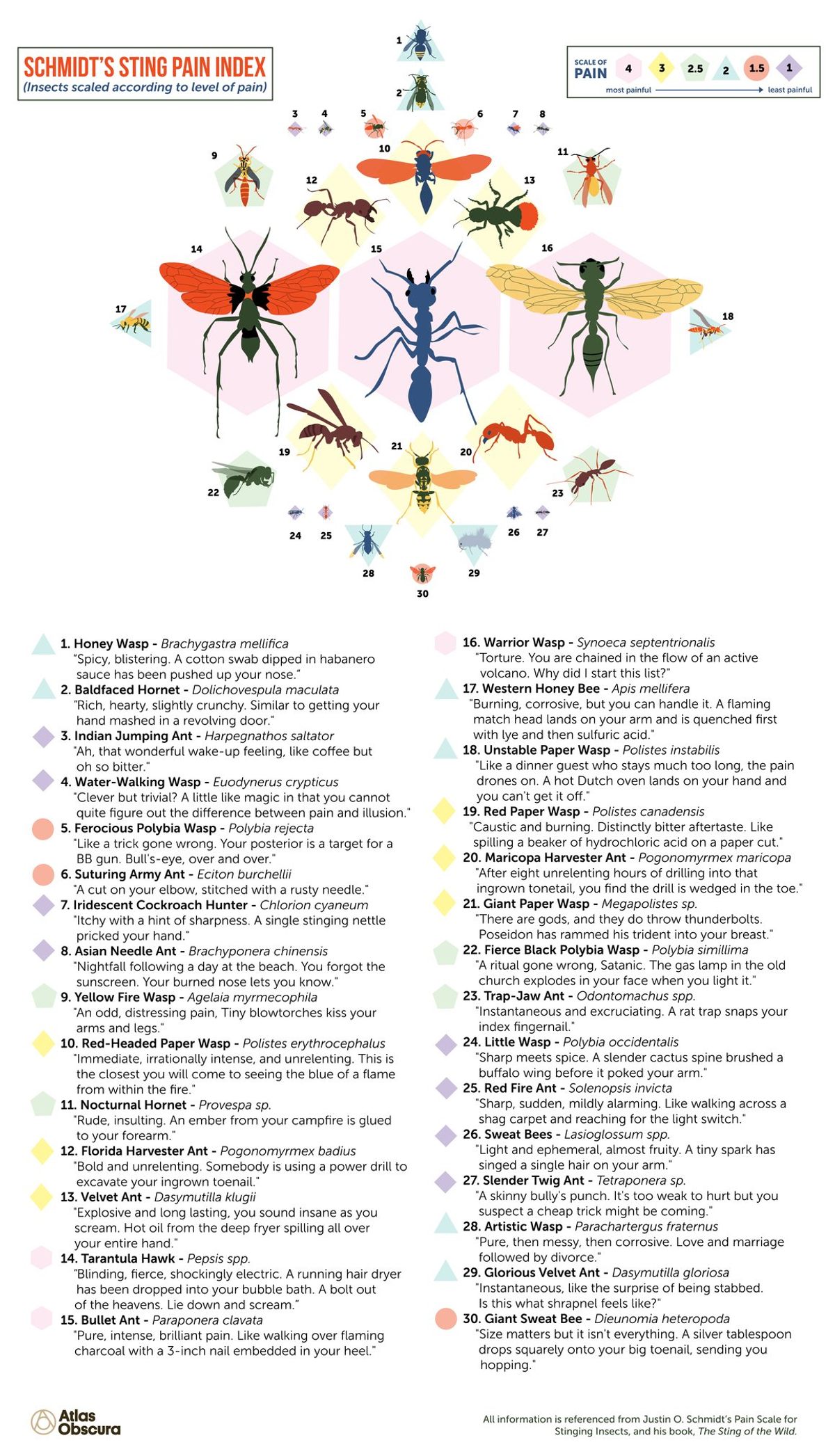
This description is one of 78 entries of ant, bee, and wasp stings in his Pain Scale for Stinging Insects, widely referred to as the Schmidt Sting Pain Index. 
 
Schmidt, who died in February 2023* was a biologist at Southwestern Biological Institute and researcher in the entomology department at the University of Arizona, and willingly offered his arm to different stinging insects of the order Hymenoptera to create the index featured in his 2016 book The Sting of the Wild. The index ranks stinging pain on a scale of 1 (red fire ant) to 4 (warrior wasp) and recounts Schmidt’s face-off with each insect with a poetic, and sometimes humorous, description. We have depicted a selection of insects included in Schmidt’s Sting Pain Index above, scaling the insects by how agonizing their stings are.
Tumblr: Image
Schmidt, who has been called “The King of Sting,” stood steadfast in the presence of vicious stinging insects. He’d been stung more than 1,000 times throughout his research career—his fascination growing from his childhood admiration for the fuzzy, brightly colored yellowjackets and bumble bees around his hometown in Pennsylvania.

He began collecting data for the pain index in 1973 after digging up sandy colonies of harvester ants in Georgia with a research colleague, Debbie, who would eventually become his wife. They were both stung, and Debbie described the episode as a “deep ripping and tearing pain, as if someone were reaching below the skin and ripping muscles and tendons; except the ripping continued with each crescendo of pain.”

“I realized [the harvester ant stings] were dramatically different from honey bees, wasps, and hornets. They are like day and night different,” said Schmidt.

He began to study the medical implications and biochemistry of the venom—the toxic compounds causing stings to often be much more painful than insect bites. Schmidt found that there was a difference in chemistry when the pain and skin reaction varied after a sting and set out to obtain a larger survey.

Collecting data on stings became Schmidt’s side project. While most people would flee, Schmidt went out of his way to get to stinging insects. He’d climbed up a tree to collect an entire nest of black Parachartergus fraternus wasps and convinced a bus filled with scientists to pull over to a bull ant colony in South Australia. He self-assessed the sting of any Hymenoptera he came across when out in the field conducting larger studies on velvet ants or sweat bees. To bring live specimens back to the lab to study their venom, he often used his bare hands to grab fistfuls of the insect and stuffs them into vials. If he didn’t get stung during that process, he’d apply one to his arm to be stung once or twice. He didn’t carry a first aid kit or ointments to prepare for a sting, only lugging ice in a chest to keep the specimens alive and a cellphone in case there was a dire emergency.

“I don’t put on suits of armor or get myself all psyched,” he said. “When I go to the doctor’s office, if I know I’m going to get an injection, it hurts a whole lot more the more I know I’m going to get a big, fat needle stuck in me. It’s very much the same way with stinging insects.”

The sting apparatus of a fire ant, Solenopsis invicta, has a thin, sharp, needle-like stinger attached to a large venom-filled reservoir and a smaller frothy-looking Dufour’s gland. Sting Pain Rating: 1 on the Pain Scale.
 
He has also found that researching stings prior to encountering the insect in the wild did not always give him proper warning of the severity or lack of pain. For example, South African giant stink ants, which live in volcano-shaped colonies and grow up to 2/3 of an inch long, were reputed to have very painful stings, Schmidt explained. When he was picking up a couple hundred ants, he thought the stings were unimpressive, scoring the pain 1.5 in the index. The giant stink ants’ putrid smell was perhaps worse than its sting.“I described it as garlic oil dribbled in your wound, but they smell like really rotten, rank garlic that you never want to eat,” he said. “It could make you sick just from the fumes.”

He determined the stinging score by two components: the actual physiological harm and what he called the “ouch factor.” While a universal definition of pain does not exist, Schmidt believed that everyone recognizes that pain comes in a variety of flavors. “Pain truth comes in two flavors, imagined and realized. With stings, our imagination is vivid and strong, even if the sting pain is not realized,” Schmidt explained in the book. He advised that if you are stung by an insect that he rates a four, that you should stop what you’re doing and seek medical aid. “They just shut you down. You can’t function in a normal fashion.”

Schmidt had lost the fear that would surface when he encountered a notoriously nasty stinging insect, but he was not numb to the pain. He once worked on a hive of honey bees and was dressed for the over 100–degree weather in Arizona: a tee shirt and shorts under his bee suit. The honey bees pierced through his thin layer of protection, leaving him with many painfully aching stings. His scores are also similar to the pain evaluations of the few other entomologists who also document sting pain, he said.

What made the Schmidt Pain Index unique was always his elaborate retellings of the stings.

“These descriptions pretty much just hit me,” said Schmidt, who admitted that he was never an “A” student in English. When he sat down to write a sting description, he’d clear his head and think of memories that reminded him of the sting—associating a strike of lighting to the sting of a tarantula hawk and the pain of a messy divorce with the sting of an artistic wasp. He started off describing a few of the stings in this colloquial manner, but realized that it was an effective way to inform people about how much each sting hurt. While the numerical scale is still valuable to entomologists, most people don’t identify with numbers, he explained.

“Numbers are kind of an unnatural thing,” he said. “I can’t even remember the numbers. I have to look at my notebook and see how I evaluated it, whereas the descriptions are much more graphic. I think they’re just a much better way of communicating and conveying the essence of what the numbers are really trying to tell you.”

Schmidt’s unique way of bringing science to a wider public will be long remembered.


Sample collection as part of a study in Costa Rica of the genetics of Africanized honey bees. These bees were intentionally provoked, something not recommended for the inexperienced.
🕵️🐜🕷️🐝🦗🐞🪰🐜🕷️🦗🐞🪰🐝🔬
Keep Exploring
 
 
🕵️🐜🕷️🐝🦗🐞🪰🐜🕷️🦗🐞🪰🐝🔬
🐜🐜🐜🐜🐜🐜🐜🐜🐜🐜🐜🐜
https://img.atlasobscura.com/YJ3TademvFDW0fSVJTEPORNxnkEAT1QbPFwMJpg4xSE/rt:fill/w:1200/el:1/q:81/sm:1/scp:1/ar:1/aHR0cHM6Ly9hdGxh/cy1kZXYuczMuYW1h/em9uYXdzLmNvbS91/cGxvYWRzL2Fzc2V0/cy8zNGMzMDRlOWU0/ZDU2MjQ2OTVfU2No/bWlkdCBQYWluIElu/ZGV4IEluZm9ncmFw/aGljLmpwZWc.jpg