Patrick Winston's How to Speak talk has been an MIT tradition for over 40 years. Offered every January, the talk is intended to improve your speaking ability in critical situations by teaching you a few heuristic rules.
🌼 Secret Gardening 🌾Ideas & Hacks 🌻 For Beginners🌱& Experts
Garden Secrets Jan 28, 2022 These are my top 50 garden ideas, garden hacks, garden secrets, tips and tricks that will blow away your mind. After the success of my 101 gardening hacks four years ago, I present these fresh and new gardening hacks and tricks for home gardening – for beginners as well as experts in gardening hobby.
Please watch all the hacks till the end. You might find these similar to garden hacks 5-minute crafts like seed hacks, pest control hacks, tips for vegetable gardening, container gardening ideas, home gardening, terrace gardening and all such tips and hacks on growing plants. 1,109,294 views
Voltaire was a versatile and prolific writer, producing works in
almost every literary form, including plays, poems, novels, essays and
historical and scientific works. He wrote more than 20,000 letters and
more than 2,000 books and pamphlets.
He was an outspoken advocate of civil liberties, despite the risk this
placed him in under the strict censorship laws of the time. As a satiricalpolemicist, he frequently made use of his works to criticize intolerance, religious dogma and the French institutions of his day.
By the time he left school, Voltaire had decided he wanted to be a
writer, against the wishes of his father, who wanted him to become a
lawyer.
Voltaire, pretending to work in Paris as an assistant to a notary,
spent much of his time writing poetry. When his father found out, he
sent Voltaire to study law, this time in Caen, Normandy.
But the young man continued to write, producing essays and historical
studies. Voltaire's wit made him popular among some of the aristocratic
families with whom he mixed. In 1713, his father obtained a job for him
as a secretary to the new French ambassador in the Netherlands, the marquis de Châteauneuf, the brother of Voltaire's godfather. At The Hague, Voltaire fell in love with a French Protestant refugee named Catherine Olympe Dunoyer (known as 'Pimpette').
Their affair, considered scandalous, was discovered by de Châteauneuf
and Voltaire was forced to return to France by the end of the year.
Voltaire Foundation
University of Oxford
Voltaire
was one of the wisest, funniest and cleverest people of the 18th
century. He continues to have lots to teach us about toleration, modesty
and kindness.
Voltaire
and Enlightenment - In terms of the history of ideas, Voltaire’s single most important achievement was to have helped in the 1730s to introduce the thought of Newton and Locke to France (and so to the rest of the Continent).
http://www.voltaire.ox.ac.uk/about-voltaire/voltaire-and-enlightenment
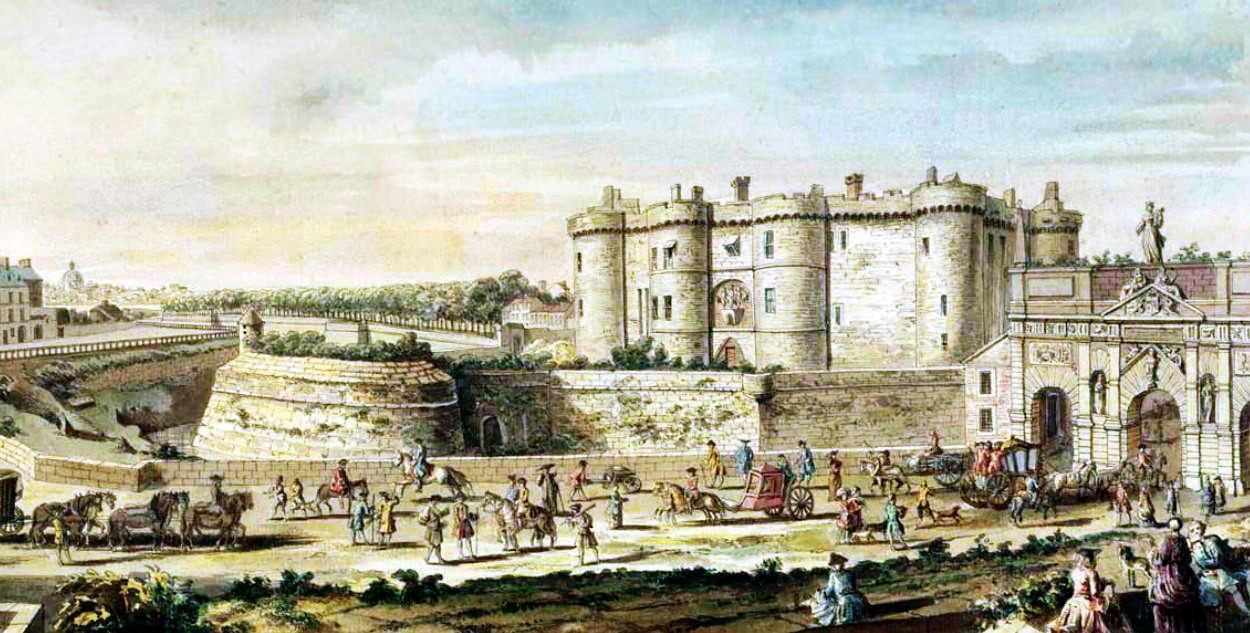
Voltaire was imprisoned in the Bastille from 16 May 1717 to 15 April 1718 in a windowless cell with ten-foot-thick walls
Most of Voltaire's early life revolved around Paris. From early on,
Voltaire had trouble with the authorities for critiques of the
government. As a result, he was twice sentenced to prison and once to
temporary exile to England. One satirical verse, in which Voltaire
accused the Régent of incest with his daughter, resulted in an eleven-month imprisonment in the Bastille. The Comédie-Française had agreed in January 1717 to stage his debut play, Œdipe, and it opened in mid-November 1718, seven months after his release. Its immediate critical and financial success established his reputation. Both the Régent and King George I of Great Britain presented Voltaire with medals as a mark of their appreciation.
He mainly argued for religious tolerance and freedom of thought.
He campaigned to eradicate priestly and aristo-monarchical authority,
and supported a constitutional monarchy that protects people's rights.
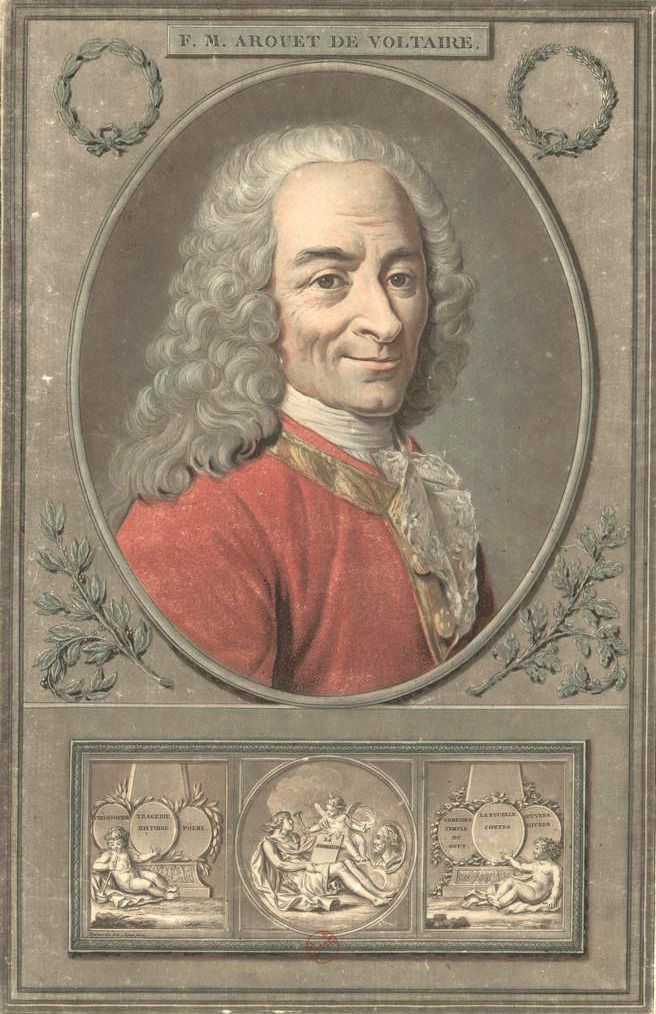
Adopts the name Voltaire The author adopted the name Voltaire in 1718, following his incarceration at the Bastille. Its origin is unclear. It is an anagram of AROVET LI, the Latinized spelling of his surname, Arouet, and the initial letters of le jeune ("the young"). According to a family tradition among the descendants of his sister, he was known as le petit volontaire ("determined little thing") as a child, and he resurrected a variant of the name in his adult life. The name also reverses the syllables of Airvault, his family's home town in the Poitou region.
Richard Holmes supports the anagrammatic derivation of the name, but adds that a writer such as Voltaire would have intended it to also convey connotations of speed and daring. These come from associations with words such as voltige (acrobatics on a trapeze or horse), volte-face (a spinning about to face one's enemies), and volatile (originally, any winged creature). "Arouet" was not a noble name fit for his growing reputation, especially given that name's resonance with à rouer ("to be beaten up") and roué (a débauché).
In a letter to Jean-Baptiste Rousseau in March 1719, Voltaire concludes by asking that, if Rousseau wishes to send him a return letter, he do so by addressing it to Monsieur de Voltaire. A postscript explains: "J'ai été si malheureux sous le nom d'Arouet que j'en ai pris un autre surtout pour n'être plus confondu avec le poète Roi", (I was so unhappy under the name of Arouet that I have taken another, primarily so as to cease to be confused with the poet Roi.) This probably refers to Adenes le Roi, and the 'oi' diphthong was then pronounced like modern 'ouai', so the similarity to 'Arouet' is clear, and thus, it could well have been part of his rationale. Voltaire is known also to have used at least 178 separate pen names during his lifetime.
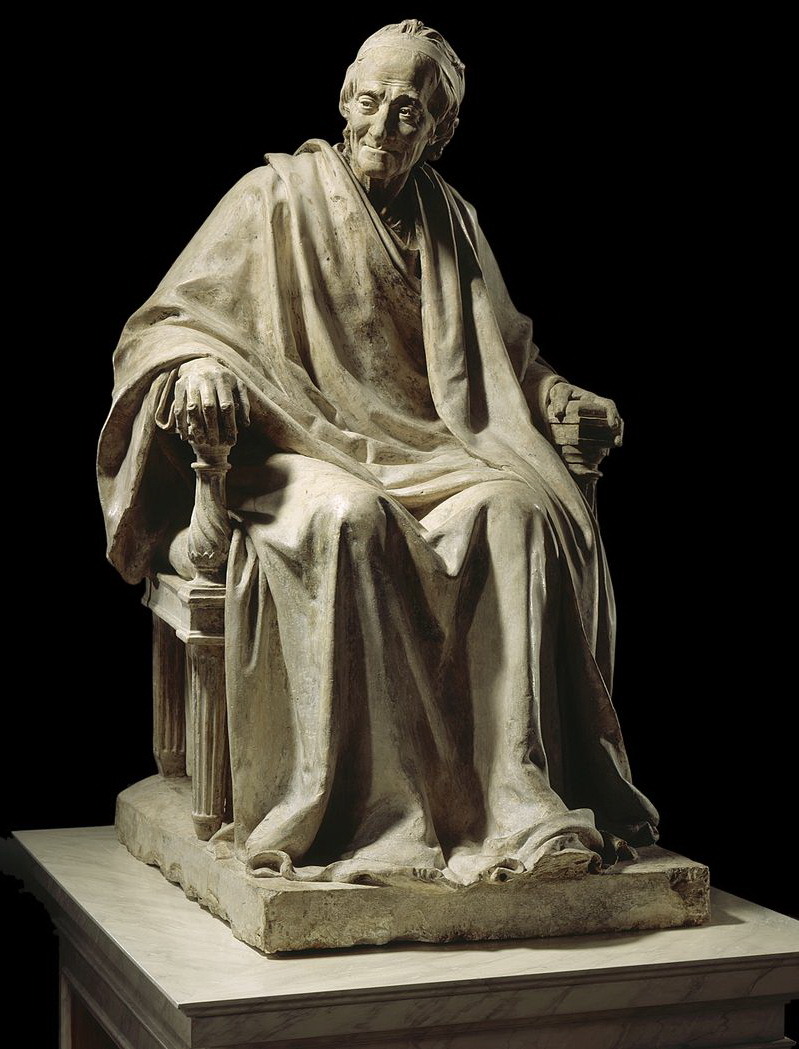
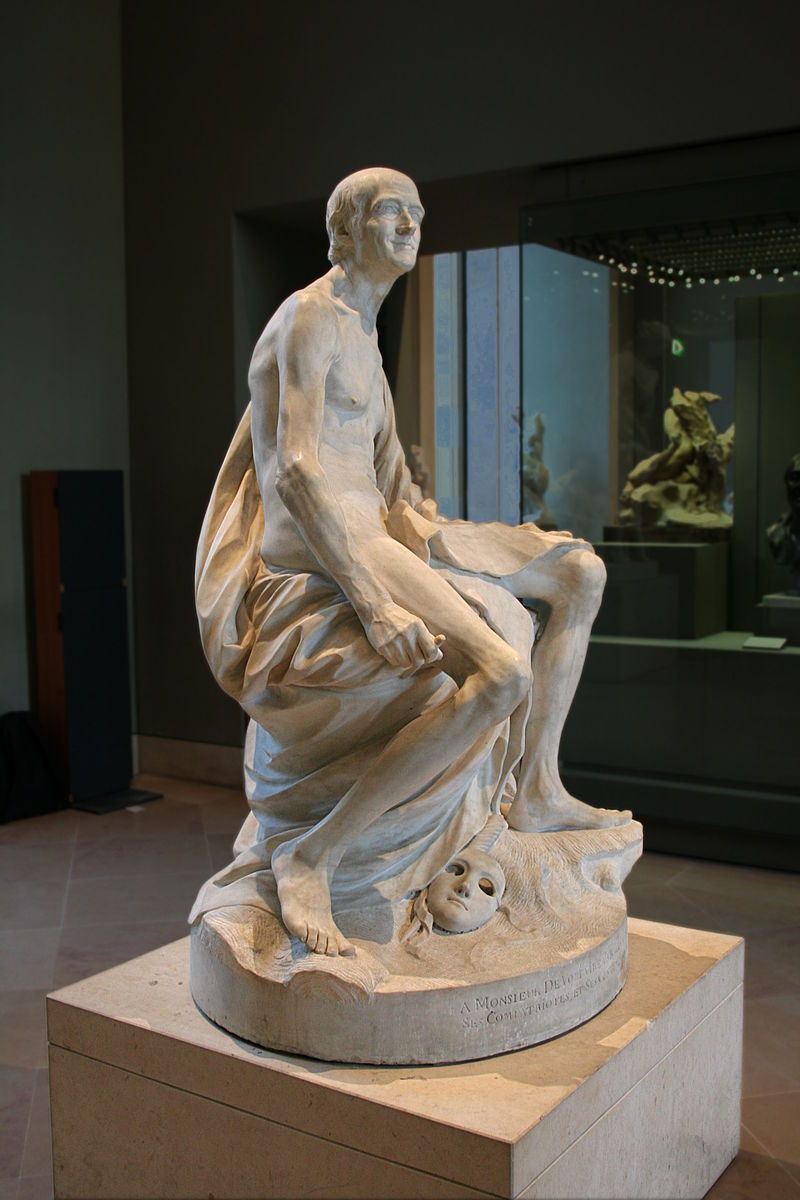
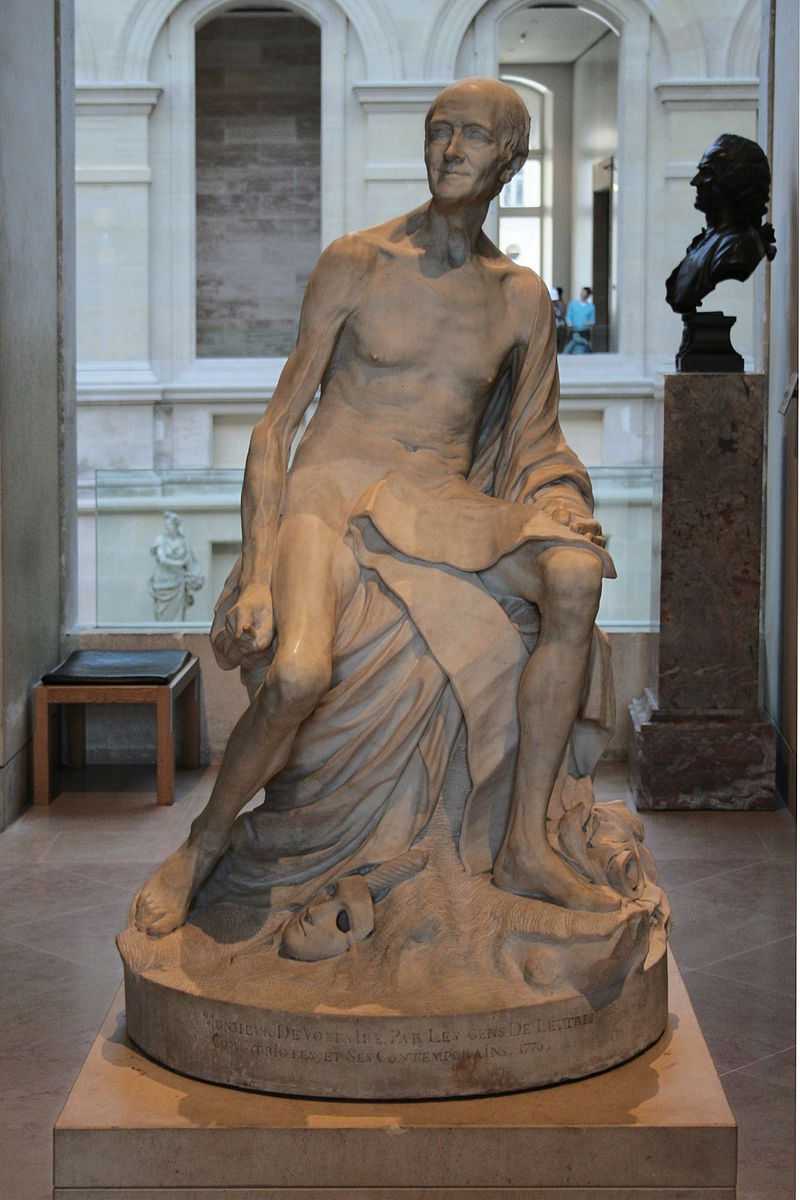
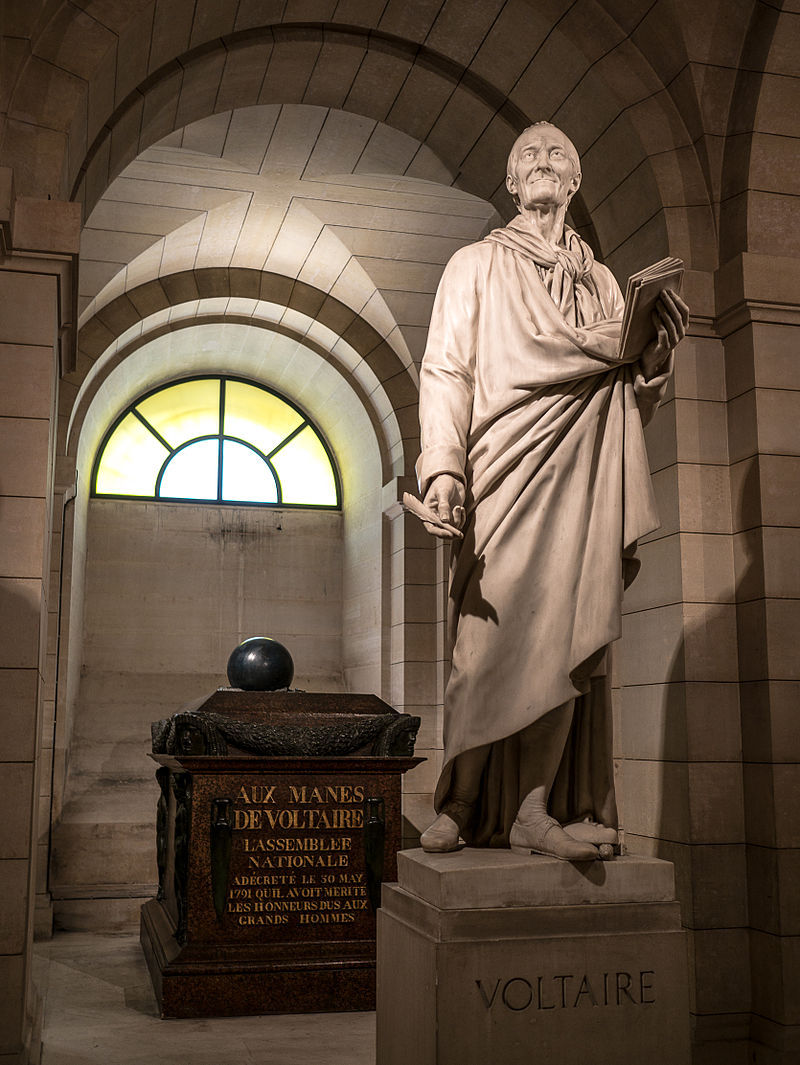
En 1770, dans le salon de Mme Necker, une souscription est ouverte pour ériger une statue au grand homme. Pigalle choisit de le représenter en nu héroïque, à l'antique, sans masquer la vérité anatomique d’un corps marqué par l’âge, en magnifiant par contraste la tête pleine d’espérance. L’œuvre, défendue par Diderot, va susciter de nombreuses critiques.
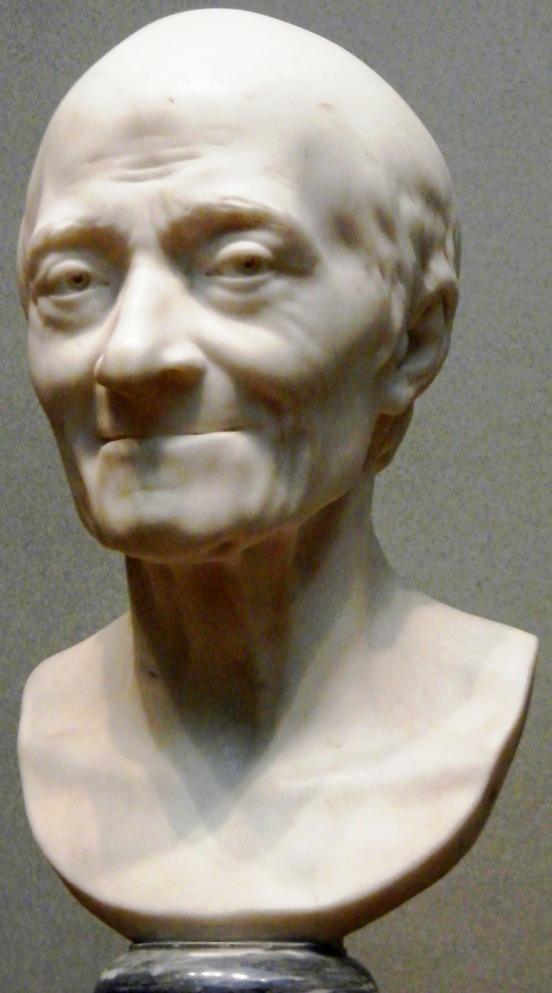
La statue fut réalisée grâce à une souscription lancée par les gens de lettres en 1770. Pigalle, qui avait modelé la tête de Voltaire à Ferney, sculpta le corps décharné d'un vieillard sans souci d'idéalisation. L'écrivain, au départ inquiet du parti-pris esthétique de Pigalle, l'accepta finalement : "Il faut laisser M. Pigalle le maître absolu de la statue ; c'est un crime en fait de beaux-arts de mettre des entraves au génie".
Représentant le plus connu de la philosophie des Lumières, anglomane, féru d'arts et de sciences,
personnage protéiforme et complexe, non dénué de contradictions,
Voltaire domine son époque par la durée de sa vie, l'ampleur de sa
production littéraire et la variété des combats politiques qu'il a
menés. Son influence est décisive sur la bourgeoisie libérale avant la Révolution française et pendant le début du XIXe siècle.
Anticlérical mais déiste, il dénonce dans son Dictionnaire philosophique
le fanatisme religieux de son époque. Sur le plan politique, il est en
faveur d’une monarchie modérée et libérale, éclairée par les
« philosophes ». Mettant sa notoriété au service des victimes de
l’intolérance religieuse ou de l’arbitraire, il prend position dans des
affaires qu’il a rendues célèbres : Jean Calas, Pierre-Paul Sirven, chevalier de La Barre et comte de Lally.
Son œuvre littéraire est riche et variée : son importante production théâtrale, ses longs poèmes épiques, telle La Henriade, et ses œuvres historiques firent de lui l’un des écrivains français les plus célèbres au XVIIIe siècle. Son œuvre comprend aussi des contes, notamment Candide ou l'Optimisme, des Lettres philosophiques, le Dictionnaire philosophique et une correspondance monumentale dont nous connaissons plus de 15 000 lettres sur un total parfois estimé à 40 000.
Listening is a more natural way of learning, when compared to reading.
Written language only began at around 3200 BC, but spoken language has
existed long ago.
This is an audio version of the Wikipedia Article:
Voltaire
Learning by listening is a great way to: - increases imagination and understanding - improves your listening skills - improves your own spoken accent - learn while on the move - reduce eye strain Now learn the vast amount of general knowledge available on Wikipedia
through audio (audio article). You could even learn subconsciously by
playing the audio while you are sleeping! If you are planning to listen a
lot, you could try using a bone conduction headphone, or a standard
speaker instead of an earphone.
You can find other Wikipedia audio articles too at:
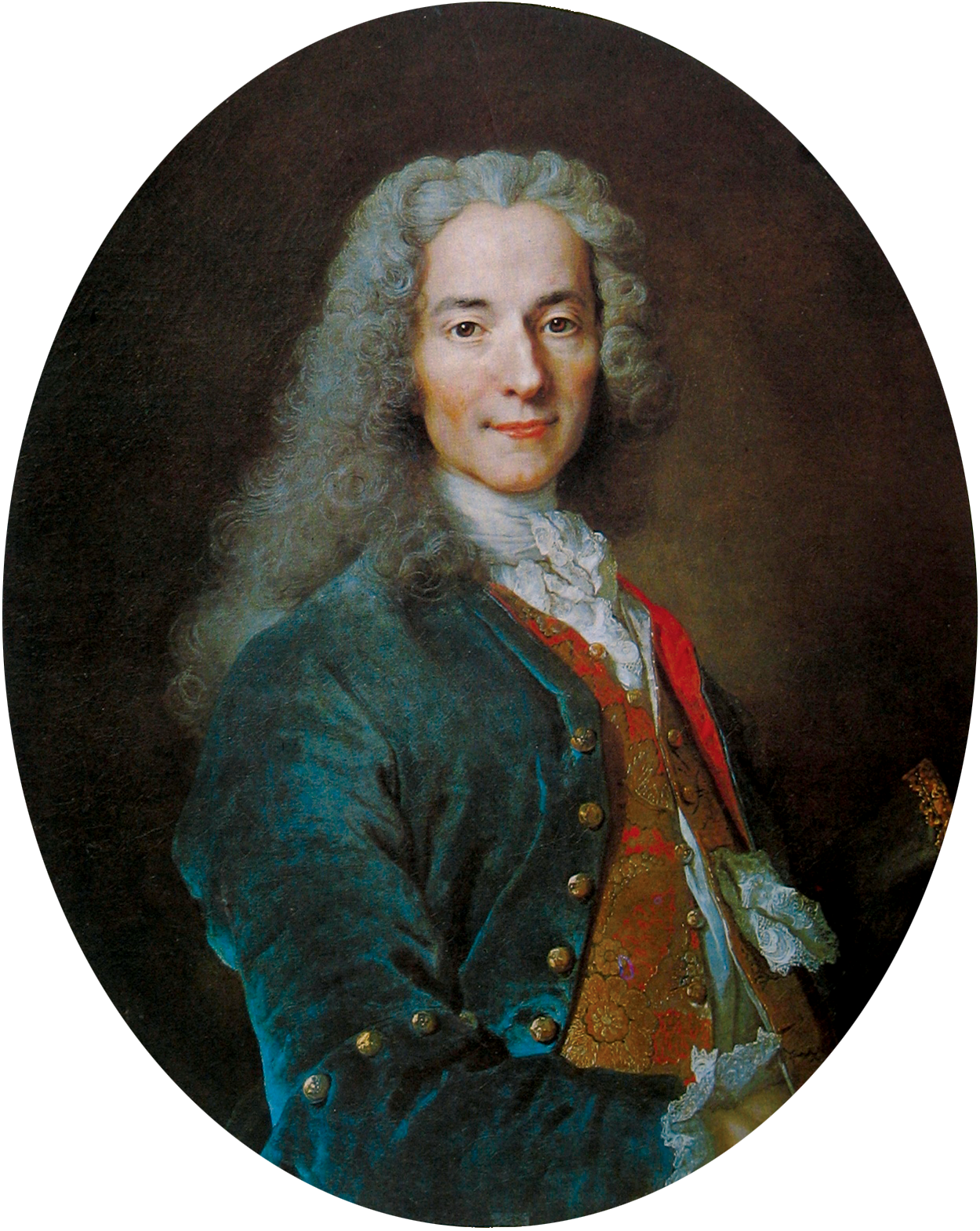
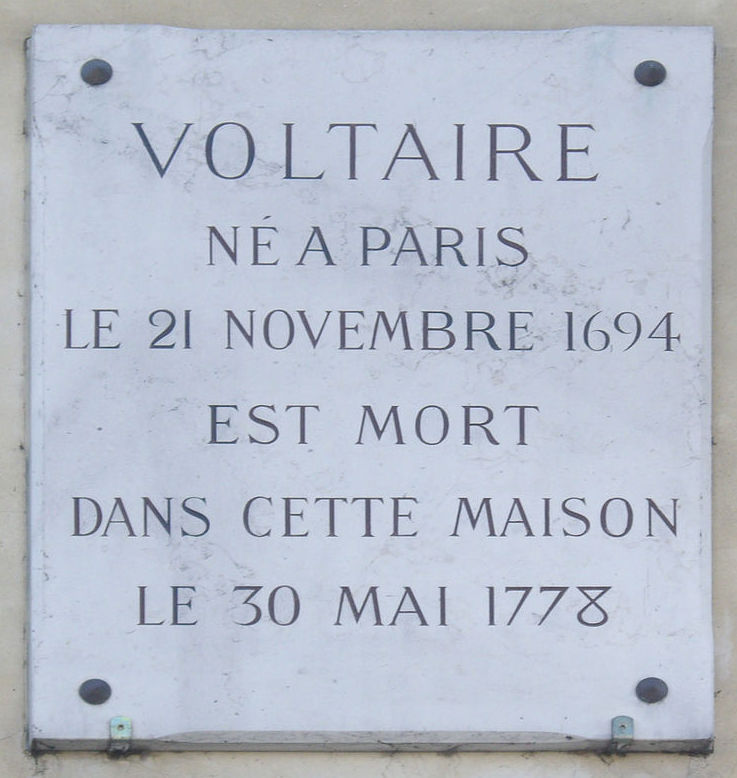
François-Marie Arouet (21 November 1694 –
30 May 1778), known by his nom de plume Voltaire,
was a French Enlightenment writer, historian and philosopher famous for
his wit, his criticism of Christianity, especially the Catholic Church,
and his advocacy of freedom of religion, freedom of speech, and
separation of church and state.
Voltaire was a versatile and prolific writer, producing works in almost
every literary form, including plays, poems, novels, essays and
historical and scientific works. He wrote more than 20,000 letters and
more than 2,000 books and pamphlets. He was an outspoken advocate of
civil liberties, despite the risk this placed him in under the strict
censorship laws of the time. As a satirical polemicist, he frequently
made use of his works to criticize intolerance, religious dogma and the
French institutions of his day.
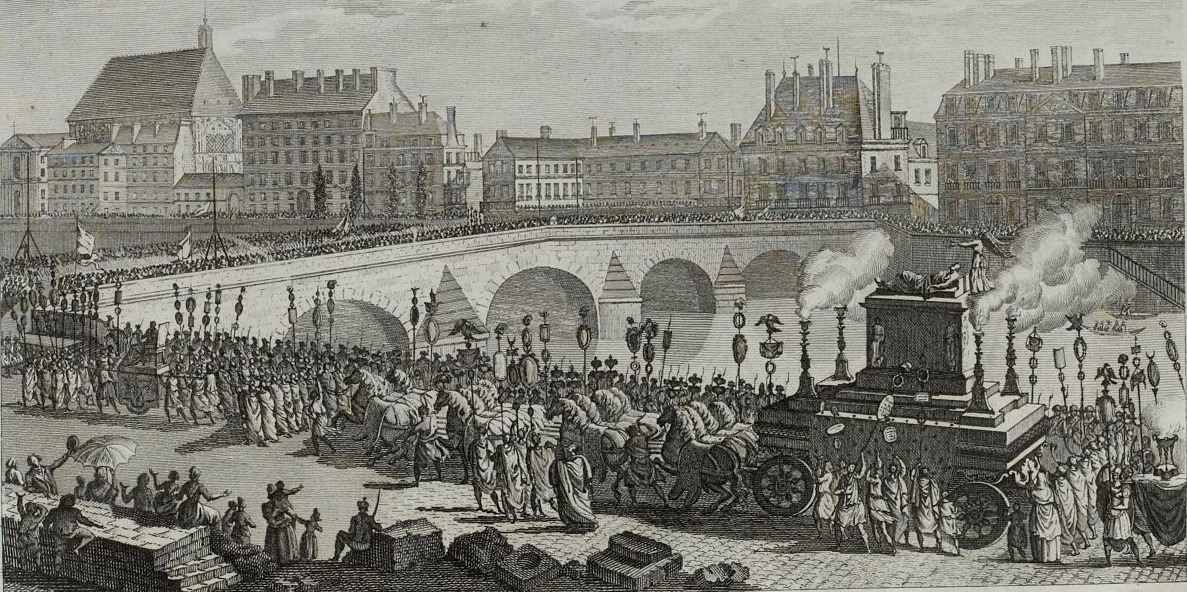
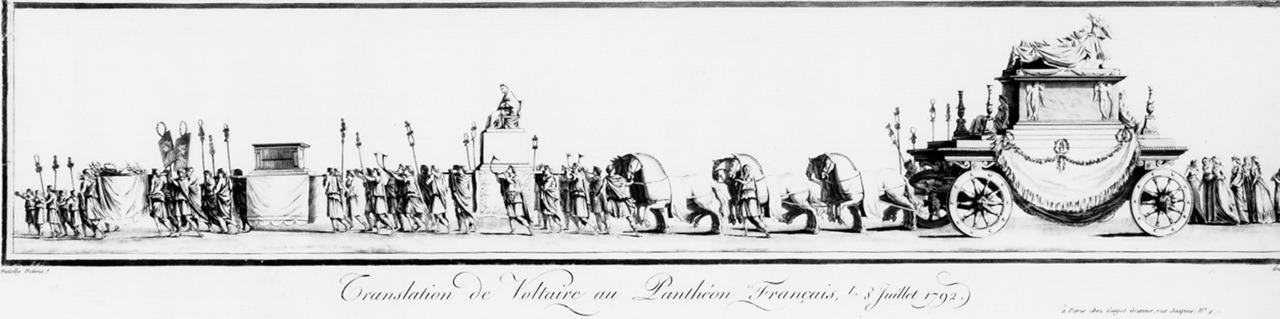
Transfert de Voltaire au Panthéon le 11 juillet 1791
Kissing Day, also known as World Kiss Day and International
Kissing Day, is a nonofficial holiday that is celebrated on July 6th every year.
It is a holiday in which people are encouraged to pucker up and kiss the person they love.
History of National Kissing Day No
one really knows when National Kissing Day was created. However, it is
believed that it was created in the United Kingdom sometime during the
19th century. Regardless of where it originated, however, it has spread
all over the globe and is celebrated in many different countries.
Benefits of Kissing
Kissing
is not only a fun activity, but it also contains some health benefits
for both of the participants – besides making them happy.
These benefits include:
Kissing leads to increased saliva production which can lead to a healthier mouth
Kissing burns 6 calories a minute
Kissing can build up immunity by introducing them to their partner’s mouth bacteria
Kissing relieves stress
Kissing can ease allergy symptoms
Why Do People Kiss? No
one is really sure why people kiss but scientists do have a number of
theories. One of these theories is that this behavior has been learned
from our ancestors. Mothers used to chew their babies’ food and then
spit it into the mouths of their infants. Some scientists say that the
fact that 9 out of 10 people in the world proves that it’s a learned
behavior because if it was instinctual, then all humans would kiss.
Other
scientists believe it’s instinctual, however, and point to the animal
kingdom to prove their point. After all, there are a number of animals
which kiss. These include squirrels, African Gray Parrots, meerkats,
chimpanzees, puffins, cows and even elephants.
Another popular
theory as to why we kiss is that it is a way to find a potential mate.
When two people are kissing, they are not only exchanging saliva but
they are also exchanging pheromones. This may let a person’s body know
if that person is a potential mater or not.
Celebrating National Kissing Day The
only real way to celebrate National Kissing Day is by kissing the
people that you love. Whether that’s a romantic kiss that you share with
your partner or a quick kiss on your mother’s cheek, the purpose of
this day is really to let the people you love know you love them. http://www.holidayscalendar.com/event/world-kissing-day
International Kissing Day Activities
1. Give someone you love a kiss Whether it's your significant other, your mom, or your best friend, remind
someone how much you love them with a kiss. Just remember: even though you might want to kiss someone, it doesn't mean they want you to be
kissed by you—keep it consensual. 2. Snack on Hershey's Kisses Did you know that Hershey's Kisses fit perfectly into your puckered lips?
Although no one knows exactly why they're called Hershey's Kisses, legend has it they were named after the sound the chocolate makes when it's dropping onto the conveyer belt. How romantic! 3. Kiss everyone hello on both cheeks In
many cultures (particularly French), it is common practice to peck
people once on both cheeks as a greeting. Try it on your friends and
colleagues. But pecks only, please—no tongue!
Why We Love
International Kissing Day
A. It's a full face workout Did you know that French kissing engages all 34 muscles in the face, whereas a simple pucker kiss only involves two? Who needs the gym when a make-out session will get our hearts racing and our muscles working? B. Kissing makes us happy and relieves stress Kissing serves as a natural relaxer that makes us feel happy and at peace. By stimulating our brain to release feel-good chemicals, kissing makes us feel both calm and excited at the same time. C. Kissing crosses language and cultural boundaries Kissing is a cross-cultural form of communication that means the same things in every country—regardless of language, ethnicity, or religion. By kissing, you can communicate complex emotions without having to exchange any words with your kissing partner.
International Kiss Day!
Do you know how many types of kisses exist? If you don't -- check out the video and enjoy it with your partner as well!