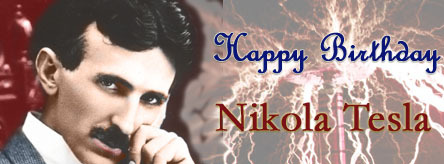
Happy Birthday
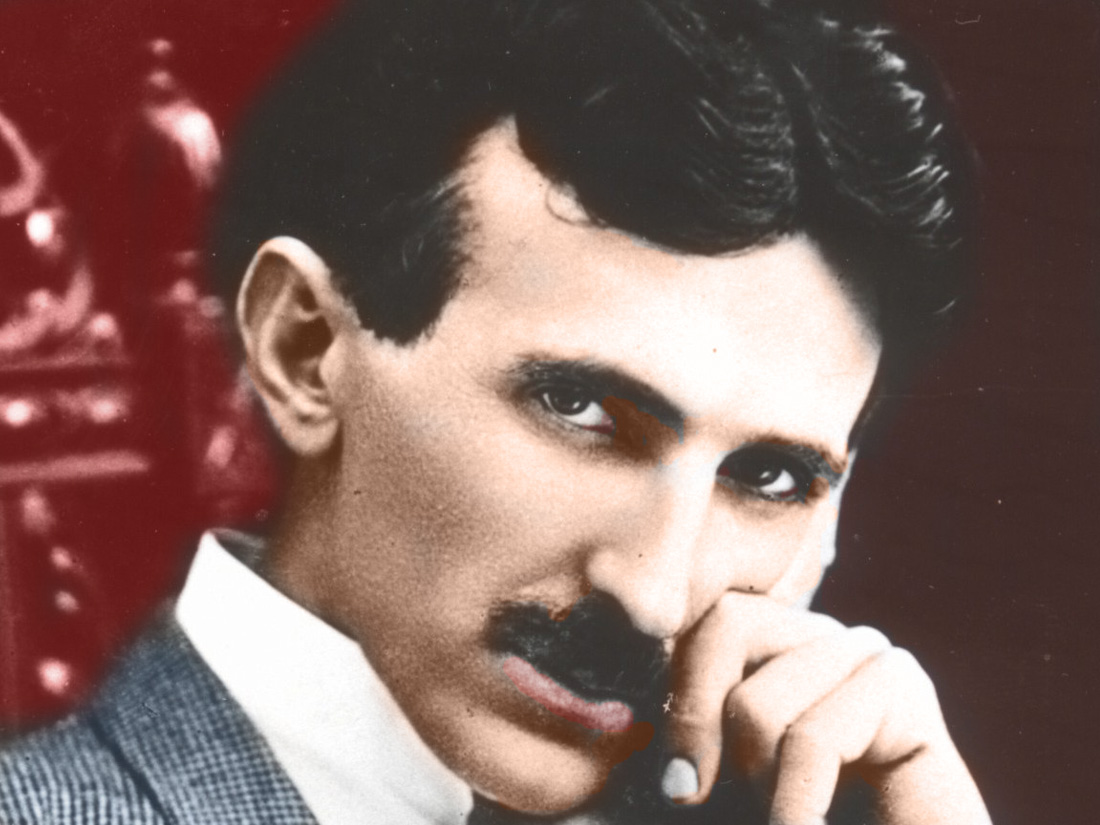
Nikola Tesla

The Man Who Invented
The Twentieth Century
Read more here:

Born 10 July 1856 - Smiljan, Austrian Empire (modern-day Croatia)
Died 7 January 1943 (aged 86) - New York City, New York, USA
Died 7 January 1943 (aged 86) - New York City, New York, USA
Engineering career
Engineering discipline Electrical engineering
Engineering discipline Electrical engineering
Mechanical engineering
Significant projects Alternating current, high-voltage, high-frequency power experiments
Significant projects Alternating current, high-voltage, high-frequency power experiments
Significant design
Induction motor Rotating magnetic field
Tesla coil
Radio remote control vehicle (torpedo)
Tesla coil
Radio remote control vehicle (torpedo)
Here’s our updated two-parter on Tesla, too:
http://www.missedinhistory.com/podcasts/nikola-tesla-and-the-war-of-currents-revisited-part-1/
http://www.missedinhistory.com/podcasts/nikola-tesla-and-the-war-of-currents-revisited-part-2/
And for further reading, see: 10 Reasons Why Tesla Is a Scientific God.
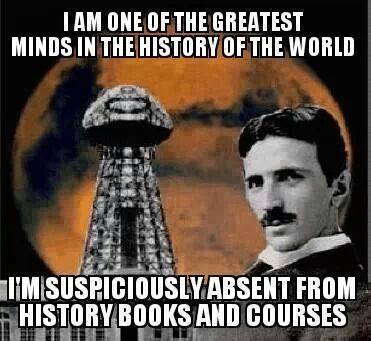
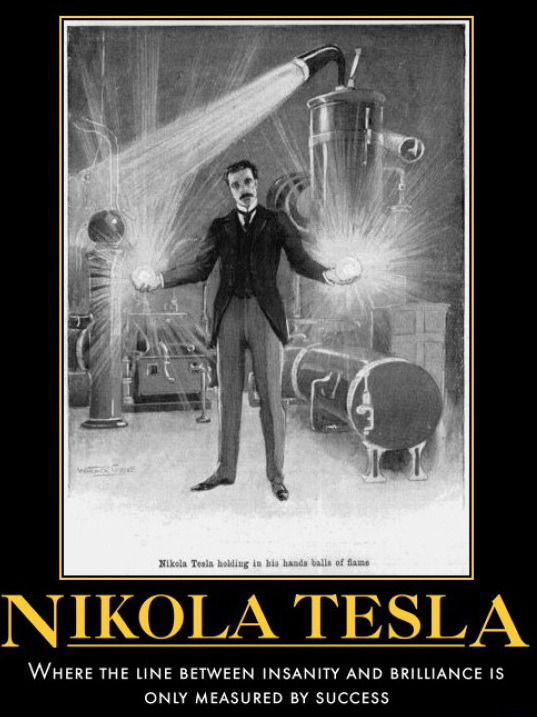
Nikola Tesla popularly known as the ‘mad scientist’ was brilliant.
He spoke eight
languages, single-handedly developed technology that harnessed the power
of electricity for household use, and invented things like electrical
generators, FM radio, remote control, robots, spark plugs, fluorescent
lights, and giant machines that shoot enormous, brain-frying lightning
bolts all over the place like crazy.
He had an unyielding, steel-trap
photographic memory and an insane ability to visualize even the most
complex pieces of machinery – he did advanced calculus and physics
equations in his own head, memorized entire books at a time, and
successfully pulled off scientific experiments that modern-day
technology still can’t replicate.
He once lit 200 light bulbs from a
power source 26 miles away, and he did it in 1899 with a machine he
built from spare parts in the middle of the god-forsaken desert,
He held
700 patents at the time of his death, made groundbreaking discoveries
in the fields of physics, robotics, steam turbine engineering, and
magnetism, and once melted one of his assistants’ hands by overloading
it with X-rays.
Nikola Tesla (Serbian Cyrillic: Никола Тесла; 10 July 1856 – 7 January 1943) was a Serbian American inventor, electrical engineer, mechanical engineer, and futurist best known for his contributions to the design of the modern alternating current (AC) electricity supply system.
Tesla gained experience in telephony and electrical engineering before immigrating to the United States in 1884 to work for Thomas Edison
in New York City. He soon struck out on his own with financial backers,
setting up laboratories and companies to develop a range of electrical
devices. His patented AC induction motor and transformer were licensed by George Westinghouse,
who also hired Tesla for a short time as a consultant. His work in the
formative years of electric power development was also involved in the
corporate struggle between making alternating current or direct current the power transmission standard, referred to as the war of currents.
Tesla went on to pursue his ideas of wireless lighting and electricity
distribution in his high-voltage, high-frequency power experiments in
New York and Colorado Springs and made early (1893) pronouncements on
the possibility of wireless communication with his devices. He tried to
put these ideas to practical use in his ill-fated attempt at
intercontinental wireless transmission; his unfinished Wardenclyffe Tower project
In his lab he also conducted a range of experiments with mechanical
oscillator/generators, electrical discharge tubes, and early X-ray
imaging. He even built a wireless controlled boat which may have been
the first such device ever exhibited.
Tesla was renowned for his achievements and showmanship, eventually
earning him a reputation in popular culture as an archetypal "mad scientist."
His patents earned him a considerable amount of money, much of which
was used to finance his own projects with varying degrees of success. He lived most of his life in a series of New York hotels, through his retirement. He died on 7 January 1943.
Tesla's work fell into relative obscurity after his death, but in 1960 the General Conference on Weights and Measures named the SI unit of magnetic field strength the tesla in his honour. Tesla has experienced a resurgence in interest in popular culture since the 1990s.


Nikola Tesla Corner
New York City
*
July 10, 1856 - Nikola Tesla
was born in Vojna Krajina, which is now part of Croatia. Tesla was
probably the greatest inventor, scientist and electrical engineer of his
day, if not of all time, though because he was a decent, honest and
eccentric fellow, I regret most people hardly even know of him. But you
can thank Tesla every time you plug something into your wall socket,
turn on a radio, and use a little electricity. You can learn more about
his life at the Tesla Society, Wikipedia, or of course, Google. Yeah - you know Tesla has coils, but did you know Tesla also has a cool car named after him? Or, that LikeTelevision named their first server after Tesla?
To
honor our hero today on his birthday - we thought we'd highlight some
cool videos that were inspired by Nikola Tesla's genius. First - check
out a few classic Superman episodes - Electronic Earthquake and Magnetic Telescope.
Both these terrific cartoons feature some mondo electronic gear
inspired by Tesla's ideas. For a vintage look at some Tesla Coils - you
can check out Fritz Lang's Metropolis, or the hilarious old serial called the Lost City.
If
you asked most people in the US - who gave us electricity?, most would
answer Thomas Edison. In truth - Edison almost killed it for all of us.
Of course it took a lot of people to make it happen, but if you had to
credit just one guy, that man would most surely be - Nikola Tesla.
Happy
Birthday Mr. Tesla!!
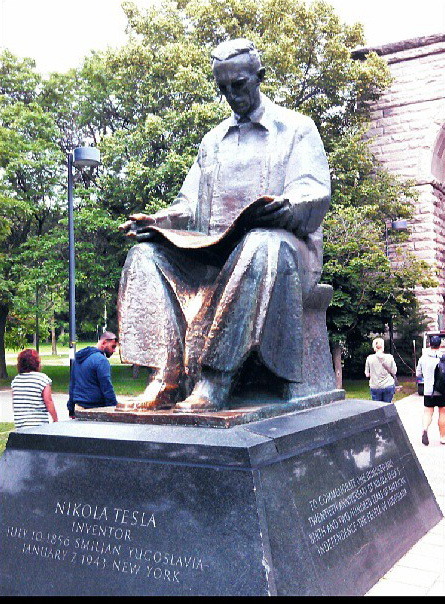
The 10 Inventions of Nikola Tesla That Changed The World
1. Alternating Current -- This is where it all began, and what ultimately caused such a stir at the 1893 World's Expo in Chicago. A war was leveled
ever-after between the vision of Edison and the vision of Tesla for
how electricity would be produced and distributed. The division can be
summarized as one of cost and safety: The DC current that Edison
(backed by General Electric) had been working on was costly over long
distances, and produced dangerous sparking from the required converter
(called a commutator). Regardless, Edison and his backers utilized the
general "dangers" of electric current to instill fear in Tesla's
alternative: Alternating Current. As proof, Edison sometimes
electrocuted animals at demonstrations. Consequently, Edison gave the
world the electric chair, while simultaneously maligning Tesla's attempt
to offer safety at a lower cost. Tesla responded by demonstrating
that AC was perfectly safe by famously shooting current through his own
body to produce light. This Edison-Tesla (GE-Westinghouse) feud in
1893 was the culmination of over a decade of shady business deals,
stolen ideas, and patent suppression that Edison and his moneyed
interests wielded over Tesla's inventions. Yet, despite it all, it is
Tesla's system that provides power generation and distribution to North
America in our modern era.
2. Light -- Of course he didn't invent light itself, but he did
invent how light can be harnessed and distributed. Tesla developed and
used fluorescent bulbs in his lab some 40 years before industry
"invented" them. At the World's Fair, Tesla took glass tubes and bent
them into famous scientists' names, in effect creating the first neon
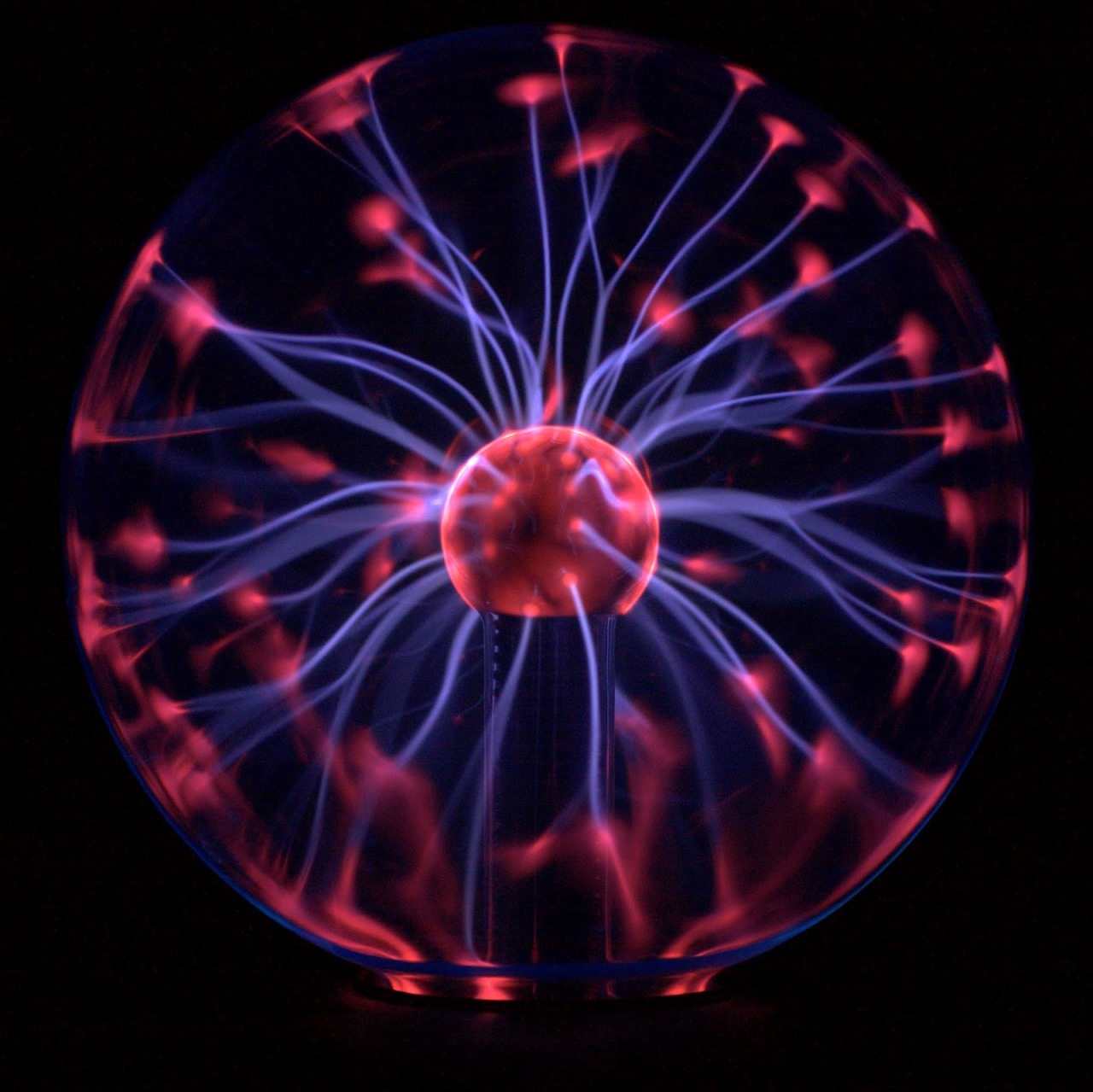
signs. However, it is his Tesla Coil that might be the most impressive,
and controversial. The Tesla Coil
is certainly something that big industry would have liked to suppress:
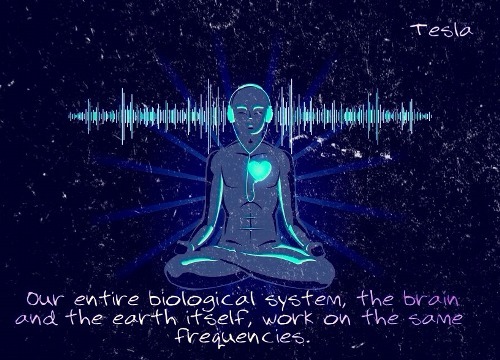
the concept that the Earth itself is a magnet that can generate
electricity (electromagnetism) utilizing frequencies as a transmitter.
All that is needed on the other end is the receiver -- much like a
radio.
3. X-rays -- Electromagnetic and ionizing radiation was heavily
researched in the late 1800s, but Tesla researched the entire gamut.
Everything from a precursor to Kirlian photography,
which has the ability to document life force, to what we now use in
medical diagnostics, this was a transformative invention of which Tesla played a central role.
X-rays, like so many of Tesla's contributions, stemmed from his belief
that everything we need to understand the universe is virtually around
us at all times, but we need to use our minds to develop real-world
devices to augment our innate perception of existence.
4. Radio -- Guglielmo Marconi was initially credited, and most
believe him to be the inventor of radio to this day. However, the
Supreme Court overturned Marconi's patent in 1943, when it was proven
that Tesla invented the radio years previous to Marconi. Radio signals
are just another frequency that needs a transmitter and receiver, which
Tesla also demonstrated in 1893 during a presentation before The
National Electric Light Association. In 1897 Tesla applied for two
patents US 645576, and US 649621.
In 1904, however, The U.S. Patent Office reversed its decision,
awarding Marconi a patent for the invention of radio, possibly
influenced by Marconi's financial backers in the States, who included
Thomas Edison and Andrew Carnegie. This also allowed the U.S.
government (among others) to avoid having to pay the royalties that
were being claimed by Tesla.
5. Remote Control -- This invention was a natural outcropping of radio. Patent No. 613809
was the first remote controlled model boat, demonstrated in 1898.
Utilizing several large batteries; radio signals controlled switches,
which then energized the boat's propeller, rudder, and scaled-down
running lights. While this exact technology was not widely used for some
time, we now can see the power that was appropriated by the military in
its pursuit of remote controlled war.
Radio controlled tanks were introduced by the Germans in WWII, and
developments in this realm have since slid quickly away from the
direction of human freedom.
6. Electric Motor -- Tesla's invention of the electric motor has finally been popularized by a car
brandishing his name. While the technical specifications are beyond
the scope of this summary, suffice to say that Tesla's invention of a
motor with rotating magnetic fields could have freed mankind much sooner
from the stranglehold of Big Oil. However, his invention in 1930
succumbed to the economic crisis and the world war that followed.
Nevertheless, this invention has fundamentally changed the landscape of
what we now take for granted: industrial fans, household applicances,
water pumps, machine tools, power tools, disk drives, electric
wristwatches and compressors.
7. Robotics -- Tesla's overly enhanced scientific mind led him to
the idea that all living beings are merely driven by external
impulses. He stated: "I have by every thought and act of mine,
demonstrated, and does so daily, to my absolute satisfaction that I am
an automaton endowed with power of movement, which merely responds to
external stimuli." Thus, the concept of the robot was born. However,
an element of the human remained present, as Tesla asserted that these
human replicas should have limitations -- namely growth and propagation.
Nevertheless, Tesla unabashedly embraced all of what intelligence could
produce. His visions for a future filled with intelligent cars,
robotic human companions, and the use of sensors, and autonomous systems
are detailed in a must-read entry in the Serbian Journal of Electrical Engineering, 2006 (PDF).
8. Laser -- Tesla's invention of the laser may be one of the best
examples of the good and evil bound up together within the mind of
man. Lasers have transformed surgical applications in an undeniably
beneficial way, and they have given rise to much of our current digital
media. However, with this leap in innovation we have also crossed into
the land of science fiction. From Reagan's "Star Wars" laser defense
system to today's Orwellian "non-lethal" weapons'
arsenal, which includes laser rifles and directed energy "death rays,"
there is great potential for development in both directions.
9 and 10. Wireless Communications and Limitless Free Energy --
These two are inextricably linked, as they were the last straw for the
power elite -- what good is energy if it can't be metered and
controlled? Free? Never. J.P. Morgan backed Tesla with $150,000 to
build a tower that would use the natural frequencies of our universe to
transmit data, including a wide range of information communicated
through images, voice messages, and text. This represented the world's
first wireless communications, but it also meant that aside from the
cost of the tower itself, the universe was filled with free energy that
could be utilized to form a world wide web connecting all people in all
places, as well as allow people to harness the free energy around them.
Essentially, the 0's and 1's of the universe are embedded in the fabric
of existence for each of us to access as needed. Nikola Tesla was
dedicated to empowering the individual to receive and transmit this data
virtually free of charge. But we know the ending to that story . . .
until now?
Tesla had perhaps thousands of other ideas and inventions that remain unreleased. A look at his hundreds of patents
shows a glimpse of the scope he intended to offer. If you feel that
the additional technical and scientific research of Nikola Tesla should
be revealed for public scrutiny and discussion, instead of suppressed by
big industry and even our supposed institutions of higher education,
join the world's call to tell power brokers everywhere that we are
ready to Occupy Energy and learn about what our universe really has to
offer.
The release of Nikola Tesla's technical and scientific research --
specifically his research into harnessing electricity from the
ionosphere at a facility called Wardenclyffe -- is a necessary step
toward true freedom of information. Please add your voice by sharing
this information with as many people as possible.
For additional information about the demand for release, or to use as a template to form your own demand, please visit: http://releaseteslasresearch.weebly.com/