Search This Blog

Thursday, June 16, 2022

Bill of Rights ๐Ÿ“œ

The Bill of Rights
https://64.media.tumblr.com/e6acaf473f15cde5ba03410aff6f107d/d599933a345cc48a-ee/s640x960/62dac99fed6c47645e92e5441f848443fb341802.jpg
After the Declaration of Independence in 1776, the Founding Fathers turned to the composition of the states’ and then the federal Constitution. Although a Bill of Rights to protect the citizens was not initially deemed important, the Constitution’s supporters realized it was crucial to achieving ratification. Thanks largely to the efforts of James Madison, the Bill of Rights—the first ten amendments to the U.S. Constitution—were ratified on December 15, 1791. 

Influence of the Magna Carta
The roots of the Bill of Rights lie deep in Anglo-American history. In 1215 England’s King John, under pressure from rebellious barons, put his seal to Magna Carta, which protected subjects against royal abuses of power. Among Magna Carta’s more important provisions are its requirement that proceedings and prosecutions be according to “the law of the land”–the forerunner of “due process of law”–and a ban on the sale, denial, or delay of justice.
In response to arbitrary actions of Charles I, Parliament in 1628 adopted the Petition of Right, condemning unlawful imprisonments and also providing that there should be no tax “without common consent of parliament.” In 1689, capping the Glorious Revolution (which placed William and Mary on the throne), Parliament adopted the Bill of Rights. Not only does its name anticipate the American document of a century later, the English Bill of Rights anticipates some of the American bill’s specific provisions–for example, the Eighth Amendment’s ban on excessive bail and fines and on cruel and unusual punishment.

The idea of written documents protecting individual liberties took early root in England’s American colonies. Colonial charters (such as the 1606 Charter for Virginia) declared that those who migrated to the New World should enjoy the same “privileges, franchises, and immunities” as if they lived in England. In the years leading up to the break with the mother country (especially after the Stamp Act of 1765), Americans wrote tracts and adopted resolutions resting their claim of rights on Magna Carta, on the colonial charters, and on the teachings of natural law.

The idea of written documents protecting individual liberties took early root in England’s American colonies. Colonial charters (such as the 1606 Charter for Virginia) declared that those who migrated to the New World should enjoy the same “privileges, franchises, and immunities” as if they lived in England. In the years leading up to the break with the mother country (especially after the Stamp Act of 1765), Americans wrote tracts and adopted resolutions resting their claim of rights on Magna Carta, on the colonial charters, and on the teachings of natural law.

Constitutional Convention
Once independence had been declared in 1776, the American states turned immediately to the writing of state constitutions and state bills of rights. In Williamsburg, George Mason was the principal architect of Virginia's Declaration of Rights. That document, which wove Lockean notions of natural rights with concrete protections against specific abuses, was the model for bills of rights in other states and, ultimately, for the federal Bill of Rights. (Mason’s declaration was also influential in the framing, in 1789, of France’s Declaration of Rights of Man and the Citizen).

In 1787, at the Constitutional Convention in Philadelphia, Mason remarked that he “wished the plan had been prefaced by a Bill of Rights.” Elbridge Gerry moved for the appointment of a committee to prepare such a bill, but the delegates, without debate, defeated the motion. They did not oppose the principle of a bill of rights; they simply thought it unnecessary, in light of the theory that the new federal government would be one of enumerated powers only. Some of the Framers were also skeptical of the utility of what James Madison called “parchment barriers” against majorities; they looked, for protection, to structural arrangements such as separation of powers and checks and balances.

Opponents of ratification quickly seized upon the absence of a bill of rights and Federalists, especially Madison, soon realized that they must offer to add amendments to the Constitution after its ratification. Only by making such a pledge were the Constitution’s supporters able to achieve ratification in such closely divided states as New York and Virginia.

Madison Drafts Amendments
In the First Congress, Madison undertook to fulfill his promise. Carefully sifting amendments from proposals made in the state ratifying conventions, Madison steered his project through the shoals of indifference on the part of some members (who thought the House had more important work to do) and outright hostility on the part of others (Antifederalists who hoped for a second convention to hobble the powers of the federal government). In September 1789 the House and Senate accepted a conference report laying out the language of proposed amendments to the Constitution.

Within six months of the time the amendments–the Bill of Rights–had been submitted to the states, nine had ratified them. Two more states were needed; Virginia’s ratification, on December 15, 1791, made the Bill of Rights part of the Constitution. (Ten amendments were ratified; two others, dealing with the number of representatives and with the compensation of senators and representatives, were not.)

On their face, it is obvious that the amendments apply to actions by the federal government, not to actions by the states. In 1833, in Barron v. Baltimore, Chief Justice John Marshall confirmed that understanding. Barron had sued the city for damage to a wharf, resting his claim on the Fifth Amendment’s requirement that private property not be taken for public use “without just compensation.” Marshall ruled that the Fifth Amendment was intended “solely as a limitation on the exercise of power by the government of the United States, and is not applicable to the legislation of the states.”

Post-Bill of Rights Amendments
The Civil War and Reconstruction brought, in their wake, the Fourteenth Amendment, which declares, among other things, that no state shall “deprive any person of life, liberty, or property, without due process of law.” In those few words lay the seed of a revolution in American constitutional law. That revolution began to take form in 1947, in Justice Hugo Black’s dissent in Adamson v. California. Reviewing the history of the Fourteenth Amendment’s adoption, Black concluded that history “conclusively demonstrates” that the amendment was meant to ensure that “no state could deprive its citizens of the privileges and protections of the Bill of Rights.”

Justice Black’s “wholesale incorporation” theory has never been adopted by the Supreme Court. During the heyday of the Warren Court, in the 1960s, however, the justices embarked on a process of “selective incorporation.” In each case, the Court asked whether a specific provision of the Bill of Rights was essential to “fundamental fairness”; if it was, then it must apply to the states as it does to the federal government. Through this process, nearly all the important provisions of the Bill of Rights now apply to the states. A partial list would include the First Amendment’s rights of speech, press, and religion; the Fourth Amendment’s protection against unreasonable searches and seizures; the Fifth Amendment’s privilege against self-incrimination; and the Sixth Amendment’s right to counsel, to a speedy and public trial, and to trial by jury.

The original Constitution has been amended a number of times–for example, to provide for direct election of senators and to give the vote to eighteen-year-olds. The Bill of Rights, however, has never been amended. There is, of course, sharp debate over Supreme Court interpretation of specific provisions, especially where social interests (such as the control of traffic in drugs) seem to come into tension with provisions of the Bill of Rights (such as the Fourth Amendment). Such debate notwithstanding, there is no doubt that the Bill of Rights, as symbol and substance, lies at the heart of American conceptions of individual liberty, limited government, and the rule of law.

Irving Brant, The Bill of Rights: 
Its Origin and Meaning (1965); Robert A. Rutland, The Birth of the Bill of Rights, 1776-1791 (1955).

The Bill of Rights is made up of the first 10 amendments to the United States Constitution.
 
The Story of the Bill of Rights
The story about the struggle over the Bill of Rights is told in this documentary, which explains how these individual freedoms that often are taken for granted today were controversial among the founding fathers and how they were eventually ratified. Ten short videos address each of the amendments.
 https://youtu.be/MVtePB8Iu9E
๐Ÿ“œ  ๐Ÿ“œ   ๐Ÿ“œ
๐Ÿ“œ  ๐Ÿ“œ   ๐Ÿ“œ 
The Bill of Rights
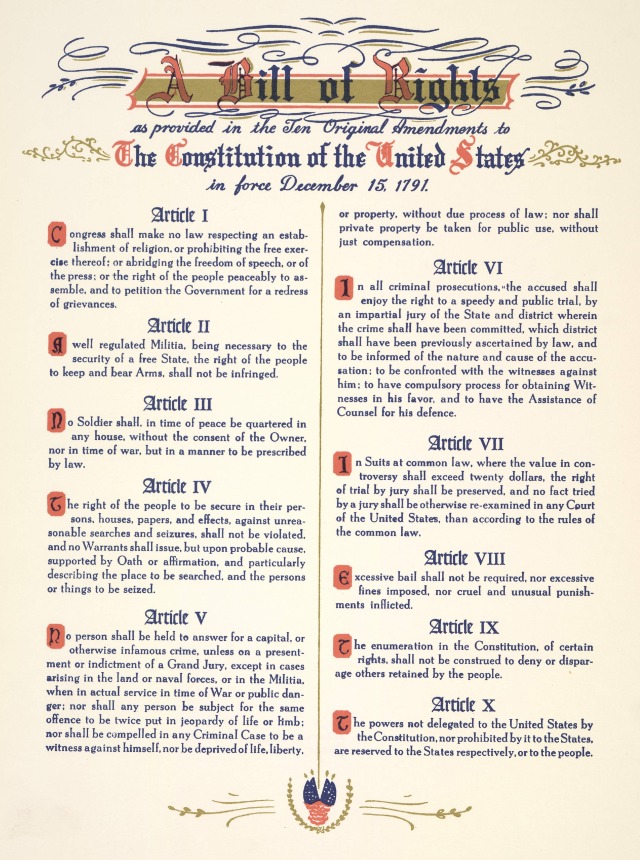
Amendment I
Congress shall make no law respecting an establishment of religion, or prohibiting the free exercise thereof; or abridging the freedom of speech, or of the press; or the right of the people peaceably to assemble, and to petition the government for a redress of grievances.

Amendment II
A well-regulated militia being necessary to the security of a free State, the right of the people to keep and bear arms shall not be infringed.

Amendment III
No soldier shall, in time of peace, be quartered in any house without the consent of the owner, nor in time of war, but in a manner to be prescribed by law.

Amendment IV
The right of the people to be secure in their persons, houses, papers, and effects, against unreasonable searches and seizures, shall not be violated, and no warrants shall issue but upon probable cause, supported by oath or affirmation, and particularly describing the place to be searched, and the persons or things to be seized.

Amendment V
No person shall be held to answer for a capital, or otherwise infamous crime, unless on a presentment or indictment of a grand jury, except in cases arising in the land or naval forces, or in the militia, when in actual service in time of war or public danger; nor shall any person be subject for the same offense to be twice put in jeopardy of life or limb; nor shall be compelled in any criminal case to be a witness against himself, nor be deprived of life, liberty, or property, without due process of law; nor shall private property be taken for public use without just compensation.

Amendment VI
In all criminal prosecutions, the accused shall enjoy the right to a speedy and public trial, by an impartial jury of the State and district wherein the crime shall have been committed, which district shall have been previously ascertained by law, and to be informed of the nature and cause of the accusation; to be confronted with the witnesses against him; to have compulsory process for obtaining witnesses in his favor, and to have the assistance of counsel for his defense.

Amendment VII
In suits at common law, where the value in controversy shall exceed twenty dollars, the right of trial by jury shall be preserved, and no fact tried by a jury shall be otherwise reexamined in any court of the United States, than according to the rules of the common law.

Amendment VIII
Excessive bail shall not be required, nor excessive fines imposed, nor cruel and unusual punishments inflicted.

Amendment IX
The enumeration in the Constitution, of certain rights, shall not be construed to deny or disparage others retained by the people.

Amendment X
The powers not delegated to the United States by the Constitution, nor prohibited by it to the States, are reserved to the States respectively, or to the people.
 
๐Ÿ“œ  ๐Ÿ“œ   ๐Ÿ“œ ๐Ÿ“œ  ๐Ÿ“œ   ๐Ÿ“œ  
A 3-minute guide to the Bill of Rights
Belinda Stutzman
๐Ÿ“œ  ๐Ÿ“œ   ๐Ÿ“œ
Daily, Americans exercise their rights secured by the Constitution.  The most widely discussed and debated part of the Constitution is known as the Bill of Rights. Belinda Stutzman provides a refresher course on exactly what the first ten amendments grant each and every American citizen.
Lesson by Belinda Stutzman, animation by Jacques Khouri.

 
๐Ÿ“œ  ๐Ÿ“œ   ๐Ÿ“œ
https://youtu.be/yYEfLm5dLMQ
๐Ÿ“œ  ๐Ÿ“œ   ๐Ÿ“œ
https://64.media.tumblr.com/e6acaf473f15cde5ba03410aff6f107d/d599933a345cc48a-ee/s640x960/62dac99fed6c47645e92e5441f848443fb341802.jpg

Wednesday, June 15, 2022

Violin ๐ŸŽปFacts

25 + Fascinating Violin Facts
That Will Surprise You
 Looking for fun violin facts?
Here, you’ll find the 25 most interesting facts about the violin we could round up!
People have spent their entire lives studying the possible benefits of playing the violin, its history, and how it functions. Enjoy exploring some of their findings in this short list of violin facts.
Interesting Violin Facts
๐Ÿ‘‡ ♪ ๐Ÿ“ฝ️ ♪ ๐Ÿ‘‡
https://youtu.be/zaYf9pRn0ls
๐ŸŽป๐ŸŽผ๐ŸŽป๐ŸŽผ๐ŸŽป๐ŸŽผ๐ŸŽป๐ŸŽผ๐ŸŽป๐ŸŽผ
Interesting Facts About the Violin
In Detail
  1. Most people consider playing the violin an intellectual pursuit. However, a violinist can burn around 170 calories per hour. That’s equivalent to about one soft drink!
  2. Based on research measuring the different levels of cognitive processing, violinists have shown to develop faster processing speeds compared to the average person who does not play an instrument.
  3. Even though the exact year the violin was officially created is a mystery, we do know that the design of the modern violin is over 500 years old. While the violin hasn’t changed much over that time, the bow and other accessories have gone through many changes.
  4. Italy is primarily attributed with the creation of the modern violin. A lot of Italian makers, such as Stradivari, lived and worked in the small town of Cremona, creating some of the world’s oldest and most valuable violins.
  5. The word “violin” comes from the medieval Latin word vitula. What makes this one of the funniest violin facts is that oddly enough, the modern Latin translation of vitula also means “female cow.”
  6. String players, like violinists, tend to have larger brains. This is due in part to the complex motor skills and reasoning required to play the instrument.
  7. The main body of the modern violin contains 70 different parts. In high quality instruments, these parts are all made from a variety of woods.
  8. Famous violinist Fritz Kreisler served in WWI as a captain. His aural sensitivity, developed by playing the violin, allowed him to determine the location of large artillery by listening to the changing pitch of incoming shells across the battlefield.
  9. The violin was the leader of the orchestra before conductors became a main fixture. Prominent composers would often conduct their orchestral arrangements from the first violin chair or the concertmaster position.
  10. Even though Mozart was a prominent pianist and composer, he also played the violin. In fact, Mozart’s father began his son’s musical training on the violin.
  11. The modern violin was developed largely by Gasparo da Salรฒ, Andrea Amati, and Antonio Stradivari, all of which lived in Italy during the 17th century.
  12. The violin has ancestral ties to the Byzantine empire through its distant cousin, the lyra. This archaic instrument evolved into the “rebec” and then the medieval fiddle, before finally transforming into the modern violin.
  13. The violin has become an essential instrument in cultures all over the world, from Ireland to India. Some of these cultures have developed different ways of playing the instrument. One of the most interesting violin facts is that some Indian players sit cross-legged while playing, and rest the scroll on their feet with the bottom of the violin under their chin!
  14. The parts of the brain that are responsible for the left and right hand are more sensitive in violinists. This means that violinists have greater conscious control over more areas of their hands.
  15. Some of the most popular careers for violinists include teaching, and performing in orchestras or other small groups. Highly sought after orchestral positions are extremely difficult to obtain.
  16. In 1626, King Louis XIII of France created an orchestra, Les 24 Violons du Roi. This helped launch the violin into prominence for the first time in history.
  17. Violinist Niccolรฒ Paganini was one of the first musicians to pioneer the “rock star” image. His revolutionary compositional style and playing inspired many other performers and composers such as Liszt, Schumann, Brahms, and Rachmaninoff.
  18. Many violin facts show that playing the instrument has a significant impact on the mind. A study from Harvard University found that early training in the violin improves a myriad of cognitive skills including memory, nonverbal reasoning, and attention.
  19. The rich sound of the violin partially comes from a small dowel inside the instrument beneath the bridge, called the “sound post.” It does this by receiving the vibrations, created by the strings, from the bridge and transmitting them to the back of the violin.
  20. The most expensive violin ever purchased by a private investor was acquired for $16 million dollars. However, The Ashmolean Museum currently owns an estimated $20 million violin.
  21. Despite contracting polio as child, famous violinist Itzhak Perlman rose to prominence and is now one of the best violinists in the world. In fact, Perlman was honored in 2016 when he was asked to perform at President Obama’s inauguration.
  22. The violin and fiddle are the same instrument. Even though the term “violin” is more often used in connection with classical music, and the “fiddle” with Irish or folk music, they are in fact the same.
  23. Researchers studying the brain’s plasticity often use violinists to examine how much the brain can adapt.
  24. YouTube sensation and violinist Lindsey Stirling has over 10.5 million subscribers. Her most watched video, “Crystallize,” has over 194 million views.
  25. Want even more shocking violin facts? Violin strings were originally made from the dried intestines of cats and other animals! Nowadays the strings are made from a combination of synthetic materials and a variety of metals.
  26. The violin bow was originally shaped like a hunting bow. This changed in the 19th century when Franรงois Tourte perfected the modern bow by creating a concave curve.
These are just a few of the most interesting facts about the violin, but there are so many other wonderful things to learn. If any of these violin facts sparked your interest, or if you’ve always wanted to play the violin, check out the spectacular teachers at TakeLessons. 

๐ŸŽป๐ŸŽผ๐ŸŽป๐ŸŽผ๐ŸŽป๐ŸŽผ๐ŸŽป๐ŸŽผ๐ŸŽป๐ŸŽผ๐ŸŽป
100 Violin Classical Music
๐Ÿ‘‡ ♪  ๐Ÿ“ฝ️ ♪ ๐Ÿ‘‡
https://youtu.be/G-1SO4NjEy0
https://www.youtube.com/watch?v=G-1SO4NjEy0

๐ŸŽป๐ŸŽผ๐ŸŽป๐ŸŽผ๐ŸŽป๐ŸŽผ๐ŸŽป๐ŸŽผ๐ŸŽป๐ŸŽผ
The violin is one of the most challenging and rewarding instruments you can learn. It is also one of the few instruments capable of matching the diversity and complexity of the human voice.

Post Author: Nicole R.  Nicole has been teaching violin since 2011 in Colorado. She has a BA in Music from the University of Denver, with certificates in the Suzuki and Alexander techniques. Learn more about Nicole here!

Interested in Private Lessons?
Search thousands of teachers for local and live, online lessons. Sign up for convenient, affordable private lessons today!
๐ŸŽป๐ŸŽผ๐ŸŽป๐ŸŽผ๐ŸŽป๐ŸŽผ๐ŸŽป๐ŸŽผ๐ŸŽป๐ŸŽผ
How The Violin Works
Discover Instruments | Classic FM
๐Ÿ‘‡ ♪  ๐Ÿ“ฝ️ ♪ ๐Ÿ‘‡
 

https://youtu.be/i9dDrK47rhM

๐ŸŽป๐ŸŽผ๐ŸŽป๐ŸŽผ๐ŸŽป๐ŸŽผ๐ŸŽป๐ŸŽผ๐ŸŽป๐ŸŽผ
Sources:
  • Elber, T., Pantev, C, Wienbruch, C., et al. (1995). “Increased cortical representation of the fingers of the left hand in string players.” Science 270, 305-309
  • “Lira.” Edited by The Editors of Encyclopaedia Britannica, Encyclopรฆdia Britannica, Encyclopรฆdia Britannica, Inc., 30 June 2017, www.britannica.com/art/lira-musical-instrument
  • “Violin.” Edited by The Editors of Encyclopaedia Britannica, Encyclopรฆdia Britannica, Encyclopรฆdia Britannica, Inc., 23 Mar. 2018, www.britannica.com/art/violin
  • “Music Improves Brain Functio.” Written by Phillip F. Shewe, Live Science, Purch, 29 Mar. 2018, https://www.livescience.com/7950-music-improves-brain-function.html
  • Halfpenny, Eric, and Theodore C. Grame. “Stringed Instrument.” Encyclopรฆdia Britannica, Encyclopรฆdia Britannica, Inc., 9 Feb. 2018, www.britannica.com/art/stringed-instrument/The-violin-family
  • “New Study Finds Playing Violin Sheds the Calories of 2 Glasses of Wine per Hour.” The World’s Leading Classical Music News Source. Est 2009., 10 Jan. 2014, theviolinchannel.com/new-study-finds-violin-practice-sheds-around-2-glasses-wine-hour
  • Lewis, Charlton T, et al. “Vitula.” Vitula – Wiktionary, Wikipedia, 26 May 2017, 16:31, en.wiktionary.org/wiki/vitula
  • KREISLER, FRITZ. FOUR WEEKS IN THE TRENCHES: the War Story of a Violinist (Wwi Centenary Series). LAST POST PRESS, 2014
  • Sadie, Stanley. “Wolfgang Amadeus Mozart.” Encyclopรฆdia Britannica, Encyclopรฆdia Britannica, Inc., 12 Jan. 2018, www.britannica.com/biography/Wolfgang-Amadeus-Mozart
  • Britannica, The Editors of Encyclopaedia. “Viol.” Encyclopรฆdia Britannica, Encyclopรฆdia Britannica, Inc., 5 Dec. 2016, www.britannica.com/art/viol
  • Britannica, The Editors of Encyclopaedia. “Niccolรฒ Paganini.” Encyclopรฆdia Britannica, Encyclopรฆdia Britannica, Inc., 24 Feb. 2017, www.britannica.com/biography/Niccolo-Paganini
  • “These Are The 12 Most Expensive Violins Of All Time.” CMUSE, 6 Sept. 2017, www.cmuse.org/12-most-expensive-violins/
๐ŸŽป๐ŸŽผ๐ŸŽป๐ŸŽผ๐ŸŽป๐ŸŽผ๐ŸŽป๐ŸŽผ๐ŸŽป๐ŸŽผ
Top 50 Best Classical Violin Music
๐Ÿ‘‡ ♪  ๐Ÿ“ฝ️ ♪ ๐Ÿ‘‡

๐ŸŽป
https://youtu.be/L5skSFHVJHk
https://www.youtube.com/watch?v=L5skSFHVJHk
 
25 Interesting Violin Facts
 
๐ŸŽป๐ŸŽผ๐ŸŽป๐ŸŽผ๐ŸŽป๐ŸŽผ๐ŸŽป๐ŸŽผ๐ŸŽป๐ŸŽผ

Wednesday, June 8, 2022

How to Sleep ๐Ÿ›Œ Comfortably on a Hot Night

How to Sleep 
Comfortably  on a   Hot Night
 
Two Methods:
๐Ÿ›️  Preparing to Go to Bed 
๐Ÿ›Œ  Staying Cool in Bed
When it's hot outside and you don't have air conditioning, it can be difficult to fall asleep. Fortunately, there are ways to get cool and remain cool long enough for you to doze off and get a good night’s sleep.
๐Ÿ›️  ๐Ÿ’ค๐Ÿ˜ด๐Ÿ’ค  ๐Ÿ›Œ
Method 1
Preparing to Go to Bed
1 Stop exercising a few hours before bedtime. When you exercise, you raise your body temperature and retain heat. Exercising several hours before you go to bed will give your body time to cool down.
You should also drink lots of water throughout the day to stay hydrated. You may also want to keep water by your bedside.
2 Take a tepid shower or a bath. Don’t take a very cold shower, as this can have a rebound effect. Your body temperature may actually rise to counteract the cold water. Instead, have a medium cold, or tepid, shower.

You can also soak your hands and feet in tepid water. Your hands and feet are your "radiators", or the areas of your body that tend to heat up. Cooling them down by soaking them will regulate your body temperature and cool you down.

3 Find a cool, dark sleeping spot that is on a lower floor or in a basement. Heat rises, so find a spot that is low to ground, such as the floor of your bedroom, or that is low in your home, such as the bottom floor or the basement.

4 Replace heavy bedding with lighter bedding. Remove thick mattress protectors or pads, which retain heat, and any heavy blankets or duvets. Use lighter bedding like cotton sheets and lightweight cotton weave blankets on your bed.
Straw or bamboo mats are also great for a cool night’s sleep. They do not retain body heat and will not warm you up. You can create a bamboo mat bed on the floor of your bedroom for an alternative spot to your regular bed.
Try Feel Drier® Moisture Wicking Sheets. They dry quicker, do not absorb the moisture like cotton sheets, so you avoid waking up in a puddle of sweat. Or try Feel Cooler bedding made with temperature regulating material that actually cools you off by absorbing some of your access heat.
 
5 Put your bedding in the freezer. Stick your pillow cases, bed sheets and blankets in the freezer 30 minutes before you plan to go to bed. Once you place the bedding on your bed, they should stay cool enough for 30-40 minutes, just enough time to fall asleep.
Avoid getting your bedding wet or sleeping on or in wet sheets or clothing. Don’t dip your socks in cold water and wear them to bed, or wear a wet t-shirt to bed. Bringing anything wet into the room, or wearing anything wet, will only trap dense humidity in your room and cause discomfort.


6  Open your windows. An hour before bedtime, open the windows in the room to increase air circulation and cool down the room. However, you should close the windows before you fall asleep to avoid heating up the room with air during the night.
While you sleep your body temperature dips to its lowest point at around 3 am. At 3 am, the temperature outside is also extremely low. If you are asleep with the windows open, the muscles around your neck and head can tense up involuntarily due to the sudden temperature drop and you can be woken up.
Keep the windows closed and the blinds or shades drawn during the day to avoid heating up the room.


7  Sleep in cotton clothing. Though you may be tempted to strip down and go naked to stay cool, sleeping naked can make you feel more hot as it does not allow moisture to evaporate between your body and the sleeping surface. 
Go for cotton sleepwear, and avoid synthetic fabrics like nylon or silk, as they are not breathable and can make you feel hotter.

8  Performance sleepwear. Try DriNights performance sleepwear, it is moisture wicking and made out of the same type of material that is used in workout clothing. It is quick drying so if you sweat at night it keeps you drier by wicking the sweat away from your body and allow for your pj to dry quick. This gives you a cooler feeling and avoids the waking up from sweaty sticky sleepwear.


9  Wipe your face, hands, and feet with a damp cloth. Use a damp cloth or towel by your bedside to wet your face or arms throughout the night. But avoid going to sleep with a wet face or arms. Once you have wiped your body, dry yourself off with a dry towel before you go to sleep.[9]
You can also buy special towels that are made of hyper-evaporative material that retains water, but stays dry to the touch. They will cool you down without getting your skin wet.


10  Run your wrists or the inside of your arms under cold running water for 30 seconds. These areas are where your blood stream flows closest to the surface of your body. Running them under cold water for a minute will cool your blood down, making your whole body cooler.
Method 2
Staying Cool in Bed
1  Encourage airflow with a fan. Keep the bedroom door open and position the fan in a corner of the room so it faces your bed.
Avoid pointing the fan at your face, your back, or too close to your body. Pointing the fan at your face can cause your neck muscles to stiffen and lead to allergies or illness.

2  Make an ice towel. Before there was AC, people would suspend ice packs, ice towels, or cooling packs in front of fans to stay cool.
To make an ice towel, hang a wet towel holding ice cubes from two chairs. Point a fan at the towel and at a wall or far away from you in the corner of the room.
Place a container under the towel to catch the melting ice water.


3  Flip your pillow over to the cool side. If you wake up due to heat during the night, flip your pillow over to the other side. The other side will be cooler than the side you were sleeping on, as it has not absorbed your body heat during the night.

4  Place an ice pack on your neck or forehead. You can buy cold packs in most grocery stores. Slip a cold pack under your neck, on your forehead, or under your arms, by your armpits. Cooling down the back of your neck, your forehead, and under your arms helps cool the rest of your body down as well.
You can also make your own cold pack at home. Place three to four tablespoons of dish soap in a resealable ziplock bag. Place it in the freezer. The soap will not harden and it will hold the cold temperature longer than ice and/or the blue ice packs. Once you are ready to use it, place in a pillowcase or fold it in a towel and apply it to your neck or arms. Because the pack is not solid, it is versatile and comfortable on most areas of your body.
You can also Make a Rice Sock. Place it in the freezer and leave it there for at least two hours. When you turn in, bring the bag with you to use as a cool compress. Try placing it under your pillow so it's nice and cool when you flip it over.
5  Mist your face and neck with a spray bottle. If you wake up during the night due to heat, take a spray bottle and fill it with cold water. Mist your face and neck to cool down.

Tuesday, June 7, 2022

Favorite Fictional๐Ÿ‘ฌ BFFs

Reasons A Bestie Is Irreplaceable
As Told Through 
๐Ÿง‘๐Ÿ‘ฆOur Favorite Fictional BFFs๐Ÿ‘ฉ๐Ÿ‘ฉ
๐Ÿ‘ญ ๐Ÿ‘ซ ๐Ÿ‘ฌ
3202064
Posted:
No one understands you like a best friend. Not your mom, not your sibling, not your spouse. A best friend will sit with you while you're crying, know when the truth is better than a white lie and even attempt to fight that ex of yours who broke your heart. In the wise words of author Kate Angell, “A good friend will come and bail you out of jail, but a best friend will be sitting next to you saying, 'Damn, that was fun.'"
 
In celebration of National Best Friend Day on June 8, we've put together some reasons having a BFF is so great using examples from the most loyal, passionate and downright fierce female friendships seen on screen. Here are 13 reasons a bestie is absolutely irreplaceable:

Happy National Best Friend Day!


1. No matter how much trouble you're in, she'll always help you get out of it. (Or at least get away with it.)
Cristina and Meredith from "Grey's Anatomy"
 
2. You're able to bond over things you'd never say out loud to anyone else.
Cher and Dionne from "Clueless"
satcanniversary

3. Any ridiculous situation you get yourself into, she'll be right by your side.
Lucy and Ethel from "I Love Lucy"
3202064
4. A best friend will hate anyone and everyone for you.
Romy and Michelle from "Romy And Michelle's High School Reunion"
satcanniversary
5. Even if you've hooked up with all of each other's mutual friends, you don't judge each other. You pour yourselves a few more drinks.
Shane and Alice from "The L Word."

6. She's always down to get a little weird.
Abbi and Ilana from "Broad City"
  broad city tv show
7. She has pictures of how you dressed in the '90s, but wouldn't show a soul.
Moesha Mitchell and Kim Parker from "Moesha"
kimmoesha

8. She was there during your awkward phases.
Rachel and Monica from "Friends"
satcanniversary

9. She'll say yes to your crazy plans, even if it means taking a risk herself.
Thelma and Louise from "Thelma & Louise"
satcanniversary

10. You can't even count the years you've been friends, and you hope you never have to.
Carrie and Miranda from "Sex And The City"
  carrie and miranda

11. She's been there through some of your darkest times.
Taystee and Poussey from "Orange Is The New Black"
satcanniversary

12. She loves you for the weirdo that you are.
Annie and Lillian from "Bridesmaids"
satcanniversary
13. She knows the truth is hard to hear, so she'll deliver it with a compliment. Or three.
Leslie Knope and Ann Perkins from "Parks and Recreation"

๐Ÿ‘ญ  ๐Ÿ‘ซ  ๐Ÿ‘ฌ  ๐Ÿ‘ญ  ๐Ÿ‘ซ  ๐Ÿ‘ฌ
Happy National Best Friend Day!

Thursday, June 2, 2022

2022 ๐Ÿงจ ๐ŸŽ‡ ๐Ÿป Holidays

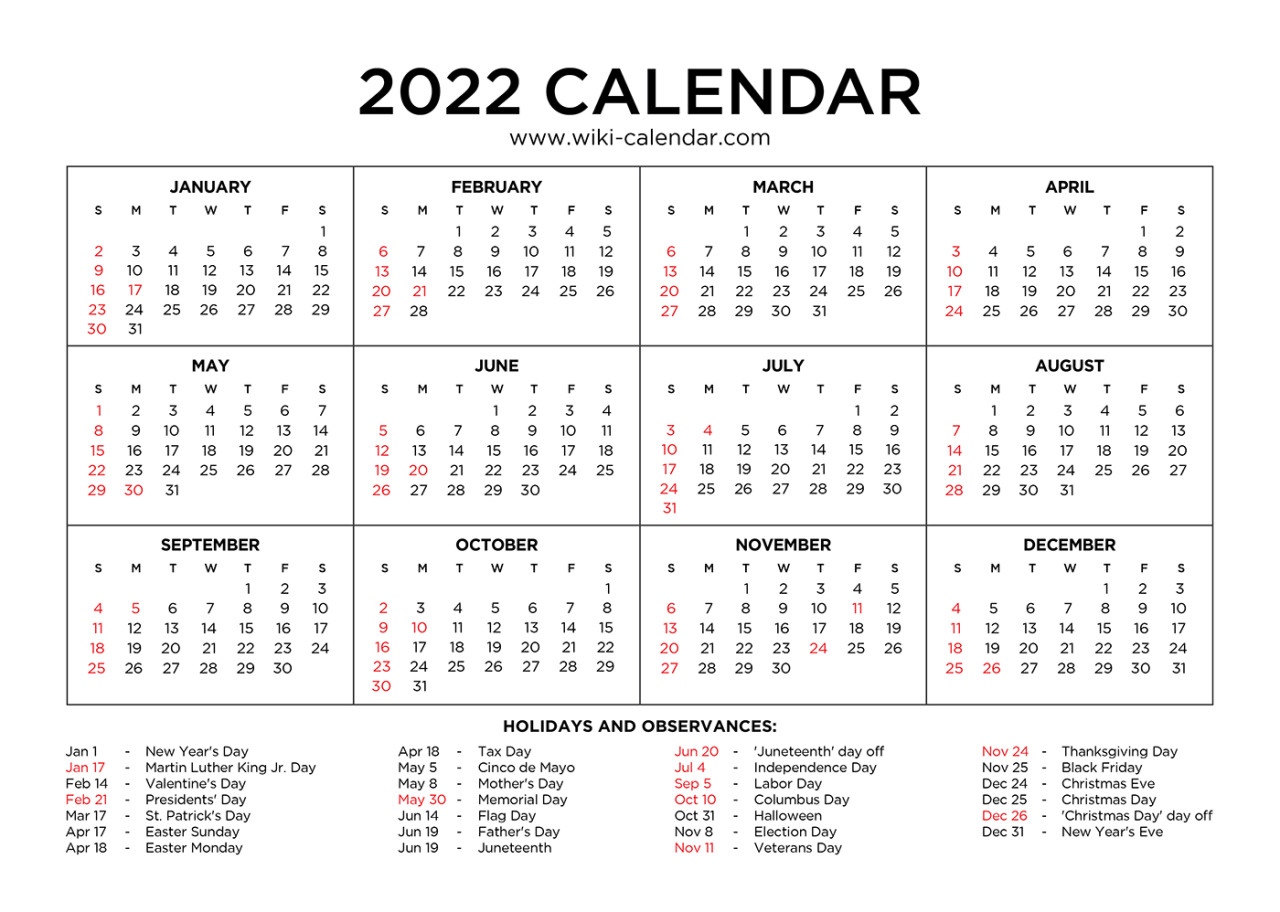
Holidays
2022

https://64.media.tumblr.com/babdf421c2e9165ef570b6cb419fe17a/f54439f280343a5b-a3/s1280x1920/8e0fcc23b47d5eac4a0bc80fe05913625e8cf082.png
Jan 01        New Year’s Day
Jan 17        Martin Luther King Jr. Day

 
Feb 14       Valentine’s Day
Feb 21       Presidents’ Day

 
Mar 17      St. Patrick’s Day
 
Apr 17      Easter Sunday
Apr 18      Easter Monday
Apr 18      Tax Day

 
May 05      Cinco de Mayo
May 08      Mother’s Day
May 30      Memorial Day
 
Jun 14       Flag Day
Jun 19       Father’s Day
Jun 19       Juneteenth
 
Jul 04         Independence Day
 
Sep 05         Labor Day
 
Oct 10         Columbus Day
Oct 31         Halloween

 
Nov 08         Election Day
Nov 11         Veterans Day
Nov 24         Thanksgiving Day
Nov 25         Black Friday

 
Dec 24         Christmas Eve
Dec 25         Christmas Day
Dec 31         New Year’s Eve
https://64.media.tumblr.com/babdf421c2e9165ef570b6cb419fe17a/f54439f280343a5b-a3/s1280x1920/8e0fcc23b47d5eac4a0bc80fe05913625e8cf082.png
https://64.media.tumblr.com/1decefb084535c9e0482e290098746e0/f54439f280343a5b-9e/s1280x1920/aa1b9d3a6219cdec8877582f1c9a844d17a2af1d.png
2022  ๐Ÿงจ ๐ŸŽ‡  ๐Ÿป   Holidays